
FP2 June 2014 Q8
8.
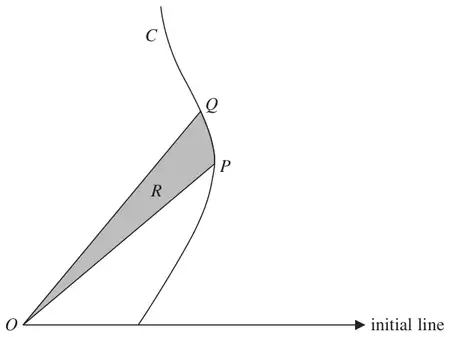
Figure 1 shows a sketch of part of the curve \(C\) with polar equation \[r = 1 + \tan\theta, \quad 0 \leqslant \theta < \frac{\pi}{2}\]
The tangent to the curve \(C\) at the point \(P\) is perpendicular to the initial line.
(a) Find the polar coordinates of the point \(P\). (5)
The point \(Q\) lies on the curve \(C\), where \(\theta = \dfrac{\pi}{3}\)
The shaded region \(R\) is bounded by \(OP\), \(OQ\) and the curve \(C\), as shown in Figure 1
(b) Find the exact area of \(R\), giving your answer in the form \[\frac{1}{2}\left(\ln p + \sqrt{q} + r\right)\] where \(p\), \(q\) and \(r\) are integers to be found. (7)
| Scheme | Marks |
|---|---|
| \(r = 1 + \tan\theta\) | |
| \(x = r\cos\theta \Rightarrow x = (1 + \tan\theta)\cos\theta\) States or implies \(x = r\cos\theta\) | M1 |
| \(x = \cos\theta + \sin\theta,\ \dfrac{\mathrm{d}x}{\mathrm{d}\theta} = \cos\theta - \sin\theta\) M1: Attempt to differentiate \(x = r\cos\theta\) or \(x = r\sin\theta\) A1: Correct derivative | M1A1 |
| Alt for the 2 diff marks: \(\dfrac{\mathrm{d}x}{\mathrm{d}\theta} = \sec^2\theta\cos\theta + (1 + \tan\theta)(-\sin\theta)\) M1: Attempt to differentiate using product rule (dep on first M1) A1: correct (unsimplified) differentiation | |
| \(\dfrac{\mathrm{d}x}{\mathrm{d}\theta} = 0 \Rightarrow \tan\theta = 1 \Rightarrow \theta = \ldots\) Set their derivative = 0 and attempt to solve for \(\theta\) (Dependent on second M mark above) | dM1 |
| \(\theta = \dfrac{\pi}{4},\ r = 2\) Both | A1 |
| NB: Use of \(x = r\sin\theta\) can score M0M1A0M1A0 max | |
| (5) |
| Scheme | Marks |
|---|---|
| \(\displaystyle\int r^2\,\mathrm{d}\theta = \int(1 + \tan\theta)^2\,\mathrm{d}\theta\) Use of \(\displaystyle\int r^2\,\mathrm{d}\theta\) and \(r = 1 + \tan\theta\) No limits needed | M1 |
| \((1 + \tan\theta)^2 = 1 + 2\tan\theta + \tan^2\theta\) \(= 1 + 2\tan\theta + \sec^2\theta - 1\) Expands and uses the correct identity | M1 |
| \(\displaystyle\int\left(2\tan\theta + \sec^2\theta\right)\mathrm{d}\theta\) Correct expression Need not be simplified, no limits needed. | A1 |
| \(\left[2\ln\sec\theta + \tan\theta\right]_{\left(\frac{\pi}{4}\right)}^{\left(\frac{\pi}{3}\right)}\) M1: Attempt to integrate – at least one trig term integrated. Dependent on the second M mark A1: Correct integration. Need not be simplified or include limits. | dM1A1 |
| \(R = \dfrac{1}{2}\left\{\left(2\ln\sec\dfrac{\pi}{3} + \tan\dfrac{\pi}{3}\right) - \left(2\ln\sec\dfrac{\pi}{4} + \tan\dfrac{\pi}{4}\right)\right\}\) Substitutes \(\dfrac{\pi}{3}\) and their \(\dfrac{\pi}{4}\) and subtracts (Dependent on 2 previous method marks in (b)) | dM1 |
| \(R = \dfrac{1}{2}\left\{\ln 2 + \sqrt{3} - 1\right\}\) Cao and cso | A1 |
| (7) | |
| (12 marks) |