
C4 June 2014 (R) Q8
8.
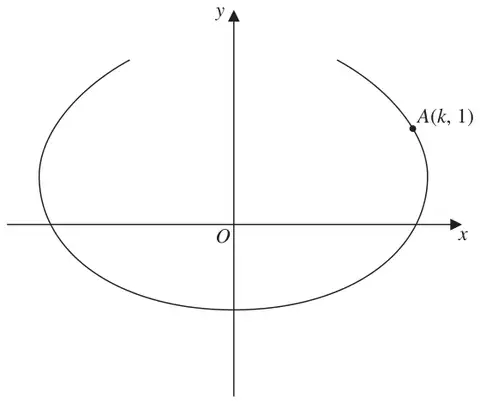
The curve shown in Figure 3 has parametric equations \[x = t - 4\sin t,\quad y = 1 - 2\cos t, \qquad -\frac{2\pi}{3} \leqslant t \leqslant \frac{2\pi}{3}\]
The point \(A\), with coordinates \((k, 1)\), lies on the curve.
Given that \(k > 0\)
There is one point on the curve where the gradient is equal to \(-\dfrac{1}{2}\)
[Solutions based entirely on graphical or numerical methods are not acceptable.] (6)
| Scheme | Marks |
|---|---|
| \(x = t - 4\sin t,\quad y = 1 - 2\cos t,\quad -\dfrac{2\pi}{3} \leqslant t \leqslant \dfrac{2\pi}{3}\quad A(k, 1)\) lies on the curve, \(k > 0\) | |
| \(\{\text{When } y = 1,\}\ 1 = 1 - 2\cos t \Rightarrow t = -\dfrac{\pi}{2},\ \dfrac{\pi}{2}\) \(k \text{ (or } x) = \dfrac{\pi}{2} - 4\sin\left(\dfrac{\pi}{2}\right)\) or \(x = -\dfrac{\pi}{2} - 4\sin\left(-\dfrac{\pi}{2}\right)\) Sets \(y = 1\) to find \(t\) and uses their \(t\) to find \(x\). | M1 |
| \(\left\{\text{When } t = -\dfrac{\pi}{2},\ k > 0,\right\}\) so \(k = 4 - \dfrac{\pi}{2}\) or \(\dfrac{8 - \pi}{2}\) \(x\) or \(k = 4 - \dfrac{\pi}{2}\) | A1 |
| (2) |
Notes
M1: Sets \(y = 1\) to find \(t\) and uses their \(t\) to find \(x\).
Note: M1 can be implied by either \(x\) or \(k = 4 - \dfrac{\pi}{2}\) or 2.429… or \(\dfrac{\pi}{2} - 4\) or \(-2.429\ldots\)
A1: \(x\) or \(k = 4 - \dfrac{\pi}{2}\) or \(\dfrac{8 - \pi}{2}\)
Note: A decimal answer of 2.429… (without a correct exact answer) is A0.
Note: Allow A1 for a candidate using \(t = \dfrac{\pi}{2}\) to find \(x = \dfrac{\pi}{2} - 4\) and then stating that \(k\) must be \(4 - \dfrac{\pi}{2}\) o.e.
| Scheme | Marks |
|---|---|
| \(\dfrac{\mathrm{d}x}{\mathrm{d}t} = 1 - 4\cos t,\quad \dfrac{\mathrm{d}y}{\mathrm{d}t} = 2\sin t\) At least one of \(\dfrac{\mathrm{d}x}{\mathrm{d}t}\) or \(\dfrac{\mathrm{d}y}{\mathrm{d}t}\) correct. Both \(\dfrac{\mathrm{d}x}{\mathrm{d}t}\) and \(\dfrac{\mathrm{d}y}{\mathrm{d}t}\) are correct. | B1 B1 |
| So, \(\dfrac{\mathrm{d}y}{\mathrm{d}x} = \dfrac{2\sin t}{1 - 4\cos t}\) At \(t = -\dfrac{\pi}{2}\), \(\dfrac{\mathrm{d}y}{\mathrm{d}x} = \dfrac{2\sin\left(-\frac{\pi}{2}\right)}{1 - 4\cos\left(-\frac{\pi}{2}\right)};\ = -2\) Applies their \(\dfrac{\mathrm{d}y}{\mathrm{d}t}\) divided by their \(\dfrac{\mathrm{d}x}{\mathrm{d}t}\) and substitutes their \(t\) into their \(\dfrac{\mathrm{d}y}{\mathrm{d}x}\). Correct value for \(\dfrac{\mathrm{d}y}{\mathrm{d}x}\) of \(-2\) | M1; A1 cao cso |
| (4) |
Notes
B1: At least one of \(\dfrac{\mathrm{d}x}{\mathrm{d}t}\) or \(\dfrac{\mathrm{d}y}{\mathrm{d}t}\) correct. Note: that this mark can be implied from their working.
B1: Both \(\dfrac{\mathrm{d}x}{\mathrm{d}t}\) and \(\dfrac{\mathrm{d}y}{\mathrm{d}t}\) are correct. Note: that this mark can be implied from their working.
M1: Applies their \(\dfrac{\mathrm{d}y}{\mathrm{d}t}\) divided by their \(\dfrac{\mathrm{d}x}{\mathrm{d}t}\) and attempts to substitute their \(t\) into their expression for \(\dfrac{\mathrm{d}y}{\mathrm{d}x}\).
Note: This mark may be implied by their final answer.
i.e. \(\dfrac{\mathrm{d}y}{\mathrm{d}x} = \dfrac{2\sin t}{1 - 4\cos t}\) followed by an answer of \(-2\) (from \(t = -\dfrac{\pi}{2}\)) or 2 (from \(t = \dfrac{\pi}{2}\))
Note: Applying \(\dfrac{\mathrm{d}x}{\mathrm{d}t}\) divided by their \(\dfrac{\mathrm{d}y}{\mathrm{d}t}\) is M0, even if they state \(\dfrac{\mathrm{d}y}{\mathrm{d}x} = \dfrac{\mathrm{d}y}{\mathrm{d}t} \div \dfrac{\mathrm{d}x}{\mathrm{d}t}\).
A1: Using \(t = -\dfrac{\pi}{2}\) \(\left(\text{and not } t = \dfrac{3\pi}{2}\right)\) to find a correct \(\dfrac{\mathrm{d}y}{\mathrm{d}x}\) of \(-2\) by correct solution only.
| Scheme | Marks |
|---|---|
| \(\dfrac{2\sin t}{1 - 4\cos t} = -\dfrac{1}{2}\) Sets their \(\dfrac{\mathrm{d}y}{\mathrm{d}x} = -\dfrac{1}{2}\) | M1 |
| gives \(4\sin t - 4\cos t = -1\) See notes | A1 |
| So \(4\sqrt{2}\sin\left(t - \dfrac{\pi}{4}\right);= -1\) or \(-4\sqrt{2}\cos\left(t + \dfrac{\pi}{4}\right);= -1\) See notes | M1; A1 |
| \(t = \sin^{-1}\left(\dfrac{-1}{4\sqrt{2}}\right) + \dfrac{\pi}{4}\) or \(t = \cos^{-1}\left(\dfrac{1}{4\sqrt{2}}\right) - \dfrac{\pi}{4}\) See notes | dM1 |
| \(t = 0.6076875626\ldots = 0.6077\) (4 dp) anything that rounds to 0.6077 | A1 |
| (6) | |
| (12 marks) |
Notes
VERY IMPORTANT NOTE FOR PART (c)
NOTE: Candidates who state \(t = 0.6077\) with no intermediate working from \(4\sin t - 4\cos t = -1\) will get 2nd M0, 2nd A0, 3rd M0, 3rd A0.
They will not express \(4\sin t - 4\cos t\) as either \(4\sqrt{2}\sin\left(t - \dfrac{\pi}{4}\right)\) or \(-4\sqrt{2}\cos\left(t + \dfrac{\pi}{4}\right)\).
OR use any acceptable alternative method to achieve \(t = 0.6077\)
NOTE: Alternative methods for part (c) are given below.
NOTE: If a candidate uses an incorrect \(\dfrac{\mathrm{d}y}{\mathrm{d}x}\) expression in part (c) then the accuracy marks are not obtainable.
1st M1: Sets their \(\dfrac{\mathrm{d}y}{\mathrm{d}x} = -\dfrac{1}{2}\)
1st A1: Rearranges to give the correct equation with \(\sin t\) and \(\cos t\) on the same side.
eg. \(4\sin t - 4\cos t = -1\) or \(4\cos t - 4\sin t = 1\) or \(\sin t - \cos t = -\dfrac{1}{4}\) or \(\cos t - \sin t = \dfrac{1}{4}\)
or \(4\sin t - 4\cos t + 1 = 0\) or \(4\cos t - 4\sin t - 1 = 0\) or \(\sin t - \cos t + \dfrac{1}{4} = 0\) etc. are fine for A1.
2nd M1: Rewrites \(\pm\lambda\sin t \pm \mu\cos t\) in the form of either \(R\cos(t \pm \alpha)\) or \(R\sin(t \pm \alpha)\) where \(R \neq 1\) or 0 and \(\alpha \neq 0\)
2nd A1: Correct equation. Eg. \(4\sqrt{2}\sin\left(t - \dfrac{\pi}{4}\right) = -1\) or \(-4\sqrt{2}\cos\left(t + \dfrac{\pi}{4}\right) = -1\)
or \(\sqrt{2}\sin\left(t - \dfrac{\pi}{4}\right) = -\dfrac{1}{4}\) or \(\sqrt{2}\cos\left(t + \dfrac{\pi}{4}\right) = \dfrac{1}{4}\), etc.
Note: Unless recovered, give A0 for \(4\sqrt{2}\sin(t - 45^\circ) = -1\) or \(-4\sqrt{2}\cos(t + 45^\circ) = -1\), etc.
3rd M1: which is dependent on the 2nd M1 mark. Uses correct algebraic processes to give \(t = \ldots\)
4th A1: anything that rounds to 0.6077
Note: Do not give the final A1 mark in (c) if there any extra solutions given in the range \(-\dfrac{2\pi}{3} \leqslant t \leqslant \dfrac{2\pi}{3}\).
Note: You can give the final A1 mark in (c) if extra solutions are given outside of \(-\dfrac{2\pi}{3} \leqslant t \leqslant \dfrac{2\pi}{3}\).
Alternative Method 1:
| Scheme | Marks |
|---|---|
| \(\dfrac{2\sin t}{1 - 4\cos t} = -\dfrac{1}{2}\) Sets their \(\dfrac{\mathrm{d}y}{\mathrm{d}x} = -\dfrac{1}{2}\) | M1 |
| eg. \(\left(\dfrac{2\sin t}{1 - 4\cos t}\right)^2 = \dfrac{1}{4}\) or \((4\sin t)^2 = (4\cos t - 1)^2\) or \((4\sin t + 1)^2 = (4\cos t)^2\) etc. Squaring to give a correct equation. This mark can be implied by a “squared” correct equation. Note: You can also give 1st A1 in this method for \(4\sin t - 4\cos t = -1\) as in the main scheme. | A1 |
| Squares their equation, applies \(\sin^2 t + \cos^2 t = 1\) and achieves a three term quadratic equation of the form \(\pm a\cos^2 t \pm b\cos t \pm c = 0\) or \(\pm a\sin^2 t \pm b\sin t \pm c = 0\) or eg. \(\pm a\cos^2 t \pm b\cos t = \pm c\) where \(a \neq 0,\ b \neq 0\) and \(c \neq 0\). | M1 |
| A1 |
| dM1 |
| \(t = 0.6076875626\ldots = 0.6077\) (4 dp) anything that rounds to 0.6077 | A1 |
| (6) |
Alternative Method 2:
| Scheme | Marks |
|---|---|
| \(\dfrac{2\sin t}{1 - 4\cos t} = -\dfrac{1}{2}\) Sets their \(\dfrac{\mathrm{d}y}{\mathrm{d}x} = -\dfrac{1}{2}\) | M1 |
| eg. \((4\sin t - 4\cos t)^2 = (-1)^2\) Squaring to give a correct equation. This mark can be implied by a correct equation. Note: You can also give 1st A1 in this method for \(4\sin t - 4\cos t = -1\) as in the main scheme. | A1 |
| So \(16\sin^2 t - 32\sin t\cos t + 16\cos^2 t = 1\) leading to \(16 - 16\sin 2t = 1\) Squares their equation, applies both \(\sin^2 t + \cos^2 t = 1\) and \(\sin 2t = 2\sin t\cos t\) and then achieves an equation of the form \(\pm a \pm b\sin 2t = \pm c\) \(16 - 16\sin 2t = 1\) or equivalent. | M1 A1 |
| \(\left\{\sin 2t = \dfrac{15}{16} \Rightarrow\right\}\ t = \dfrac{\sin^{-1}(\ldots)}{2}\) which is dependent on the 2nd M1 mark. Uses correct algebraic processes to give \(t = \ldots\) | dM1 |
| \(t = 0.6076875626\ldots = 0.6077\) (4 dp) anything that rounds to 0.6077 | A1 |
| (6) |