
C4 June 2012 Q6
6.
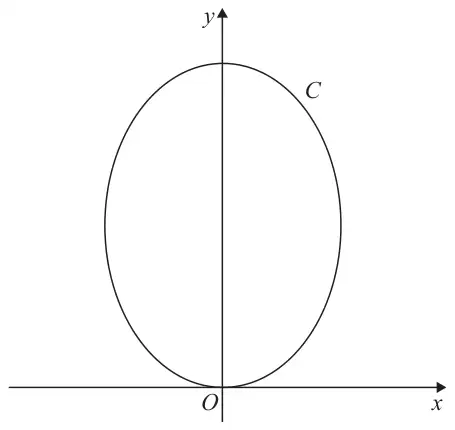
Figure 2 shows a sketch of the curve \(C\) with parametric equations\[x = (\sqrt{3})\sin 2t, \qquad y = 4\cos^2 t, \qquad 0 \leqslant t \leqslant \pi\]
(a) Show that \(\dfrac{\mathrm{d}y}{\mathrm{d}x} = k(\sqrt{3})\tan 2t\), where \(k\) is a constant to be determined. (5)
(b) Find an equation of the tangent to \(C\) at the point where \(t = \dfrac{\pi}{3}\).
Give your answer in the form \(y = ax + b\), where \(a\) and \(b\) are constants. (4)
Give your answer in the form \(y = ax + b\), where \(a\) and \(b\) are constants. (4)
(c) Find a cartesian equation of \(C\). (3)
| Scheme | Marks |
|---|---|
| \(\dfrac{\mathrm{d}x}{\mathrm{d}t} = 2\sqrt{3}\cos 2t\) | B1 |
| \(\dfrac{\mathrm{d}y}{\mathrm{d}t} = -8\cos t\sin t\) | M1 A1 |
| \(\dfrac{\mathrm{d}y}{\mathrm{d}x} = \dfrac{-8\cos t\sin t}{2\sqrt{3}\cos 2t}\) | M1 |
| \(= -\dfrac{4\sin 2t}{2\sqrt{3}\cos 2t}\) \(\dfrac{\mathrm{d}y}{\mathrm{d}x} = -\dfrac{2}{3}\sqrt{3}\tan 2t \qquad \left(k = -\dfrac{2}{3}\right)\) | A1 |
| (5) |
| Scheme | Marks |
|---|---|
| When \(t = \dfrac{\pi}{3} \qquad x = \dfrac{3}{2},\ y = 1\) can be implied | B1 |
| \(m = -\dfrac{2}{3}\sqrt{3}\tan\left(\dfrac{2\pi}{3}\right) \quad (= 2)\) | M1 |
| \(y - 1 = 2\left(x - \dfrac{3}{2}\right)\) | M1 |
| \(y = 2x - 2\) | A1 |
| (4) |
Notes
In the printed scheme a bracket joins the two M1 marks: the second is dependent on the first.
| Scheme | Marks |
|---|---|
| \(x = \sqrt{3}\sin 2t = \sqrt{3} \times 2\sin t\cos t\) | M1 |
| \(x^2 = 12\sin^2 t\cos^2 t = 12\left(1 - \cos^2 t\right)\cos^2 t\) \(x^2 = 12\left(1 - \dfrac{y}{4}\right)\dfrac{y}{4}\) or equivalent | M1 A1 |
| (3) | |
| (12 marks) |
Notes
In the printed scheme a bracket joins the two M1 marks: the second is dependent on the first.
Alternative to (c)
| Scheme | Marks |
|---|---|
| \(y = 2\cos 2t + 2\) | M1 |
| \(\sin^2 2t + \cos^2 2t = 1\) \(\dfrac{x^2}{3} + \dfrac{(y - 2)^2}{4} = 1\) | M1 A1 |
| (3) |