
C4 January 2012 Q5
5.
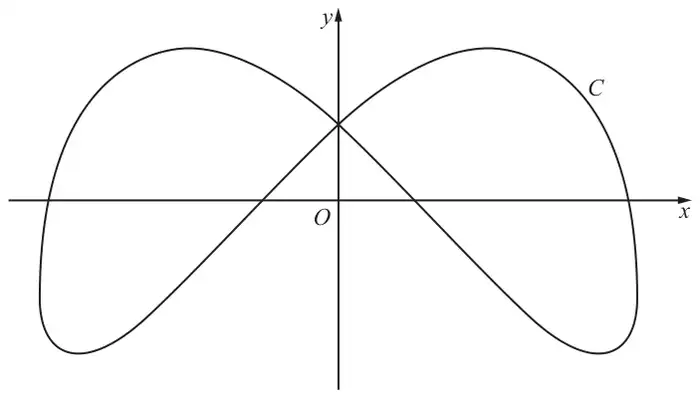
Figure 2 shows a sketch of the curve \(C\) with parametric equations\[x = 4\sin\left(t + \frac{\pi}{6}\right), \qquad y = 3\cos 2t, \qquad 0 \leqslant t \lt 2\pi\]
| Scheme | Marks |
|---|---|
| \(x = 4\sin\left(t + \dfrac{\pi}{6}\right), \quad y = 3\cos 2t, \quad 0 \leqslant t \lt 2\pi\) | |
| \(\dfrac{\mathrm{d}x}{\mathrm{d}t} = 4\cos\left(t + \dfrac{\pi}{6}\right), \quad \dfrac{\mathrm{d}y}{\mathrm{d}t} = -6\sin 2t\) | B1 B1 |
| So, \(\dfrac{\mathrm{d}y}{\mathrm{d}x} = \underline{\dfrac{-6\sin 2t}{4\cos\left(t + \frac{\pi}{6}\right)}}\) | B1ft oe |
| (3) |
Notes
B1: Either one of \(\dfrac{\mathrm{d}x}{\mathrm{d}t} = 4\cos\left(t + \dfrac{\pi}{6}\right)\) or \(\dfrac{\mathrm{d}y}{\mathrm{d}t} = -6\sin 2t\). They do not have to be simplified.
B1: Both \(\dfrac{\mathrm{d}x}{\mathrm{d}t}\) and \(\dfrac{\mathrm{d}y}{\mathrm{d}t}\) correct. They do not have to be simplified.
Any or both of the first two marks can be implied.
Don’t worry too much about their notation for the first two B1 marks.
B1: Their \(\dfrac{\mathrm{d}y}{\mathrm{d}t}\) divided by their \(\dfrac{\mathrm{d}x}{\mathrm{d}t}\) or their \(\dfrac{\mathrm{d}y}{\mathrm{d}t} \times \dfrac{1}{\text{their}\left(\dfrac{\mathrm{d}x}{\mathrm{d}t}\right)}\). Note: This is a follow through mark.
Alternative differentiation in part (a)
\(x = 2\sqrt{3}\sin t + 2\cos t \Rightarrow \dfrac{\mathrm{d}x}{\mathrm{d}t} = 2\sqrt{3}\cos t - 2\sin t\)
\(y = 3(2\cos^2 t - 1) \Rightarrow \dfrac{\mathrm{d}y}{\mathrm{d}t} = 3(-4\cos t\sin t)\)
or \(y = 3\cos^2 t - 3\sin^2 t \Rightarrow \dfrac{\mathrm{d}y}{\mathrm{d}t} = -6\cos t\sin t - 6\sin t\cos t\)
or \(y = 3(1 - 2\sin^2 t) \Rightarrow \dfrac{\mathrm{d}y}{\mathrm{d}t} = 3(-4\cos t\sin t)\)
| Scheme | Marks |
|---|---|
| \(\left\{\dfrac{\mathrm{d}y}{\mathrm{d}x} = 0 \Rightarrow\right\} -6\sin 2t = 0\) | M1 oe |
| @ \(t = 0,\ \ x = 4\sin\left(\dfrac{\pi}{6}\right) = 2,\ \ y = 3\cos 0 = 3 \quad \to (2, 3)\) | M1 |
| @ \(t = \dfrac{\pi}{2},\ \ x = 4\sin\left(\dfrac{2\pi}{3}\right) = \dfrac{4\sqrt{3}}{2},\ \ y = 3\cos\pi = -3 \to (2\sqrt{3}, -3)\) @ \(t = \pi,\ \ x = 4\sin\left(\dfrac{7\pi}{6}\right) = -2,\ \ y = 3\cos 2\pi = 3 \to (-2, 3)\) @ \(t = \dfrac{3\pi}{2},\ x = 4\sin\left(\dfrac{5\pi}{3}\right) = \dfrac{4(-\sqrt{3})}{2},\ \ y = 3\cos 3\pi = -3 \to (-2\sqrt{3}, -3)\) | A1A1A1 |
| (5) | |
| (8 marks) |
Notes
M1: Candidate sets their numerator from part (a) or their \(\dfrac{\mathrm{d}y}{\mathrm{d}t}\) equal to 0.
Note that their numerator must be a trig function. Ignore \(\dfrac{\mathrm{d}x}{\mathrm{d}t}\) equal to 0 at this stage.
M1: Candidate substitutes a found value of \(t\), to attempt to find either one of \(x\) or \(y\).
The first two method marks can be implied by ONE correct set of coordinates for \((x, y)\) or \((y, x)\) interchanged.
A correct point coming from NO WORKING can be awarded M1M1.
A1: At least TWO sets of coordinates.
A1: At least THREE sets of coordinates.
A1: ONLY FOUR correct sets of coordinates. If there are more than 4 sets of coordinates then award A0.
Note: Candidate can use the diagram’s symmetry to write down some of their coordinates.
Note: When \(x = 4\sin\left(\dfrac{\pi}{6}\right) = 2\), \(y = 3\cos 0 = 3\) is acceptable for a pair of coordinates.
Also it is fine for candidates to display their coordinates on a table of values.
Note: The coordinates must be exact for the accuracy marks. Ie \((3.46\ldots, -3)\) or \((-3.46\ldots, -3)\) is A0.
Note: \(\dfrac{\mathrm{d}y}{\mathrm{d}x} = 0 \Rightarrow \sin t = 0\) ONLY is fine for the first M1, and potentially the following M1A1A0A0.
Note: \(\dfrac{\mathrm{d}y}{\mathrm{d}x} = 0 \Rightarrow \cos t = 0\) ONLY is fine for the first M1 and potentially the following M1A1A0A0.
Note: \(\dfrac{\mathrm{d}y}{\mathrm{d}x} = 0 \Rightarrow \sin t = 0\ \&\ \cos t = 0\) has the potential to achieve all five marks.
Note: It is possible for a candidate to gain full marks in part (b) if they make sign errors in part (a).
(b) An alternative method for finding the coordinates of the two maximum points.
Some candidates may use \(y = 3\cos 2t\) to write down that the \(y\)-coordinate of a maximum point is 3.
They will then deduce that \(t = 0\) or \(\pi\) and proceed to find the \(x\)-coordinate of their maximum point. These candidates will receive no credit until they attempt to find one of the \(x\)-coordinates for the maximum point.
M1M1: Candidate states \(y = 3\) and attempts to substitute \(t = 0\) or \(\pi\) into \(x = 4\sin\left(t + \dfrac{\pi}{6}\right)\).
M1M1 can be implied by candidate stating either \((2, 3)\) or \((2, -3)\).
Note: these marks can only be awarded together for a candidate using this method.
A1: For both \((2, 3)\) or \((-2, 3)\).
A0A0: Candidate cannot achieve the final two marks by using this method. They can, however, achieve these marks by subsequently solving their numerator equal to 0.