
C4 June 2011 Q7
7.
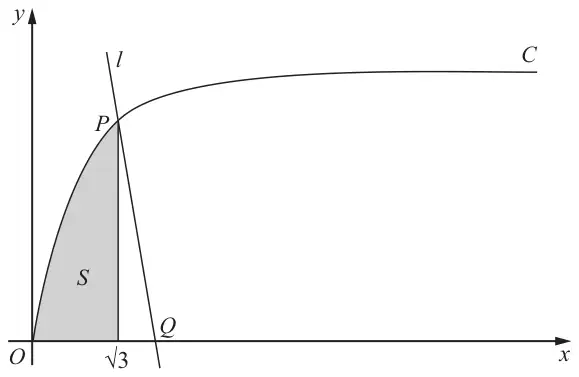
Figure 3 shows part of the curve \(C\) with parametric equations\[x = \tan\theta, \qquad y = \sin\theta, \qquad 0 \leqslant \theta \lt \frac{\pi}{2}\]
The point \(P\) lies on \(C\) and has coordinates \(\left(\sqrt{3}, \dfrac{1}{2}\sqrt{3}\right)\).
The line \(l\) is a normal to \(C\) at \(P\). The normal cuts the \(x\)-axis at the point \(Q\).
The finite shaded region \(S\) shown in Figure 3 is bounded by the curve \(C\), the line \(x = \sqrt{3}\) and the \(x\)-axis. This shaded region is rotated through \(2\pi\) radians about the \(x\)-axis to form a solid of revolution.
| Scheme | Marks |
|---|---|
| \(\tan\theta = \sqrt{3}\) or \(\sin\theta = \dfrac{\sqrt{3}}{2}\) | M1 |
| \(\theta = \dfrac{\pi}{3}\) awrt 1.05 | A1 |
| (2) |
| Scheme | Marks |
|---|---|
| \(\dfrac{\mathrm{d}x}{\mathrm{d}\theta} = \sec^2\theta,\ \dfrac{\mathrm{d}y}{\mathrm{d}\theta} = \cos\theta\) \(\dfrac{\mathrm{d}y}{\mathrm{d}x} = \dfrac{\cos\theta}{\sec^2\theta} \quad (= \cos^3\theta)\) | M1 A1 |
| At \(P\), \(\qquad m = \cos^3\left(\dfrac{\pi}{3}\right) = \dfrac{1}{8}\) Can be implied | A1 |
| Using \(mm' = -1, \qquad m' = -8\) | M1 |
| For normal \(\qquad y - \tfrac{1}{2}\sqrt{3} = -8\left(x - \sqrt{3}\right)\) | M1 |
| At \(Q\), \(y = 0 \qquad -\tfrac{1}{2}\sqrt{3} = -8\left(x - \sqrt{3}\right)\) leading to \(\qquad x = \tfrac{17}{16}\sqrt{3} \qquad \left(k = \tfrac{17}{16}\right)\) 1.0625 | A1 |
| (6) |
Notes
In the printed scheme a bracket joins the two M1 marks for the normal: the second is dependent on the first.
| Scheme | Marks |
|---|---|
| \(\displaystyle\int y^2\,\mathrm{d}x = \int y^2\frac{\mathrm{d}x}{\mathrm{d}\theta}\,\mathrm{d}\theta = \int \sin^2\theta\sec^2\theta\,\mathrm{d}\theta\) | M1 A1 |
| \(= \displaystyle\int \tan^2\theta\,\mathrm{d}\theta\) | A1 |
| \(= \displaystyle\int \left(\sec^2\theta - 1\right)\mathrm{d}\theta\) | M1 |
| \(= \tan\theta - \theta \quad (+C)\) | A1 |
| \(V = \pi\displaystyle\int_0^{\frac{\pi}{3}} y^2\,\mathrm{d}x = \left[\tan\theta - \theta\right]_0^{\frac{\pi}{3}} = \pi\left[\left(\sqrt{3} - \tfrac{\pi}{3}\right) - (0 - 0)\right]\) | M1 |
| \(= \sqrt{3}\pi - \tfrac{1}{3}\pi^2 \qquad \left(p = 1,\ q = -\tfrac{1}{3}\right)\) | A1 |
| (7) | |
| (15 marks) |
Notes
In the printed scheme a bracket joins these method marks: each later M mark is dependent on the M mark before it.