
C4 January 2013 Q5
5.
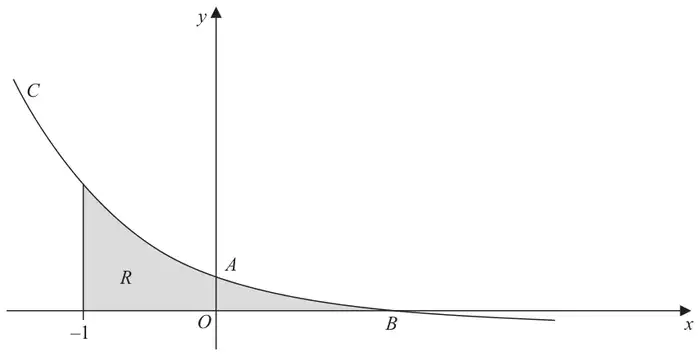
Figure 2 shows a sketch of part of the curve \(C\) with parametric equations\[x = 1 - \frac{1}{2}t, \qquad y = 2^t - 1\]
The curve crosses the \(y\)-axis at the point \(A\) and crosses the \(x\)-axis at the point \(B\).
The region \(R\), as shown shaded in Figure 2, is bounded by the curve \(C\), the line \(x = -1\) and the \(x\)-axis.
| Scheme | Marks |
|---|---|
| Working parametrically: \(x = 1 - \dfrac{1}{2}t, \quad y = 2^t - 1\) or \(y = \mathrm{e}^{t\ln 2} - 1\) | |
| \(\{x = 0 \Rightarrow\}\ 0 = 1 - \dfrac{1}{2}t \Rightarrow t = 2\) Applies \(x = 0\) to obtain a value for \(t\). | M1 |
| When \(t = 2\), \(y = 2^2 - 1 = 3\) Correct value for \(y\). | A1 |
| (2) |
Notes
M1: Applies \(x = 0\) and obtains a value of \(t\).
A1: For \(y = 2^2 - 1 = 3\) or \(y = 4 - 1 = 3\)
Alternative Solution 1:
M1: For substituting \(t = 2\) into either \(x\) or \(y\).
A1: \(x = 1 - \dfrac{1}{2}(2) = 0\) and \(y = 2^2 - 1 = 3\)
Alternative Solution 2:
M1: Applies \(y = 3\) and obtains a value of \(t\).
A1: For \(x = 1 - \dfrac{1}{2}(2) = 0\) or \(x = 1 - 1 = 0\).
Alternative Solution 3:
M1: Applies \(y = 3\) or \(x = 0\) and obtains a value of \(t\).
A1: Shows that \(t = 2\) for both \(y = 3\) and \(x = 0\).
Alternative: Converting to a Cartesian equation:
| Scheme | Marks |
|---|---|
| \(t = 2 - 2x \Rightarrow y = 2^{2 - 2x} - 1\) | |
| \(\{x = 0 \Rightarrow\}\ y = 2^2 - 1\) Applies \(x = 0\) in their Cartesian equation... | M1 |
| \(y = 3\) ... to arrive at a correct answer of 3. | A1 |
| (2) |
| Scheme | Marks |
|---|---|
| \(\{y = 0 \Rightarrow\}\ 0 = 2^t - 1 \Rightarrow t = 0\) Applies \(y = 0\) to obtain a value for \(t\). (Must be seen in part (b)). | M1 |
| When \(t = 0\), \(x = 1 - \dfrac{1}{2}(0) = 1\) \(x = 1\) | A1 |
| (2) |
Notes
M1: Applies \(y = 0\) and obtains a value of \(t\). Working must be seen in part (b).
A1: For finding \(x = 1\).
Note: Award M1A1 for \(x = 1\).
Alternative: Converting to a Cartesian equation:
| Scheme | Marks |
|---|---|
| \(\{y = 0 \Rightarrow\}\ 0 = 2^{2 - 2x} - 1 \Rightarrow 0 = 2 - 2x \Rightarrow x = \ldots\) Applies \(y = 0\) to obtain a value for \(x\). (Must be seen in part (b)). | M1 |
| \(x = 1\) \(x = 1\) | A1 |
| (2) |
| Scheme | Marks |
|---|---|
| \(\dfrac{\mathrm{d}x}{\mathrm{d}t} = -\dfrac{1}{2}\) and either \(\dfrac{\mathrm{d}y}{\mathrm{d}t} = 2^t\ln 2\) or \(\dfrac{\mathrm{d}y}{\mathrm{d}t} = \mathrm{e}^{t\ln 2}\ln 2\) | B1 |
| \(\dfrac{\mathrm{d}y}{\mathrm{d}x} = \dfrac{2^t\ln 2}{-\frac{1}{2}}\) Attempts their \(\dfrac{\mathrm{d}y}{\mathrm{d}t}\) divided by their \(\dfrac{\mathrm{d}x}{\mathrm{d}t}\). | M1 |
| At \(A\), \(t = \text{"}2\text{"}\), so \(m(\mathbf{T}) = -8\ln 2 \Rightarrow m(\mathbf{N}) = \dfrac{1}{8\ln 2}\) Applies \(t = \text{"}2\text{"}\) and \(m(\mathbf{N}) = \dfrac{-1}{m(\mathbf{T})}\) | M1 |
| \(y - 3 = \dfrac{1}{8\ln 2}(x - 0)\) or \(y = 3 + \dfrac{1}{8\ln 2}x\) or equivalent. See notes. | M1 A1 oe cso |
| (5) |
Notes
B1: Both \(\dfrac{\mathrm{d}x}{\mathrm{d}t}\) and \(\dfrac{\mathrm{d}y}{\mathrm{d}t}\) correct. This mark can be implied by later working.
M1: Their \(\dfrac{\mathrm{d}y}{\mathrm{d}t}\) divided by their \(\dfrac{\mathrm{d}x}{\mathrm{d}t}\) or their \(\dfrac{\mathrm{d}y}{\mathrm{d}t} \times \dfrac{1}{\text{their}\left(\dfrac{\mathrm{d}x}{\mathrm{d}t}\right)}\). Note: their \(\dfrac{\mathrm{d}y}{\mathrm{d}t}\) must be a function of \(t\).
M1: Uses their value of \(t\) found in part (a) and applies \(m(\mathbf{N}) = \dfrac{-1}{m(\mathbf{T})}\).
M1: \(y - 3 = (\text{their normal gradient})x\) or \(y = (\text{their normal gradient})x + 3\) or equivalent.
A1: \(y - 3 = \dfrac{1}{8\ln 2}(x - 0)\) or \(y = 3 + \dfrac{1}{8\ln 2}x\) or \(y - 3 = \dfrac{1}{\ln 256}(x - 0)\) or \((8\ln 2)y - 24\ln 2 = x\)
or \(\dfrac{y - 3}{(x - 0)} = \dfrac{1}{8\ln 2}\). You can apply isw here.
Working in decimals is ok for the three method marks. B1, A1 require exact values.
Alternative: Converting to a Cartesian equation:
| Scheme | Marks |
|---|---|
| \(\dfrac{\mathrm{d}y}{\mathrm{d}x} = -2\left(2^{2 - 2x}\right)\ln 2\) \(\pm\lambda 2^{2 - 2x},\ \lambda \neq 1\) | M1 |
| \(-2\left(2^{2 - 2x}\right)\ln 2\) or equivalent | A1 |
| At \(A\), \(x = 0\), so \(m(\mathbf{T}) = -8\ln 2 \Rightarrow m(\mathbf{N}) = \dfrac{1}{8\ln 2}\) Applies \(x = 0\) and \(m(\mathbf{N}) = \dfrac{-1}{m(\mathbf{T})}\) | M1 |
| \(y - 3 = \dfrac{1}{8\ln 2}(x - 0)\) or \(y = 3 + \dfrac{1}{8\ln 2}x\) or equivalent. As in the original scheme. | M1 A1 oe |
| (5) |
| Scheme | Marks |
|---|---|
| \(\text{Area}(R) = \displaystyle\int \left(2^t - 1\right).\left(-\frac{1}{2}\right)\mathrm{d}t\) Complete substitution for both \(y\) and \(\mathrm{d}x\) | M1 |
| \(x = -1 \to t = 4\) and \(x = 1 \to t = 0\) | B1 |
| \(= \left\{-\dfrac{1}{2}\right\}\left(\dfrac{2^t}{\ln 2} - t\right)\) Either \(2^t \to \dfrac{2^t}{\ln 2}\) or \(\left(2^t - 1\right) \to \dfrac{(2^t)}{\pm\alpha(\ln 2)} - t\) or \(\left(2^t - 1\right) \to \pm\alpha(\ln 2)(2^t) - t\) | M1* |
| \(\left(2^t - 1\right) \to \dfrac{2^t}{\ln 2} - t\) | A1 |
| \(\left\{-\dfrac{1}{2}\left[\dfrac{2^t}{\ln 2} - t\right]_4^0\right\} = -\dfrac{1}{2}\left(\left(\dfrac{1}{\ln 2}\right) - \left(\dfrac{16}{\ln 2} - 4\right)\right)\) Depends on the previous method mark. Substitutes their changed limits in \(t\) and subtracts either way round. | dM1* |
| \(= \dfrac{15}{2\ln 2} - 2\) \(\dfrac{15}{2\ln 2} - 2\) or equivalent. | A1 |
| (6) | |
| (15 marks) |
Notes
M1: Complete substitution for both \(y\) and \(\mathrm{d}x\). So candidate should write down \(\displaystyle\int \left(2^t - 1\right).\left(\text{their } \dfrac{\mathrm{d}x}{\mathrm{d}t}\right)\)
B1: Changes limits from \(x \to t\). \(x = -1 \to t = 4\) and \(x = 1 \to t = 0\). Note \(t = 4\) and \(t = 0\) seen is B1.
M1*: Integrates \(2^t\) correctly to give \(\dfrac{2^t}{\ln 2}\)
... or integrates \(\left(2^t - 1\right)\) to give either \(\dfrac{(2^t)}{\pm\alpha(\ln 2)} - t\) or \(\pm\alpha(\ln 2)(2^t) - t\).
A1: Correct integration of \(\left(2^t - 1\right)\) with respect to \(t\) to give \(\dfrac{2^t}{\ln 2} - t\).
dM1*: Depends upon the previous method mark.
Substitutes their limits in \(t\) and subtracts either way round.
A1: Exact answer of \(\dfrac{15}{2\ln 2} - 2\) or \(\dfrac{15}{\ln 4} - 2\) or \(\dfrac{15 - 4\ln 2}{2\ln 2}\) or \(\dfrac{7.5}{\ln 2} - 2\) or \(\dfrac{15}{2}\log_2 \mathrm{e} - 2\) or equivalent.
Alternative: Converting to a Cartesian equation:
| Scheme | Marks |
|---|---|
| \(\text{Area}(R) = \displaystyle\int \left(2^{2 - 2x} - 1\right)\mathrm{d}x\) Form the integral of their Cartesian equation of \(C\). | M1 |
| \(= \displaystyle\int_{-1}^{1} \left(2^{2 - 2x} - 1\right)\mathrm{d}x\) For \(2^{2 - 2x} - 1\) with limits of \(x = -1\) and \(x = 1\). Ie. \(\displaystyle\int_{-1}^{1} \left(2^{2 - 2x} - 1\right)\) | B1 |
| \(= \left(\dfrac{2^{2 - 2x}}{-2\ln 2} - x\right)\) Either \(2^{2 - 2x} \to \dfrac{2^{2 - 2x}}{-2\ln 2}\) or \(\left(2^{2 - 2x} - 1\right) \to \dfrac{2^{2 - 2x}}{\pm\alpha(\ln 2)} - x\) or \(\left(2^{2 - 2x} - 1\right) \to \pm\alpha(\ln 2)(2^{2 - 2x}) - x\) | M1* |
| \(\left(2^{2 - 2x} - 1\right) \to \dfrac{2^{2 - 2x}}{-2\ln 2} - x\) | A1 |
| \(\left\{\left[\dfrac{2^{2 - 2x}}{-2\ln 2} - x\right]_{-1}^{1}\right\} = \left(\left(\dfrac{1}{-2\ln 2} - 1\right) - \left(\dfrac{16}{-2\ln 2} + 1\right)\right)\) Depends on the previous method mark. Substitutes limits of \(-1\) and their \(x_B\) and subtracts either way round. | dM1* |
| \(= \dfrac{15}{2\ln 2} - 2\) \(\dfrac{15}{2\ln 2} - 2\) or equivalent. | A1 |
| (6) |
Alternative method: In Cartesian and applying \(u = 2 - 2x\)
| Scheme | Marks |
|---|---|
| \(\text{Area}(R) = \displaystyle\int \left(2^u - 1\right)\{\mathrm{d}x\}\), where \(u = 2 - 2x\) \(= \displaystyle\int_4^0 \left(2^u - 1\right)\left(-\tfrac{1}{2}\right)\{\mathrm{d}u\}\) M0: Unless a candidate writes \(\displaystyle\int \left(2^{2 - 2x} - 1\right)\{\mathrm{d}x\}\). Then apply the “working parametrically” mark scheme. | M0 |
Alternative method: For substitution \(u = 2^t\)
| Scheme | Marks |
|---|---|
| \(\text{Area}(R) = \displaystyle\int \left(2^t - 1\right).\left(-\frac{1}{2}\right)\mathrm{d}t\) Complete substitution for both \(y\) and \(\mathrm{d}x\) | M1 |
| where \(u = 2^t \Rightarrow \dfrac{\mathrm{d}u}{\mathrm{d}t} = 2^t\ln 2 \Rightarrow \dfrac{\mathrm{d}u}{\mathrm{d}t} = u\ln 2\) \(x = -1 \to t = 4 \to u = 16\) and \(x = 1 \to t = 0 \to u = 1\) Both correct limits in \(t\) or both correct limits in \(u\). | B1 |
| So \(\text{area}(R) = -\dfrac{1}{2}\displaystyle\int \frac{u - 1}{u\ln 2}\,\mathrm{d}u\) If not awarded above, you can award M1 for this integral \(= -\dfrac{1}{2}\displaystyle\int \frac{1}{\ln 2} - \frac{1}{u\ln 2}\,\mathrm{d}u\) | |
| \(= \left\{-\dfrac{1}{2}\right\}\left(\dfrac{u}{\ln 2} - \dfrac{\ln u}{\ln 2}\right)\) Either \(2^t \to \dfrac{u}{\ln 2}\) or \(\left(2^t - 1\right) \to \dfrac{u}{\pm\alpha(\ln 2)} - \dfrac{\ln u}{\ln 2}\) or \(\left(2^t - 1\right) \to \pm\alpha(\ln 2)(u) - \dfrac{\ln u}{\ln 2}\) | M1* |
| \(\left(2^t - 1\right) \to \dfrac{u}{\ln 2} - \dfrac{\ln u}{\ln 2}\) | A1 |
| \(\left\{-\dfrac{1}{2}\left[\dfrac{u}{\ln 2} - \dfrac{\ln u}{\ln 2}\right]_{16}^{1}\right\} = -\dfrac{1}{2}\left(\left(\dfrac{1}{\ln 2}\right) - \left(\dfrac{16}{\ln 2} - \dfrac{\ln 16}{\ln 2}\right)\right)\) Depends on the previous method mark. Substitutes their changed limits in u and subtracts either way round. | dM1* |
| \(= \dfrac{15}{2\ln 2} - \dfrac{\ln 16}{2\ln 2}\) or \(\dfrac{15}{2\ln 2} - 2\) \(\dfrac{15}{2\ln 2} - \dfrac{\ln 16}{2\ln 2}\) or \(\dfrac{15}{2\ln 2} - 2\) or equivalent. | A1 |
| (6) |