
C4 June 2008 Q8
8.
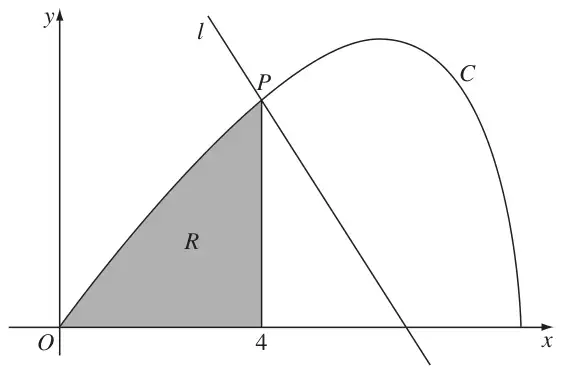
Figure 3 shows the curve \(C\) with parametric equations\[x = 8\cos t, \qquad y = 4\sin 2t, \qquad 0 \leqslant t \leqslant \frac{\pi}{2}.\]The point \(P\) lies on \(C\) and has coordinates \((4, 2\sqrt{3})\).
The line \(l\) is a normal to \(C\) at \(P\).
The finite region \(R\) is enclosed by the curve \(C\), the \(x\)-axis and the line \(x = 4\), as shown shaded in Figure 3.
| Scheme | Marks |
|---|---|
| At \(P(4, 2\sqrt{3})\) either \(\underline{4 = 8\cos t}\) or \(\underline{2\sqrt{3} = 4\sin 2t}\) | M1 |
| \(\Rightarrow\) only solution is \(\underline{t = \tfrac{\pi}{3}}\) where \(0 \leqslant t \leqslant \tfrac{\pi}{2}\) | A1 |
| (2) |
Notes
M1: \(\underline{4 = 8\cos t}\) or \(\underline{2\sqrt{3} = 4\sin 2t}\)
A1: \(\underline{t = \tfrac{\pi}{3}}\) or \(\underline{\text{awrt } 1.05}\) (radians) only stated in the range \(0 \leqslant t \leqslant \tfrac{\pi}{2}\)
| Scheme | Marks |
|---|---|
| \(x = 8\cos t,\quad y = 4\sin 2t\) | |
| \(\dfrac{\mathrm{d}x}{\mathrm{d}t} = -8\sin t,\quad \dfrac{\mathrm{d}y}{\mathrm{d}t} = 8\cos 2t\) | M1 A1 |
| At \(P\), \(\underline{\dfrac{\mathrm{d}y}{\mathrm{d}x} = \dfrac{8\cos\left(\frac{2\pi}{3}\right)}{-8\sin\left(\frac{\pi}{3}\right)}}\) | M1* |
| \(\left\{= \dfrac{8\left(-\frac{1}{2}\right)}{(-8)\left(\frac{\sqrt{3}}{2}\right)} = \dfrac{1}{\sqrt{3}} = \text{awrt } 0.58\right\}\) | |
| Hence m(N) \(= -\sqrt{3}\) or \(\dfrac{-1}{\frac{1}{\sqrt{3}}}\) | dM1* |
| N: \(y - 2\sqrt{3} = -\sqrt{3}(x - 4)\) | dM1* |
| N: \(\underline{y = -\sqrt{3}x + 6\sqrt{3}}\) AG | A1 cso AG |
| or \(2\sqrt{3} = -\sqrt{3}(4) + c \Rightarrow c = 2\sqrt{3} + 4\sqrt{3} = 6\sqrt{3}\) so N: \(\left[\underline{y = -\sqrt{3}x + 6\sqrt{3}}\right]\) | |
| (6) |
Notes
M1: Attempt to differentiate both \(x\) and \(y\) wrt \(t\) to give \(\pm p\sin t\) and \(\pm q\cos 2t\) respectively. A1: Correct \(\tfrac{\mathrm{d}x}{\mathrm{d}t}\) and \(\tfrac{\mathrm{d}y}{\mathrm{d}t}\)
M1*: Divides in correct way round and attempts to substitute their value of \(t\) (in degrees or radians) into their \(\tfrac{\mathrm{d}y}{\mathrm{d}x}\) expression. You may need to check candidate’s substitutions for M1*. Note the next two method marks are dependent on M1*
dM1*: Uses m(N) \(= -\dfrac{1}{\text{their m}(\mathbf{T})}\).
dM1*: Uses \(y - 2\sqrt{3} = (\text{their } m_N)(x - 4)\) or finds c using \(x = 4\) and \(y = 2\sqrt{3}\) and uses \(y = (\text{their } m_N)x + {}\)“\(c\)”.
A1 cso AG: \(\underline{y = -\sqrt{3}x + 6\sqrt{3}}\)
| Scheme | Marks |
|---|---|
| \(A = \displaystyle\int_0^4 y\,\mathrm{d}x = \int_{\frac{\pi}{2}}^{\frac{\pi}{3}} 4\sin 2t.(-8\sin t)\,\mathrm{d}t\) | M1 A1 |
| \(A = \displaystyle\int_{\frac{\pi}{2}}^{\frac{\pi}{3}} -32\sin 2t.\sin t\,\mathrm{d}t = \int_{\frac{\pi}{2}}^{\frac{\pi}{3}} -32(2\sin t\cos t).\sin t\,\mathrm{d}t\) | M1 |
| \(A = \displaystyle\int_{\frac{\pi}{2}}^{\frac{\pi}{3}} -64.\sin^2 t\cos t\,\mathrm{d}t\) | |
| \(A = \displaystyle\int_{\frac{\pi}{3}}^{\frac{\pi}{2}} 64.\sin^2 t\cos t\,\mathrm{d}t\) | A1 AG |
| (4) |
Notes
M1: attempt at \(A = \displaystyle\int\underline{y\,\tfrac{\mathrm{d}x}{\mathrm{d}t}}\,\mathrm{d}t\) A1: correct expression (ignore limits and d\(t\))
M1: Seeing \(\sin 2t = 2\sin t\cos t\) anywhere in PART (c).
A1 AG: Correct proof. Appreciation of how the negative sign affects the limits. Note that the answer is given in the question.
| Scheme | Marks |
|---|---|
| {Using substitution \(u = \sin t \Rightarrow \tfrac{\mathrm{d}u}{\mathrm{d}t} = \cos t\)} {change limits: when \(t = \tfrac{\pi}{3}\), \(u = \tfrac{\sqrt{3}}{2}\) & when \(t = \tfrac{\pi}{2}\), \(u = 1\)} | |
| \(A = 64\left[\dfrac{\sin^3 t}{3}\right]_{\frac{\pi}{3}}^{\frac{\pi}{2}}\) or \(A = 64\left[\dfrac{u^3}{3}\right]_{\frac{\sqrt{3}}{2}}^{1}\) | M1 A1 |
| \(A = 64\left[\dfrac{1}{3} - \left(\dfrac{1}{3}.\dfrac{\sqrt{3}}{2}.\dfrac{\sqrt{3}}{2}.\dfrac{\sqrt{3}}{2}\right)\right]\) | dM1 |
| \(A = 64\left(\dfrac{1}{3} - \dfrac{1}{8}\sqrt{3}\right) = \underline{\dfrac{64}{3} - 8\sqrt{3}}\) | A1 aef isw |
| (Note that \(a = \tfrac{64}{3}\), \(b = -8\)) | |
| (4) | |
| (16 marks) |
Notes
M1: \(k\sin^3 t\) or \(ku^3\) with \(u = \sin t\) A1: Correct integration ignoring limits.
dM1: Substitutes limits of either \(\left(t = \tfrac{\pi}{2} \text{ and } t = \tfrac{\pi}{3}\right)\) or \(\left(u = 1 \text{ and } u = \tfrac{\sqrt{3}}{2}\right)\) and subtracts the correct way round.
A1 aef isw: \(\underline{\dfrac{64}{3} - 8\sqrt{3}}\). Aef in the form \(a + b\sqrt{3}\), with awrt 21.3 and anything that cancels to \(a = \tfrac{64}{3}\) and \(b = -8\).