
C4 January 2009 Q2
2.
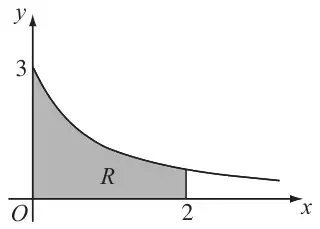
Figure 1 shows part of the curve \(y = \dfrac{3}{\sqrt{(1 + 4x)}}\). The region \(R\) is bounded by the curve, the \(x\)-axis, and the lines \(x = 0\) and \(x = 2\), as shown shaded in Figure 1.
The region \(R\) is rotated 360° about the \(x\)-axis.
| Scheme | Marks |
|---|---|
| \(\text{Area}(R) = \displaystyle\int_0^2 \dfrac{3}{\sqrt{(1 + 4x)}}\,\mathrm{d}x = \int_0^2 3(1 + 4x)^{-\frac{1}{2}}\,\mathrm{d}x\) | |
| \(= \left[\dfrac{3(1 + 4x)^{\frac{1}{2}}}{\frac{1}{2}.4}\right]_0^2\) | M1 A1 |
| \(= \left[\tfrac{3}{2}(1 + 4x)^{\frac{1}{2}}\right]_0^2\) | |
| \(= \left(\tfrac{3}{2}\sqrt{9}\right) - \left(\tfrac{3}{2}(1)\right)\) | M1 |
| \(= \tfrac{9}{2} - \tfrac{3}{2} = \underline{3}\) (units)\(^2\) | A1 |
| (Answer of 3 with no working scores M0A0M0A0.) | |
| (4) |
Notes
M1: Integrating \(3(1 + 4x)^{-\frac{1}{2}}\) to give \(\pm k(1 + 4x)^{\frac{1}{2}}\).
A1: Correct integration. Ignore limits.
M1: Substitutes limits of 2 and 0 into a changed function and subtracts the correct way round.
A1: 3
Aliter 2. (a) Way 2
| Scheme | Marks |
|---|---|
| \(\text{Area}(R) = \displaystyle\int_0^2 \dfrac{3}{\sqrt{(1 + 4x)}}\,\mathrm{d}x = \int_0^2 3(1 + 4x)^{-\frac{1}{2}}\,\mathrm{d}x\) | |
| \(\left\{\text{Using substitution } u = 1 + 4x \Rightarrow \tfrac{\mathrm{d}u}{\mathrm{d}x} = 4\right\}\) \(\left\{\text{change limits: When } x = 0,\ u = 1 \text{ \& when } x = 2,\ u = 9\right\}\) | |
| So, \(\text{Area}(R) = \displaystyle\int_1^9 3u^{-\frac{1}{2}}\,\tfrac{1}{4}\,\mathrm{d}u\) | |
| \(= \left[\dfrac{3}{4}\,\dfrac{u^{\frac{1}{2}}}{\left(\frac{1}{2}\right)}\right]_1^9\) (corrected from the printed mark scheme: the limits on this line are printed as 0 and 2) | M1 A1 |
| \(= \left[\tfrac{3}{2}u^{\frac{1}{2}}\right]_1^9\) | |
| \(= \left(\tfrac{3}{2}\sqrt{9}\right) - \left(\tfrac{3}{2}(1)\right)\) | M1 |
| \(= \tfrac{9}{2} - \tfrac{3}{2} = \underline{3}\) (units)\(^2\) | A1 |
| (4) |
M1: Integrating \(\pm\lambda u^{-\frac{1}{2}}\) to give \(\pm ku^{\frac{1}{2}}\). A1: Correct integration. Ignore limits.
M1: Substitutes limits of either \((u = 9 \text{ and } u = 1)\) or in \(x\), \((x = 2 \text{ and } x = 0)\) into a changed function and subtracts the correct way round. A1: 3
Aliter 2. (a) Way 3
| Scheme | Marks |
|---|---|
| \(\text{Area}(R) = \displaystyle\int_0^2 \dfrac{3}{\sqrt{(1 + 4x)}}\,\mathrm{d}x = \int_0^2 3(1 + 4x)^{-\frac{1}{2}}\,\mathrm{d}x\) | |
| \(\left\{\text{Using substitution } u^2 = 1 + 4x \Rightarrow 2u\tfrac{\mathrm{d}u}{\mathrm{d}x} = 4 \Rightarrow \tfrac{1}{2}u\,\mathrm{d}u = \mathrm{d}x\right\}\) \(\left\{\text{change limits: When } x = 0,\ u = 1 \text{ \& when } x = 2,\ u = 3\right\}\) | |
| So, \(\text{Area}(R) = \displaystyle\int_1^3 \tfrac{3}{u}\,\tfrac{1}{2}u\,\mathrm{d}u = \int_1^3 \tfrac{3}{2}\,\mathrm{d}u\) | |
| \(= \left[\underline{\dfrac{3}{2}u}\right]_1^3\) | M1 A1 |
| \(= \left(\tfrac{3}{2}(3)\right) - \left(\tfrac{3}{2}(1)\right)\) | M1 |
| \(= \tfrac{9}{2} - \tfrac{3}{2} = \underline{3}\) (units)\(^2\) | A1 |
| (4) |
M1: Integrating \(\pm\lambda\) to give \(\pm ku\). A1: Correct integration. Ignore limits.
M1: Substitutes limits of either \((u = 3 \text{ and } u = 1)\) or in \(x\), \((x = 2 \text{ and } x = 0)\) into a changed function and subtracts the correct way round. A1: 3
| Scheme | Marks |
|---|---|
| Volume \(= \underline{\pi\displaystyle\int_0^2 \left(\dfrac{3}{\sqrt{(1 + 4x)}}\right)^2\,\mathrm{d}x}\) | B1 |
| \(= (\pi)\displaystyle\int_0^2 \dfrac{9}{1 + 4x}\,\mathrm{d}x\) | |
| \(= (\pi)\left[\tfrac{9}{4}\ln\left|1 + 4x\right|\right]_0^2\) | M1 A1 |
| \(= (\pi)\left[\left(\tfrac{9}{4}\ln 9\right) - \left(\tfrac{9}{4}\ln 1\right)\right]\) | dM1 |
| So Volume \(= \underline{\tfrac{9}{4}\pi\ln 9}\) | A1 oe isw |
| (5) | |
| (9 marks) |
Notes
B1: Use of \(V = \underline{\pi\int y^2\,\mathrm{d}x}\). Can be implied. Ignore limits and d\(x\).
M1: \(\pm k\ln\left|1 + 4x\right|\) A1: \(\tfrac{9}{4}\ln\left|1 + 4x\right|\)
dM1: Substitutes limits of 2 and 0 and subtracts the correct way round.
A1 oe isw: \(\underline{\tfrac{9}{4}\pi\ln 9}\) or \(\underline{\tfrac{9}{2}\pi\ln 3}\) or \(\underline{\tfrac{18}{4}\pi\ln 3}\)
Note that \(\ln 1\) can be implied as equal to 0.
Note the answer must be a one term exact value. Note, also you can ignore subsequent working here.
Note that \(= \tfrac{9}{4}\pi\ln 9 + c\) (oe.) would be awarded the final A0.