
C3 June 2017 Q6
6. Given that \(a\) and \(b\) are positive constants,
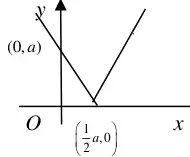
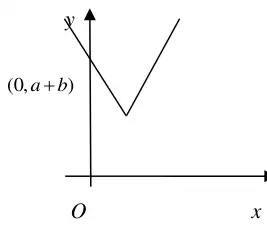
Show, on each sketch, the coordinates of each point at which the graph crosses or meets the axes.
(4)Given that the equation\[|2x - a| + b = \frac{3}{2}x + 8\]has a solution at \(x = 0\) and a solution at \(x = c\),
(a)(i)
| Scheme | Marks |
|---|---|
| V shape on \(x\) - axis or coordinates \(\left(\tfrac{1}{2}a, 0\right)\) and \((0, a)\) | B1 |
| Correct shape, position and coordinates | B1 |
(a)(ii)
| Scheme | Marks |
|---|---|
| Their "V" shape translated up or \((0, a + b)\) | B1ft |
| Correct shape, position and \((0, a + b)\) | B1 |
| (4) |
Notes
(a)(i)
B1: V shape sitting anywhere on the \(x\)- axis or for \(\left(\tfrac{1}{2}a, 0\right)\) and \((0, a)\) lying on the curve.
Condone non -symmetrical graphs and ones lying on just one side of the \(y\) -axis
B1: V shape sitting on the positive \(x\)-axis at \(\left(\tfrac{1}{2}a, 0\right)\), cutting the \(y\)-axis at \((0, a)\) and lying in both quadrants 1 and 2
Accept \(\dfrac{1}{2}a\) and \(a\) marked on the correct axis. Condone say \((a, 0)\) for \((0, a)\) as long as it is on the correct axis.
Condone a dotted line appearing on the diagram as many reflect \(y = 2x - a\) to sketch \(y = |2x - a|\)
If it is a solid line then it would not score the shape mark.
(a)(ii)
B1ft: Follow through on (a)(i). Their graph translated up. Allow on U shapes and non symmetrical graphs.
Alternatively score for the \((0, a + b)\) lying on the curve
B1: V shape lying in quadrants 1 and 2 with the vertex in quadrant 1 cutting the \(y\)- axis at \((0, a + b)\)
Ignore any coordinates given for the vertex.
| Scheme | Marks |
|---|---|
| States or uses \(a + b = 8\) | B1 |
| Attempts to solve \(|2x - a| + b = \dfrac{3}{2}x + 8\) in either \(x\) or with \(x = c\) \(2c - a + b = \dfrac{3}{2}c + 8 \Rightarrow kc = \mathrm{f}(a, b)\) | M1 |
| Combines \(kc = \mathrm{f}(a, b)\) with \(a + b = 8 \quad \Rightarrow c = 4a\) | dM1 A1 |
| (4) | |
| (8 marks) |
Notes
B1: States or uses \(a + b = 8\) or exact equivalent. Condone use of capital letters throughout
It is not scored for just \(|0 - a| + b = 8\)
M1: This M is for an understanding of the modulus.
It is scored for an attempt at solving \((2x - a) + b = \dfrac{3}{2}x + 8\) or \(-(2x - a) + b = \dfrac{3}{2}x + 8\) in either \(x\) or with \(x\) replaced by \(c\). The signs of the \(2x\) and the \(a\) must be different. \(|2x - a| \neq 2x + a\)
You may see \((2x - a) + b = \dfrac{3}{2}x + 8 \Rightarrow kx = \mathrm{f}(a, b)\)
You may see \(-2x + a + b = \dfrac{3}{2}x + 8 \Rightarrow kx = \mathrm{f}(a, b)\)
You may see \((2x - a) + b = \dfrac{3}{2}x + 8 \Rightarrow kx = \mathrm{f}(a, b)\) being solved with \(b\) replaced with their \(a + b = 8\)
You may see \(-2c + a + b = \dfrac{3}{2}c + 8 \Rightarrow kc = \mathrm{f}(a, b)\) being solved with \(b\) replaced with their \(a + b = 8\)
dM1: This dM mark is scored for combining \(b = 8 - a\) with \((2x - a) + b = \dfrac{3}{2}x + 8\) (or their \(kx = \mathrm{f}(a, b)\) resulting from that equation) resulting in a link between \(x\) and \(a\) Both equations must have been correct initially.
Alternatively for combining \(b = 8 - a\) with their \(2c - a + b = \dfrac{3}{2}c + 8\) (or their \(kc = \mathrm{f}(a, b)\) resulting from that equation) resulting in a link between \(c\) and \(a\)
You may condone sign slips in finding the link between \(x\) (or \(c\)) and \(a\)
If you see an approach that involves making \(|2x - a|\) the subject followed by squaring, and you feel that it deserves credit, please send to review. The solution proceeds as follows
Look for \(|2x - a| = \dfrac{3}{2}x + 8 - b \Rightarrow |2x - a| = \dfrac{3}{2}x + a \Rightarrow (2x - a)^2 = \left(\dfrac{3}{2}x + a\right)^2 \Rightarrow 7x\left(\dfrac{1}{4}x - a\right) = 0\)
A1: \(c = 4a\) ONLY
Special Case where they have the roots linked with the incorrect branch of the curve.
They have \(x = 0\) as the solution to \(2x - a + b = \dfrac{3}{2}x + 8 \Rightarrow -a + b = 8\)...................(1)
They have \(x = c\) as the solution to \(-2x + a + b = \dfrac{3}{2}x + 8 \Rightarrow \dfrac{7}{2}x = a + b - 8\).............(2)
Solve (1) and (2) \(\Rightarrow x = \dfrac{4}{7}a\)
Hence \(\Rightarrow c = \dfrac{4}{7}a\)
This would score B0 M1 dM0 A0 anyway but should be awarded SC B0, M1 dM1, A0 for above work leading to either \(x = \dfrac{4}{7}a\) or \(c = \dfrac{4}{7}a\)