
C3 June 2017 Q5
5.
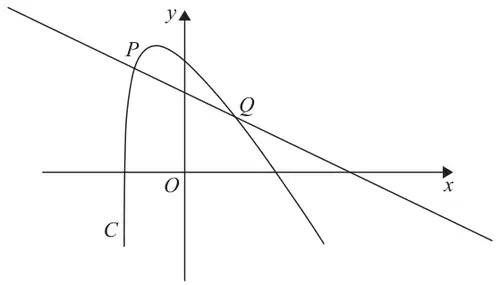
Figure 2 shows a sketch of part of the curve \(C\) with equation\[y = 2\ln(2x + 5) - \frac{3x}{2}, \qquad x > -2.5\]The point \(P\) with \(x\) coordinate \(-2\) lies on \(C\).
The normal to \(C\) at \(P\) cuts the curve again at the point \(Q\), as shown in Figure 2.
The iteration formula\[x_{n+1} = \frac{20}{11}\ln(2x_n + 5) - 2\]can be used to find an approximation for the \(x\) coordinate of \(Q\).
| Scheme | Marks |
|---|---|
| At P \(x = -2 \Rightarrow y = 3\) | B1 |
| \(\dfrac{\mathrm{d}y}{\mathrm{d}x} = \dfrac{4}{2x + 5} - \dfrac{3}{2}\) | M1, A1 |
| \(\left.\dfrac{\mathrm{d}y}{\mathrm{d}x}\right|_{x=-2} = \dfrac{5}{2} \Rightarrow\) Equation of normal is \(y - \text{'}3\text{'} = -\dfrac{2}{5}\left(x - (-2)\right)\) | M1 |
| \(\Rightarrow 2x + 5y = 11\) | A1 |
| (5) |
Notes
B1: \(y = 3\) at point \(P\). This may be seen embedded within their equation which may be a tangent
M1: Differentiates \(\ln(2x + 5) \to \dfrac{A}{2x + 5}\) or equivalent. You may see \(\ln(2x + 5)^2 \to \dfrac{A(2x + 5)}{(2x + 5)^2}\)
A1: \(\dfrac{\mathrm{d}y}{\mathrm{d}x} = \dfrac{4}{2x + 5} - \dfrac{3}{2}\) oe. It need not be simplified.
M1: For using a correct method of finding the equation of the normal using their numerical value of \(-\left.\dfrac{\mathrm{d}x}{\mathrm{d}y}\right|_{x=-2}\) as the gradient. Allow for \((y - \text{'}3\text{'}) = -\left.\dfrac{\mathrm{d}x}{\mathrm{d}y}\right|_{x=-2}(x - -2)\), oe.
At least one bracket must be correct for their \((-2, 3)\)
If the form \(y = mx + c\) is used it is scored for proceeding as far as \(c\) = ..
A1: \(\pm k(5y + 2x = 11)\) It must be in the form \(ax + by = c\) as stated in the question
Score this mark once it is seen. Do not withhold it if they proceed to another form, \(y = mx + c\) for example
If a candidate uses a graphical calculator to find the gradient they can score a maximum of B1 M0 A0 M1 A1
| Scheme | Marks |
|---|---|
| Combines \(5y + 2x = 11\) and \(y = 2\ln(2x + 5) - \dfrac{3x}{2}\) to form equation in \(x\) | |
| \(5\left(2\ln(2x + 5) - \dfrac{3x}{2}\right) + 2x = 11\) | M1 |
| \(\Rightarrow x = \dfrac{20}{11}\ln(2x + 5) - 2\) | dM1 A1* |
| (3) |
Notes
M1: For combining 'their' linear \(5y + 2x = 11\) with \(y = 2\ln(2x + 5) - \dfrac{3x}{2}\) to form equation in just \(x\), condoning slips on the rearrangement of their \(5y + 2x = 11\). Eg \(2\ln(2x + 5) - \dfrac{3x}{2} = \dfrac{11 \pm 2x}{5}\) is OK
dM1: Collects the two terms in \(x\) and proceeds to \(ax = b\ln(2x + 5) + c\) Allow numerical slips
A1*: This is a given answer. All aspects must be correct including bracketing
| Scheme | Marks |
|---|---|
| Substitutes \(x_1 = 2 \Rightarrow x_2 = \dfrac{20}{11}\ln 9 - 2\) | M1 |
| Awrt \(x_2 = 1.9950\) and \(x_3 = 1.9929\). | A1 |
| (2) | |
| (10 marks) |
Notes
M1: Score for substituting \(x_1 = 2 \Rightarrow x_2 = \dfrac{20}{11}\ln(2 \times 2 + 5) - 2\) or exact equivalent
This may implied by \(x_2 = 1.99...\)
A1: Both values correct. Allow awrt \(x_2 = 1.9950\) and \(x_3 = 1.9929\) but condone \(x_2 = 1.995\)
Ignore subscripts. Mark on the first and second values given.