
C3 June 2013 (R) Q7
7.
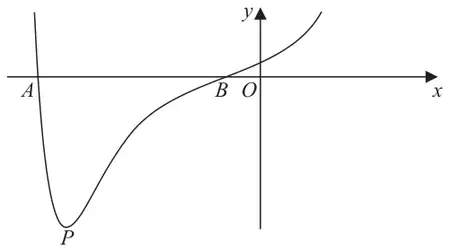
Figure 2 shows a sketch of part of the curve with equation \(y=\mathrm{f}(x)\) where\[\mathrm{f}(x)=(x^2+3x+1)\mathrm{e}^{x^2}\]The curve cuts the \(x\)-axis at points \(A\) and \(B\) as shown in Figure 2.
The curve has a minimum turning point at the point \(P\) as shown in Figure 2.
The \(x\) coordinate of \(P\) is \(\alpha\).
| Scheme | Marks |
|---|---|
| \(f(x)=0\Rightarrow x^2+3x+1=0\) | |
| \(\Rightarrow x=\dfrac{-3\pm\sqrt{5}}{2}=\text{awrt }-0.382,\ -2.618\) | M1A1 |
| (2) |
Notes
M1 Solves \(x^2+3x+1=0\) by completing the square or the formula, producing two ‘non integer answers. Do not accept factorisation here. Accept awrt -0.4 and -2.6 for this mark
A1 Answers correct. Accept awrt -0.382, -2.618.
Accept just the answers for both marks. Don’t withhold the marks for incorrect labelling.
| Scheme | Marks |
|---|---|
| Uses \(vu'+uv'\) \(\mathrm{f}^{\prime}(x)=e^{x^2}(2x+3)+(x^2+3x+1)e^{x^2}\times 2x\) | M1A1A1 |
| (3) |
Notes
M1 Applies the product rule \(vu'+uv'\) to \((x^2+3x+1)e^{x^2}\).
If the rule is quoted it must be correct and there must have been some attempt to differentiate both terms. If the rule is not quoted (nor implied by their working, ie. terms are written out u=…,u’=….,v=….,v’=….followed by their vu’+uv’ ) only accept answers of the form
\(\left(\dfrac{\mathrm{d}y}{\mathrm{d}x}\right)=\mathrm{f}^{\prime}(x)=e^{x^2}(Ax+B)+(x^2+3x+1)Cxe^{x^2}\)
A1 One term of \(\mathrm{f}^{\prime}(x)=e^{x^2}(2x+3)+(x^2+3x+1)e^{x^2}\times 2x\) correct.
There is no need to simplify
A1 A fully correct (un simplified) answer \(\mathrm{f}^{\prime}(x)=e^{x^2}(2x+3)+(x^2+3x+1)e^{x^2}\times 2x\)
| Scheme | Marks |
|---|---|
| \(e^{x^2}(2x+3)+(x^2+3x+1)e^{x^2}\times 2x=0\) | |
| \(\Rightarrow e^{x^2}\left\{2x^3+6x^2+4x+3\right\}=0\) | M1 |
| \(\Rightarrow x(2x^2+4)=-3(2x^2+1)\) | M1 |
| \(\Rightarrow x=-\dfrac{3(2x^2+1)}{2(x^2+2)}\) | A1* |
| (3) |
Notes
M1 Sets their \(\mathrm{f}^{\prime}(x)=0\) and either factorises out, or cancels by \(e^{x^2}\) to produce a polynomial equation in \(x\)
M1 Rearranges the cubic polynomial to \(Ax^3+Bx=Cx^2+D\) and factorises to reach \(x(Ax^2+B)=Cx^2+D\) or equivalent
A1* Correctly proceeds to \(x=-\dfrac{3(2x^2+1)}{2(x^2+2)}\). This is a given answer
Alt 7(c)
| Scheme | Marks |
|---|---|
| \(x=-\dfrac{3(2x^2+1)}{2(x^2+2)}\quad\Rightarrow 2x(x^2+2)=-3(2x^2+1)\quad\Rightarrow 2x^3+6x^2+4x+3=0\) | M1 |
| \(\mathrm{f}^{\prime}(x)=e^{x^2}\left\{2x^3+6x^2+4x+3\right\}=0\) when \(2x^3+6x^2+4x+3=0\) | M1 |
| Hence the minimum point occurs when \(x=-\dfrac{3(2x^2+1)}{(2x^2+4)}\) | A1 |
(c) Alternative to (c) working backwards
M1 Moves correctly from \(x=-\dfrac{3(2x^2+1)}{2(x^2+2)}\) to \(2x^3+6x^2+4x+3=0\)
M1 States or implies that \(\mathrm{f}^{\prime}(x)=0\)
A1 Makes a conclusion to tie up the argument
For example, hence the minimum point occurs when \(x=-\dfrac{3(2x^2+1)}{(2x^2+4)}\)
| Scheme | Marks |
|---|---|
| Sub \(x_0=-2.4\) into \(x_{n+1}=-\dfrac{3(2x_n^2+1)}{2(x_n^2+2)}\) | |
| \(x_1=awrt-2.420,\ \ x_2=awrt-2.427\ \ x_3=awrt-2.430\) | M1A1,A1 |
| (3) |
Notes
M1 Sub \(x_0=-2.4\) into \(x_{n+1}=-\dfrac{3(2x_n^2+1)}{2(x_n^2+2)}\)
This may be implied by awrt -2.42, or \(x_{n+1}=-\dfrac{3(2\times-2.4^2+1)}{2(-2.4^2+2)}\)
A1 Awrt. \(x_1=-2.420\).
The subscript is not important. Mark as the first value given
A1 awrt \(x_2=-2.427\) awrt \(x_3=-2.430\)
The subscripts are not important. Mark as the second and third values given
| Scheme | Marks |
|---|---|
| Sub \(x=-2.425\) and \(-2.435\) into \(\mathrm{f}^{\prime}(x)\) and start to compare signs \(\mathrm{f}^{\prime}(-2.425)=+22.4,\ \mathrm{f}^{\prime}(-2.435)=-15.02\) | M1 |
| Change in sign, hence \(\mathrm{f}^{\prime}(x)=0\) in between. Therefore \(\alpha=-2.43\) (2dp) | A1 |
| (2) | |
| (13 marks) |
Notes
Note that continued iteration is not allowedM1 Sub \(x=-2.425\) and \(-2.435\) into \(\mathrm{f}^{\prime}(x)\), starts to compare signs and gets at least one correct to 1 sf rounded or truncated.
A1 Both values correct (1sf rounded or truncated), a reason and a minimal conclusion
Acceptable reasons are change in sign, positive and negative and \(\mathrm{f}^{\prime}(a)\times\mathrm{f}^{\prime}(b)<0\)
Minimal conclusions are hence \(\alpha=-2.43\), hence shown, hence root
Alt 1 7(e)
| Scheme | Marks |
|---|---|
| Sub \(x=-2.425\) and \(-2.435\) into cubic part of \(\mathrm{f}^{\prime}(x)=2x^3+6x^2+4x+3\) and start to compare signs Adapted \(\mathrm{f}^{\prime}(-2.425)=+0.06,\ \mathrm{f}^{\prime}(-2.435)=-0.04\) | M1 |
| Change in sign, hence \(\mathrm{f}^{\prime}(x)=0\) in between. Therefore \(\alpha=-2.43\) (2dp) | A1 |
| (2) |
M1 Sub \(x=-2.425\) and \(-2.435\) into cubic part of \(\mathrm{f}^{\prime}(x)\), starts to compare signs and gets at least one correct to 1 sf rounded or truncated.
A1 Both values correct of adapted \(\mathrm{f}^{\prime}(x)\) correct (1sf rounded or truncated), a reason and a minimal conclusion
Acceptable reasons are change in sign, positive and negative and \(\mathrm{f}^{\prime}(a)\times\mathrm{f}^{\prime}(b)<0\)
Minimal conclusions are hence \(\alpha=-2.43\), hence shown, hence root
Alt 2 7(e)
| Scheme | Marks |
|---|---|
| Sub \(x=-2.425,\ -2.43\) and \(-2.435\) into \(\mathrm{f}(x)=(x^2+3x+1)e^{x^2}\) and start to compare sizes \(\mathrm{f}(-2.425)=-141.2,\ \mathrm{f}(-2.435)=-141.2,\ \mathrm{f}(-2.43)=-141.3\) | M1 |
| \(\mathrm{f}(-2.43)<\mathrm{f}(-2.425),\ \mathrm{f}(-2.43)<\mathrm{f}(-2.435)\). Therefore \(\alpha=-2.43\) (2dp) | A1 |
| (2) |
M1 Sub \(x=-2.425,\ -2.43\) and \(-2.435\) into \(\mathrm{f}(x)\), starts to compare sizes and gets at least one correct to 4sf rounded
A1 All three values correct of \(\mathrm{f}(x)\) correct (4sf rounded ), a reason and a minimal conclusion
Acceptable reasons are \(\mathrm{f}(-2.43)<\mathrm{f}(-2.425),\ \mathrm{f}(-2.43)<\mathrm{f}(-2.435)\), a sketch
Minimal conclusions are hence \(\alpha=-2.43\), hence shown, hence root