
C3 June 2013 (R) Q5
5.
| Scheme | Marks |
|---|---|
| \(\dfrac{\mathrm{d}}{\mathrm{d}x}(\cos 2x)=-2\sin 2x\) | B1 |
| Applies \(\dfrac{vu'-uv'}{v^2}\) to \(\dfrac{\cos 2x}{\sqrt{x}}\quad=\dfrac{\sqrt{x}\times-2\sin 2x-\cos 2x\times\frac{1}{2}x^{-\frac{1}{2}}}{(\sqrt{x})^2}\) | M1A1 |
| \(=\dfrac{-2\sqrt{x}\sin 2x-\frac{1}{2}x^{-\frac{1}{2}}\cos 2x}{x}\) | |
| (3) |
Notes
B1 Award for the sight of \(\dfrac{\mathrm{d}}{\mathrm{d}x}(\cos 2x)=-2\sin 2x\). This could be seen in their differential.
M1 Applies \(\dfrac{vu'-uv'}{v^2}\) to \(\dfrac{\cos 2x}{\sqrt{x}}\)
If the rule is quoted it must be correct. There must have been some attempt to differentiate both terms. If the rule is not quoted (nor implied by their working, with terms written out u=…,u’=….,v=….,v’=….followed by their \(\dfrac{vu'-uv'}{v^2}\)) then only accept answers of the form
\(\dfrac{\sqrt{x}\times\pm A\sin 2x-\cos 2x\times Bx^{-\frac{1}{2}}}{(\sqrt{x})^2\text{ or }x^{\frac{1}{4}}}\)
A1 Award for a correct answer. This does not need to be simplified.
Alt (a) using the product rule
B1 Award for the sight of \(\dfrac{\mathrm{d}}{\mathrm{d}x}(\cos 2x)=-2\sin 2x\). This could be seen in their differential.
M1 Applies \(vu'+uv'\) to \(x^{-\frac{1}{2}}\cos 2x\). If the rule is quoted it must be correct. There must have been some attempt to differentiate both terms. If the rule is not quoted (nor implied by their working, with terms written out u=…,u’=….,v=….,v’=….followed by their \(vu'+uv'\)) then only accept answers of the form
\(\pm Ax^{-\frac{1}{2}}\sin 2x-Bx^{-\frac{3}{2}}\cos 2x\)
A1 Award for a correct answer. This does not need to be simplified.
\(-2x^{-\frac{1}{2}}\sin 2x-\dfrac{1}{2}x^{-\frac{3}{2}}\cos 2x\)
| Scheme | Marks |
|---|---|
| \(\dfrac{\mathrm{d}}{\mathrm{d}x}(\sec^2 3x)=2\sec 3x\times 3\sec 3x\tan 3x\ (=6\sec^2 3x\tan 3x)\) | M1 |
| \(=6(1+\tan^2 3x)\tan 3x\) | dM1 |
| \(=6(\tan 3x+\tan^3 3x)\) | A1 |
| (3) |
Notes
M1 Award for a correct application of the chain rule on \(\sec^2 3x\)
Sight of \(C\sec 3x\sec 3x\tan 3x\) is sufficient
dM1 Replacing \(\sec^2 3x=1+\tan^2 3x\) in their derivative to create an expression in just \(\tan 3x\). It is dependent upon the first M being scored.
A1 The correct answer \(6(\tan 3x+\tan^3 3x)\). There is no need to write \(\mu=6\)
Alt (b) using the product rule
M1 Writes \(\sec^2 3x\) as \(\sec 3x\times\sec 3x\) and uses the product rule with \(u'=A\sec 3x\tan 3x\) and \(v'=B\sec 3x\tan 3x\) to produce a derivative of the form \(A\sec 3x\tan 3x\sec 3x+B\sec 3x\tan 3x\sec 3x\)
dM1 Replaces \(\sec^2 3x\) with \(1+\tan^2 3x\) to produce an expression in just \(\tan 3x\). It is dependent upon the first M being scored.
A1 The correct answer \(6(\tan 3x+\tan^3 3x)\). There is no need to write \(\mu=6\)
Alt (b) using \(\sec 3x=\dfrac{1}{\cos 3x}\) and proceeding by the chain or quotient rule
M1 Writes \(\sec^2 3x\) as \((\cos 3x)^{-2}\) and differentiates to \(A(\cos 3x)^{-3}\sin 3x\)
Alternatively writes \(\sec^2 3x\) as \(\dfrac{1}{(\cos 3x)^2}\) and achieves \(\dfrac{(\cos 3x)^2\times 0-1\times A\cos 3x\sin 3x}{\left(\cos^2 3x\right)^2}\)
dM1 Uses \(\dfrac{\sin 3x}{\cos 3x}=\tan 3x\) and \(\dfrac{1}{\cos^2 3x}=\sec^2 3x\) and \(\sec^2 3x=1+\tan^2 3x\) in their derivative to create an expression in just \(\tan 3x\). It is dependent upon the first M being scored.
A1 The correct answer \(6(\tan 3x+\tan^3 3x)\). There is no need to write \(\mu=6\)
Alt (b) using \(\sec^2 3x=1+\tan^2 3x\)
M1 Writes \(\sec^2 3x\) as \(1+\tan^2 3x\) and
uses chain rule to produce a derivative of the form \(A\tan 3x\sec^2 3x\)
or the product rule to produce a derivative of the form \(C\tan 3x\sec^2 3x+D\tan 3x\sec^2 3x\)
dM1 Replaces \(\sec^2 3x=1+\tan^2 3x\) to produce an expression in just \(\tan 3x\). It is dependent upon the first M being scored.
A1 The correct answer \(6(\tan 3x+\tan^3 3x)\). There is no need to write \(\mu=6\)
| Scheme | Marks |
|---|---|
| \(x=2\sin\left(\dfrac{y}{3}\right)\Rightarrow\dfrac{\mathrm{d}x}{\mathrm{d}y}=\dfrac{2}{3}\cos\left(\dfrac{y}{3}\right)\) | M1A1 |
| \(\dfrac{\mathrm{d}y}{\mathrm{d}x}=\dfrac{1}{\frac{2}{3}\cos\left(\frac{y}{3}\right)}=\dfrac{1}{\frac{2}{3}\sqrt{\left(1-\sin^2\left(\frac{y}{3}\right)\right)}}=\dfrac{1}{\frac{2}{3}\sqrt{1-\left(\frac{x}{2}\right)^2}}\) | dM1 |
| \(\dfrac{\mathrm{d}y}{\mathrm{d}x}=\dfrac{3}{\sqrt{4-x^2}}\) cao | A1 |
| (4) | |
| (10 marks) |
Notes
M1 Award for knowing the method that \(\sin\left(\dfrac{y}{3}\right)\) differentiates to \(\cos\left(\dfrac{y}{3}\right)\) The lhs does not need to be correct/present. Award for \(2\sin\left(\dfrac{y}{3}\right)\to A\cos\left(\dfrac{y}{3}\right)\)
A1 \(x=2\sin\left(\dfrac{y}{3}\right)\Rightarrow\dfrac{\mathrm{d}x}{\mathrm{d}y}=\dfrac{2}{3}\cos\left(\dfrac{y}{3}\right)\). Both sides must be correct
dM1 Award for inverting their \(\dfrac{\mathrm{d}x}{\mathrm{d}y}\) and using \(\sin^2\dfrac{y}{3}+\cos^2\dfrac{y}{3}=1\) to produce an expression for \(\dfrac{\mathrm{d}y}{\mathrm{d}x}\) in terms of \(x\) only. It is dependent upon the first M 1 being scored.
An alternative to Pythagoras is a triangle.
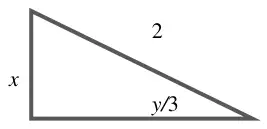
\(\sin\left(\dfrac{y}{3}\right)=\dfrac{x}{2}\Rightarrow\cos\left(\dfrac{y}{3}\right)=\dfrac{\sqrt{4-x^2}}{2}\)
Candidates who write \(\dfrac{\mathrm{d}y}{\mathrm{d}x}=\dfrac{3}{2\cos\left(\arcsin\left(\frac{x}{2}\right)\right)}\) do not score the mark.
BUT \(\dfrac{\mathrm{d}y}{\mathrm{d}x}=\dfrac{3}{2\sqrt{1-\sin^2\left(\arcsin\left(\frac{x}{2}\right)\right)}}\) does score M1 as they clearly use a correct Pythagorean identity as required by the notes.
A1 \(\dfrac{\mathrm{d}y}{\mathrm{d}x}=\dfrac{3}{\sqrt{4-x^2}}\). Expression must be in its simplest form.
Do not accept \(\dfrac{\mathrm{d}y}{\mathrm{d}x}=\dfrac{3}{2\sqrt{1-\frac{1}{4}x^2}}\) or \(\dfrac{\mathrm{d}y}{\mathrm{d}x}=\dfrac{1}{\frac{1}{3}\sqrt{4-x^2}}\) for the final A1
Alt 5(c)
| Scheme | Marks |
|---|---|
| \(y=3\arcsin\left(\dfrac{x}{2}\right)\Rightarrow\dfrac{\mathrm{d}y}{\mathrm{d}x}=\dfrac{3}{\sqrt{1-\left(\frac{x}{2}\right)^2}}\times\dfrac{1}{2}\) | M1dM1A1 |
| \(\dfrac{\mathrm{d}y}{\mathrm{d}x}=\dfrac{3}{\sqrt{4-x^2}}\) | A1 |
| (4) |
M1 Rearranging to \(y=A\arcsin Bx\) and differentiating to \(\dfrac{\mathrm{d}y}{\mathrm{d}x}=\dfrac{A}{\sqrt{1-Bx^2}}\)
dM1 As above, but form of the rhs must be correct \(\dfrac{\mathrm{d}y}{\mathrm{d}x}=\dfrac{C}{\sqrt{1-\left(\frac{x}{2}\right)^2}}\)
A1 Correct but un simplified answer