
C3 June 2007 Q5
5. The functions f and g are defined by\[\mathrm{f} : x \mapsto \ln(2x - 1), \qquad x \in \mathbb{R},\ x > \frac{1}{2},\]\[\mathrm{g} : x \mapsto \frac{2}{x - 3}, \qquad x \in \mathbb{R},\ x \neq 3.\]
(a) Find the exact value of \(\mathrm{fg}(4)\). (2)
(b) Find the inverse function \(\mathrm{f}^{-1}(x)\), stating its domain. (4)
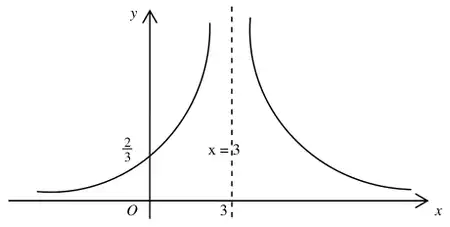
(c) Sketch the graph of \(y = |\mathrm{g}(x)|\). Indicate clearly the equation of the vertical asymptote and the coordinates of the point at which the graph crosses the \(y\)-axis. (3)
(d) Find the exact values of \(x\) for which \(\left|\dfrac{2}{x - 3}\right| = 3\). (3)
| Scheme | Marks |
|---|---|
| Finding \(\mathrm{g}(4) = k\) and \(\mathrm{f}(k) = \ldots\) or \(\mathrm{fg}(x) = \ln\left(\dfrac{4}{x - 3} - 1\right)\) | M1 |
| \([\ \mathrm{f}(2) = \ln(2\times 2 - 1)\) \(\mathrm{fg}(4) = \ln(4 - 1)\ ]\) \(= \ln 3\) | A1 |
| (2) |
| Scheme | Marks |
|---|---|
| \(y = \ln(2x - 1) \Rightarrow \mathrm{e}^y = 2x - 1\) or \(e^x = 2y - 1\) | M1, A1 |
| \(\mathrm{f}^{-1}(x) = \tfrac{1}{2}(\mathrm{e}^x + 1)\) Allow \(y = \tfrac{1}{2}(\mathrm{e}^x + 1)\) | A1 |
| Domain \(x \in \mathbb{R}\) [Allow \(\mathbb{R}\), all reals, \((-\infty, \infty)\)] independent | B1 |
| (4) |
| Scheme | Marks |
|---|---|
| Shape, and \(x\)-axis should appear to be asymptote | B1 |
| Equation \(x = 3\) needed, may see in diagram (ignore others) | B1 ind. |
| Intercept \((0, \tfrac{2}{3})\) no other; accept \(y = \tfrac{2}{3}\) (0.67) or on graph | B1 ind |
| (3) |
| Scheme | Marks |
|---|---|
| \(\dfrac{2}{x - 3} = 3 \Rightarrow x = 3\tfrac{2}{3}\) or exact equiv. | B1 |
| \(\dfrac{2}{x - 3} = -3\), \(\Rightarrow x = 2\tfrac{1}{3}\) or exact equiv. | M1, A1 |
| Note: \(2 = 3(x + 3)\) or \(2 = 3(-x - 3)\) o.e. is M0A0 | |
| (3) | |
| (12 marks) |
Notes
Alt: Squaring to quadratic \((9x^2 - 54x + 77 = 0)\) and solving M1; B1A1