
C3 January 2007 Q6
6. The function f is defined by\[\mathrm{f} : x \mapsto \ln(4 - 2x), \quad x \lt 2 \text{ and } x \in \mathbb{R}.\]
(a) Show that the inverse function of f is defined by\[\mathrm{f}^{-1} : x \mapsto 2 - \frac{1}{2}\mathrm{e}^x\]and write down the domain of \(\mathrm{f}^{-1}\). (4)
(b) Write down the range of \(\mathrm{f}^{-1}\). (1)
(c) In the space provided, sketch the graph of \(y = \mathrm{f}^{-1}(x)\). State the coordinates of the points of intersection with the \(x\) and \(y\) axes. (4)
The graph of \(y = x + 2\) crosses the graph of \(y = \mathrm{f}^{-1}(x)\) at \(x = k\).
The iterative formula\[x_{n+1} = -\frac{1}{2}\mathrm{e}^{x_n}, \quad x_0 = -0.3\]is used to find an approximate value for \(k\).
(d) Calculate the values of \(x_1\) and \(x_2\), giving your answers to 4 decimal places. (2)
(e) Find the value of \(k\) to 3 decimal places. (2)
| Scheme | Marks |
|---|---|
| \(y = \ln(4 - 2x)\) | |
| \(\mathrm{e}^y = 4 - 2x\) leading to \(x = 2 - \dfrac{1}{2}\mathrm{e}^y\) Changing subject and removing ln | M1 A1 |
| \(y = 2 - \dfrac{1}{2}\mathrm{e}^x \Rightarrow \mathrm{f}^{-1} \mapsto 2 - \dfrac{1}{2}\mathrm{e}^x\) * cso | A1 |
| Domain of \(\mathrm{f}^{-1}\) is \(\mathbb{R}\) | B1 |
| (4) |
Notes
(corrected from the printed mark scheme: the symbol \(\mathbb{R}\) is missing after “Domain of \(\mathrm{f}^{-1}\) is” and after “\(\mathrm{f}^{-1}(x) \in\)” in (b))
| Scheme | Marks |
|---|---|
| Range of \(\mathrm{f}^{-1}\) is \(\mathrm{f}^{-1}(x) \lt 2\) (and \(\mathrm{f}^{-1}(x) \in \mathbb{R}\)) | B1 |
| (1) |
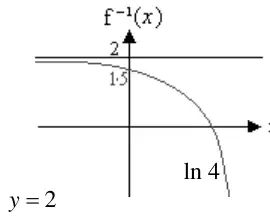
| Scheme | Marks |
|---|---|
| Shape | B1 |
| 1.5 | B1 |
| \(\ln 4\) | B1 |
| \(y = 2\) | B1 |
| (4) |
| Scheme | Marks |
|---|---|
| \(x_1 \approx -0.3704,\quad x_2 \approx -0.3452\) cao | B1, B1 |
| (2) |
Notes
If more than 4 dp given in this part a maximum on one mark is lost. Penalise on the first occasion.
| Scheme | Marks |
|---|---|
| \(x_3 = -0.354\,030\,19\ldots\) \(x_4 = -0.350\,926\,88\ldots\) \(x_5 = -0.352\,017\,61\ldots\) \(x_6 = -0.351\,633\,86\ldots\) Calculating to at least \(x_6\) to at least four dp | M1 |
| \(k \approx -0.352\) cao | A1 |
| (2) | |
| (13 marks) |
Alternative to (e)
| \(k \approx -0.352\) Found in any way Let \(\mathrm{g}(x) = x + \dfrac{1}{2}\mathrm{e}^x\) \(\mathrm{g}(-0.3515) \approx +0.0003,\quad \mathrm{g}(-0.3525) \approx -0.001\) | M1 |
| Change of sign (and continuity) \(\Rightarrow k \in (-0.3525, -0.3515)\) \(\Rightarrow k = -0.352\) (to 3 dp) | A1 (2) |