
AS June 2018 Q3
3.
| Activity | Time taken (days) | Immediately preceding activities |
|---|---|---|
| A | 5 | – |
| B | 8 | – |
| C | 4 | – |
| D | 14 | A |
| E | 10 | A |
| F | 3 | B, C, E |
| G | 7 | C |
| H | 5 | D, F, G |
| I | 7 | H |
| J | 9 | H |
The table above shows the activities required for the completion of a building project. For each activity, the table shows the time it takes, in days, and the immediately preceding activities. Each activity requires one worker. The project is to be completed in the shortest possible time.
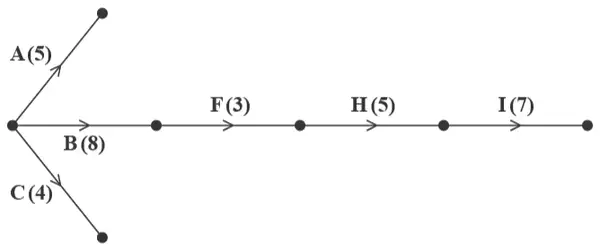
Figure 2 shows a partially completed activity network used to model the project. The activities are represented by the arcs and the number in brackets on each arc is the time taken, in days, to complete the corresponding activity.
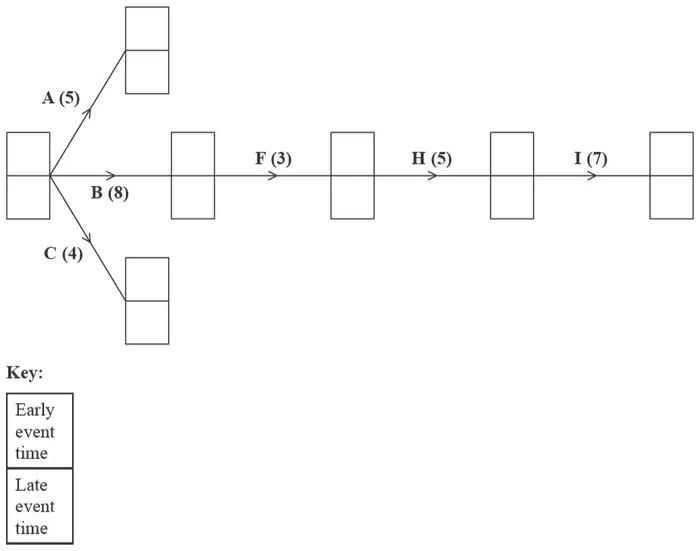
At the beginning of the project it is decided that activity G is no longer required.
| Scheme | Marks | AO |
|---|---|---|
 | M1 A1 A1 | 1.1b 1.1b 1.1b |
| (3) |
Notes
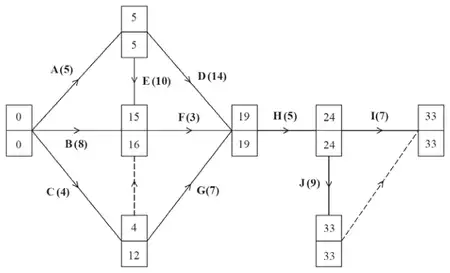
M1: Any three activities of D, E, G, J added together with at least one dummy
A1: D, E, G and first dummy added correctly (with arrows) i.e. first part of the network correct
A1: J and second dummy added correctly (with arrows) i.e. second part of the network correct
SC: If M1A0A0 but only error is any missing arrows then award M1A1A0
SC: Award M1A1A0 for a ‘correct’ diagram with more than two dummies
| Scheme | Marks | AO |
|---|---|---|
| M1 M1 A1 | 1.1b 1.1b 1.1b |
| (3) |
Notes
(The mark scheme gives one diagram for (a) and (b) together.)
M1: All top boxes complete, numbers increasing in the direction of the arrows – dependent on all four activities D, E, G, J added (bod if not labelled) – condone lack of additional event node for J
M1: All bottom boxes complete, numbers decreasing in the opposite direction of the arrows – dependent on all four activities D, E, G, J added (bod if not labelled) – condone lack of additional event node for J
A1: Cso (including diagram) - must contain exactly 8 early and late event times and only two correct dummies placed with one finish – note that some candidates may start with e.g. a dummy at the event before the start of activity I which will affect their early and late event times at this node (both values should be 24))
| Scheme | Marks | AO |
|---|---|---|
| The critical activities are A, D, H and J | B1 | 1.1b |
| (1) |
Notes
B1: Cao (A, D, H and J)
| Scheme | Marks | AO |
|---|---|---|
| (i) No effect (as G is not one of the critical activities) | B1 | 2.4 |
| (ii) Activity C is the only affected activity and it can now start 4 days later at time 12 (rather than at time 8) or finish as late as time 16 | M1 A1 | 3.4 1.1b |
| (3) | ||
| (10 marks) |
Notes
(d)(i) B1: Explanation that there is no effect on the completion time (as G is not critical)
(d)(ii) M1: Use their model to deduce that C is the (only) activity that is affected
A1: Correct answer that activity C (only – maybe implicit) can e.g. finish at time 16 or start at time 12 – for this mark the explanation must give a relevant time