
AS June 2019 Q3
3.
| Activity | Immediately preceding activities |
|---|---|
| A | - |
| B | - |
| C | A |
| D | A |
| E | A |
| F | B, C |
| G | B, C |
| H | D |
| I | D, E, F, G |
| J | D, E, F, G |
| K | G |
Every activity shown in the precedence table has the same duration.
| Scheme | Marks | AO |
|---|---|---|
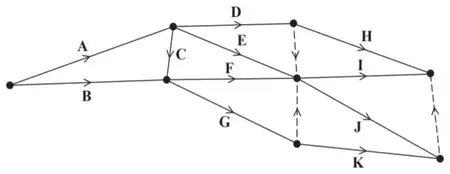 | M1 A1 A1 A1 A1 | 1.1b 1.1b 1.1b 1.1b 1.1b |
| (5) |
Notes
In (a) condone lack of, or incorrect, numbered events throughout. ‘Dealt with correctly’ means that the activity starts from the correct event but need not necessarily finishes at the correct event, e.g. ‘G dealt with correctly’ requires the correct precedences for this activity, i.e. B and C labelled correctly and leading into the same node and G starting from that node but do not consider the end node for G. Activity on node is M0
If an arc is not labelled, for example, if the arc for activity G is not labelled (but the arc is present) then this will lose the first A mark and the final (CSO) A mark – they can still earn the second A mark on the bod. If two or more arcs are not labelled then mark according to the scheme. Assume that a solid line is an activity which has not been labelled rather than a dummy (even if in the corrct place for where a dummy should be)
M1: At least eight activities (labelled on arc), one start, and at least two dummies placed
A1: Activities A – G dealt with correctly (bod if no arrow on activity C)
A1: First two required dummies + arrows dealt with correctly
A1: Activities H – K dealt with correctly (A0 if no arrows on preceding dummies (oe))
A1: CSO – Final required dummy + all arrows present and correctly placed with one finish and no additional dummies. Note that the arrow for the final dummy could be reversed. Note that there are several correct viable positions for the final dummy
Note that additional (but unecessary) ‘correct’ dummies that still maintain precedence for the network should only be penalised with the final A mark if earned
| Scheme | Marks | AO |
|---|---|---|
| Activity F (and/or G) requires activity B and the two activities A and C to be completed before F (and/or G) can begin. The time to complete A and C is double that of B and so B can be delayed waiting for A and C to be completed and so B is therefore not critical. | B1 | 2.4 |
| (1) |
Notes
B1: CAO - some mention of the time required to complete A + C compared with B (for the next activity to begin (either F and/or G)) oe e.g. paths through B have a maximum length of 3 (non-dummy) activities and there is at least one path of length 4 which does not include B so B cannot be critical OR the late time for B must be the same as the late time for A + C which is twice the duration of B and therefore B is not critical. Give bod to responses that imply that B and C meet at the same event, but C is also dependent on A (the key point for awarding this mark is that activities A and C imply that B is not critical)
| Scheme | Marks | AO |
|---|---|---|
| Activities D, E and H | B1 | 2.2a |
| (1) | ||
| (7 marks) |
Notes
B1: All three correct with no extras (ignore any mention of activity B)