
D1 June 2019 Q7
7.
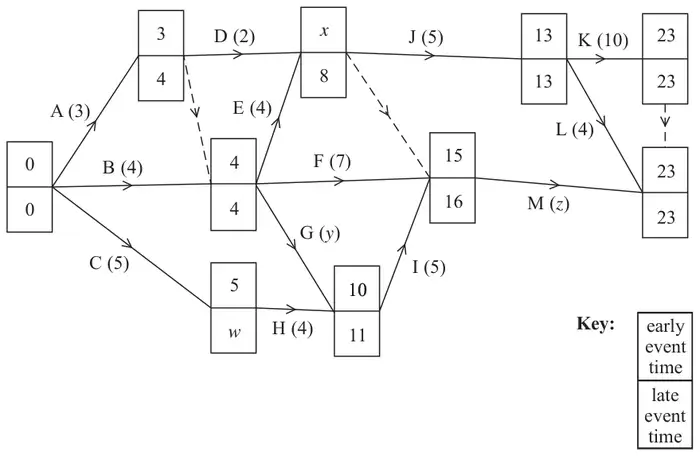
The network in Figure 5 shows the activities that need to be undertaken in order to complete a project. Each activity is represented by an arc. The number in brackets is the duration of the activity in hours. The early event times and late event times are shown at each node. The project can be completed in 23 hours.
Given that the total float on activity G is 1 hour,
This project is being completed by a company that has only two permanent workers available. The project must be completed in 23 hours and, in order to achieve this, the company is prepared to hire additional workers at a cost of £35 per hour payable only for the time that the workers are engaged in activities. The company wishes to minimise the money spent on additional workers. Any worker can undertake any activity and each activity requires only one worker. Once an activity has been started it must be completed without interruption and by the same worker.
Due to bad weather, activity H may take 7 hours to complete.
| Scheme | Marks |
|---|---|
| \(w = 7,\ x = 8,\ y = 6,\ z = 7\) | B4,3,2,1,0 |
| (4) |
Notes
a1B1: One value correct
a2B1: Two values correct
a3B1: Three values correct
a4B1: All four values correct (check carefully for answers written on the diagram rather than on the given answer lines)
| Scheme | Marks |
|---|---|
| The dummy is required as J relies on D and E but M relies on D, E, F and I | B1 |
| (1) |
Notes
b1B1: Correct answer regarding precedence – must mention J, M and one of D and E and one of F and I
| Scheme | Marks |
|---|---|
| Critical activities: B, E, J and K | B1 |
| (1) |
Notes
c1B1: CAO (B, E, J, K)
| Scheme | Marks |
|---|---|
| e.g. \(\dfrac{53 + y + z}{23} = \dfrac{66}{23} = 2.869\ldots\) so at least three workers are required | B1 |
| (1) |
Notes
d1B1: Correct calculation or argument with the correct values of \(y\) and \(z\). Other equivalent answers with regards to scheduling are acceptable (e.g. with only two workers the minimum completion time for the project is 33 hours or at time 2.5 activities A, B and C must be taking place (in situations like this detail of both activities and time must be given))
| Scheme | Marks |
|---|---|
e.g.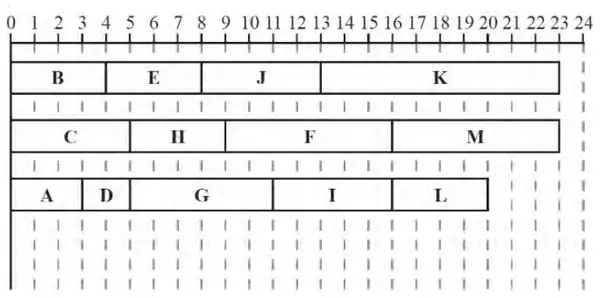 | M1 A1 A1 |
| (3) |
Notes
e1M1: Not a cascade chart. 4 ‘workers’ used at most and at least 9 activities placed
e1A1: 3 workers. All 13 activities present (just once). Condone at most two errors. An activity can give rise to at most three errors; one on duration, one on time interval and only one on IPA
e2A1: 3 workers. All 13 activities present (just once). No errors
| Activity | Duration | Time interval | IPA |
|---|---|---|---|
| A | 3 | 0 - 4 | - |
| B | 4 | 0 – 4 | - |
| C | 5 | 0 – 7 | - |
| D | 2 | 3 – 8 | A |
| E | 4 | 4 – 8 | A, B |
| F | 7 | 4 – 16 | A, B |
| G | 6 | 4 – 11 | A, B |
| H | 4 | 5 – 11 | C |
| I | 5 | 10 – 16 | G, H |
| J | 5 | 8 – 13 | D, E |
| K | 10 | 13 – 23 | J |
| L | 4 | 13 – 23 | J |
| M | 7 | 15 – 23 | D, E, F, I |
| Scheme | Marks |
|---|---|
| \(35 \times \left(\sum \text{activities completed by additional worker(s)}\right)\) | M1 |
| £700 | A1 |
| (2) |
Notes
f1M1: Correct calculation (so cost of one or more additional workers only) for their schedule – dependent on scheduling at least 12 activities in (e) – M0 if attempted cost of the two permanent workers is included
f1A1: CAO (their schedule must have had two workers working continuously from 0 to 23) – condone lack of units (but not incorrect units)
| Scheme | Marks |
|---|---|
| H requiring 7 hours will delay the completion of the project because the total float on activity H is 2 hours and so the project will be delayed by 1 hour | M1 A1 |
| (2) | |
| 14 marks |
Notes
g1M1: Delayed together with some mention of time and/or float for activity H
g1A1: Project delayed by 1 hour (oe e.g. minimum completion time is now 24) - just mentioning that the total float for activity H is 2 (or that H cannot be completed on time) is A0. Give bod that ‘a delay of 1 hour’ is considering the entire project but A0 if clearly only talking about activities