
October 2020 Paper 1 Q9
9.
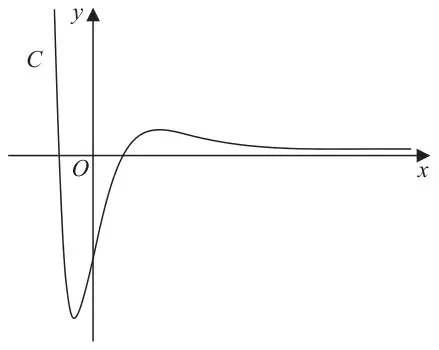
Figure 2 shows a sketch of the curve \(C\) with equation \(y = \mathrm{f}(x)\) where\[\mathrm{f}(x) = 4\left(x^2 - 2\right)\mathrm{e}^{-2x} \qquad x \in \mathbb{R}\]
The function g and the function h are defined by\[\begin{aligned} \mathrm{g}(x) &= 2\mathrm{f}(x) && x \in \mathbb{R} \\ \mathrm{h}(x) &= 2\mathrm{f}(x) - 3 && x \geqslant 0 \end{aligned}\]
| Scheme | Marks | AO |
|---|---|---|
| \(\mathrm{f}(x) = 4\left(x^2 - 2\right)\mathrm{e}^{-2x}\) | ||
| Differentiates to \(\mathrm{e}^{-2x} \times 8x + 4\left(x^2 - 2\right) \times -2\mathrm{e}^{-2x}\) | M1 A1 | 1.1b 1.1b |
| \(\mathrm{f}^{\prime}(x) = 8\mathrm{e}^{-2x}\left\{x - \left(x^2 - 2\right)\right\} = 8\left(2 + x - x^2\right)\mathrm{e}^{-2x}\) * | A1* | 2.1 |
| (3) |
Notes
M1: Attempts the product rule and uses \(\mathrm{e}^{-2x} \to k\mathrm{e}^{-2x},\quad k \neq 0\)
If candidate states \(u = 4(x^2 - 2), v = \mathrm{e}^{-2x}\) with \(u^{\prime} = \ldots, v^{\prime} = \ldots\mathrm{e}^{-2x}\) it can be implied by their \(vu^{\prime} + uv^{\prime}\)
If they just write down an answer without working award for \(\mathrm{f}^{\prime}(x) = px\mathrm{e}^{-2x} \pm q\left(x^2 - 2\right)\mathrm{e}^{-2x}\)
They may multiply out first \(\mathrm{f}(x) = 4x^2\mathrm{e}^{-2x} - 8\mathrm{e}^{-2x}\). Apply in the same way condoning slips
Alternatively attempts the quotient rule on \(\mathrm{f}(x) = \dfrac{u}{v} = \dfrac{4\left(x^2 - 2\right)}{\mathrm{e}^{2x}}\) with \(v^{\prime} = k\mathrm{e}^{2x}\) and \(\mathrm{f}^{\prime}(x) = \dfrac{vu^{\prime} - uv^{\prime}}{v^2}\)
A1: A correct \(\mathrm{f}^{\prime}(x)\) which may be unsimplified.
Via the quotient rule you can award for \(\mathrm{f}^{\prime}(x) = \dfrac{8x\mathrm{e}^{2x} - 8\left(x^2 - 2\right)\mathrm{e}^{2x}}{\mathrm{e}^{4x}}\) o.e.
A1*: Proceeds correctly to given answer showing all necessary steps.
The \(\mathrm{f}^{\prime}(x)\) or \(\dfrac{\mathrm{d}y}{\mathrm{d}x}\) must be present at some point in the solution
This is a "show that" question and there must not be any errors. All bracketing must be correct.
Allow a candidate to move from the simplified unfactorised answer of \(\mathrm{f}^{\prime}(x) = 8x\mathrm{e}^{-2x} - 8\left(x^2 - 2\right)\mathrm{e}^{-2x}\) to the given answer in one step.
Do not allow it from an unsimplified \(\mathrm{f}^{\prime}(x) = 4 \times 2x\mathrm{e}^{-2x} + 4\left(x^2 - 2\right) \times -2\mathrm{e}^{-2x}\)
Allow the expression / bracketed expression to be written in a different order.
So, for example, \(8\left(x - x^2 + 2\right)\mathrm{e}^{-2x}\) is OK
| Scheme | Marks | AO |
|---|---|---|
| States roots of \(\mathrm{f}^{\prime}(x) = 0\) \(x = -1, 2\) | B1 | 1.1b |
| Substitutes one \(x\) value to find a \(y\) value | M1 | 1.1b |
| Stationary points are \(\left(-1, -4\mathrm{e}^{2}\right)\) and \(\left(2, 8\mathrm{e}^{-4}\right)\) | A1 | 1.1b |
| (3) |
Notes
B1: States or implies \(x = -1, 2\) (as the roots of \(\mathrm{f}^{\prime}(x) = 0\))
M1: Substitutes one \(x\) value of their solution to \(\mathrm{f}^{\prime}(x) = 0\) in \(\mathrm{f}(x)\) to find a \(y\) value.
Allow decimals here (3sf). FYI, to 3 sf, \(-4\mathrm{e}^{2} = -29.6\) and \(8\mathrm{e}^{-4} = 0.147\)
Some candidates just write down the \(x\) coordinates but then go on in part (c) to find the ranges using the \(y\) coordinates. Allow this mark to be scored from work in part (c)
A1: Obtains \(\left(-1, -4\mathrm{e}^{2}\right)\) and \(\left(2, 8\mathrm{e}^{-4}\right)\) as the stationary points. This must be scored in (b). Remember to isw after a correct answer. Allow these to be written separately. E.g. \(x = -1,\ y = -4\mathrm{e}^{2}\)
Extra solutions, e.g. from \(x = 0\) will be penalised on this mark.
| Scheme | Marks | AO |
|---|---|---|
| (i) Range \(\left[-8\mathrm{e}^{2}, \infty\right)\) o.e. such as \(\mathrm{g}(x) \geqslant -8\mathrm{e}^{2}\) | B1ft | 2.5 |
(ii) For
| M1 | 3.1a |
| Range \(\left[-19, 16\mathrm{e}^{-4} - 3\right]\) | A1 | 1.1b |
| (3) | ||
| (9 marks) |
Notes
(c)(i) B1ft: For a correct range written using correct notation.
Follow through on 2 \(\times\) their minimum "\(y\)" value from part (b), providing it is negative.
Condone a decimal answer if this is consistent with their answer in (b) to 3sf or better.
Examples of correct responses are \(\left[-8\mathrm{e}^{2}, \infty\right),\ \mathrm{g} \geqslant -8\mathrm{e}^{2},\ \ y \geqslant -8\mathrm{e}^{2},\ \left\{q \in \mathbb{R}, q \geqslant -8\mathrm{e}^{2}\right\}\)
(c)(ii) M1: See main scheme. Follow through on \(2 \times\) their "\(8\mathrm{e}^{-4}\)" \(- 3\) for the upper bound.
A1: Range \(\left[-19, 16\mathrm{e}^{-4} - 3\right]\) o.e. such as \(-19 \leqslant y \leqslant 16\mathrm{e}^{-4} - 3\) but must be exact