
June 2024 Paper 2 Q6
6.
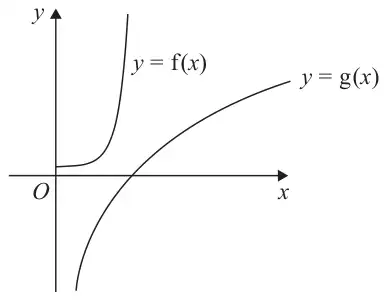
Figure 1 shows a sketch of the curves with equations \(y = \mathrm{f}(x)\) and \(y = \mathrm{g}(x)\) where
\[\begin{aligned}&\mathrm{f}(x) = \mathrm{e}^{4x^2-1} &&\qquad x \gt 0\\&\mathrm{g}(x) = 8\ln x &&\qquad x \gt 0\end{aligned}\]Given that \(\mathrm{f}^{\prime}(x) = \mathrm{g}^{\prime}(x)\) at \(x = \alpha\)
The iterative formula
\[x_{n+1} = \sqrt{\frac{1 - 2\ln x_n}{4}}\]is used with \(x_1 = 0.6\) to find an approximate value for \(\alpha\)
| Scheme | Marks | AO |
|---|---|---|
| (i) \(\left(\mathrm{f}^{\prime}(x) =\right) 8x\mathrm{e}^{4x^2-1}\) or e.g. \(\dfrac{8x\mathrm{e}^{4x^2}}{\mathrm{e}}\) oe | B1 | 1.1b |
| (ii) \(\left(\mathrm{g}^{\prime}(x) =\right) \dfrac{8}{x}\) or e.g. \(8x^{-1}\) oe | B1 | 1.2 |
| (2) |
Notes
(a)(i)
B1: Correct derivative in any form. "\(\mathrm{f}^{\prime}(x) =\)" is not required. Apply isw if necessary.
(ii)
B1: Correct derivative in any form. "\(\mathrm{g}^{\prime}(x) =\)" is not required. Apply isw if necessary.
| Scheme | Marks | AO |
|---|---|---|
| \(8x\mathrm{e}^{4x^2-1} = \dfrac{8}{x} \Rightarrow \mathrm{e}^{4x^2-1} = \dfrac{1}{x^2} \Rightarrow 4x^2 - 1 = \ln\dfrac{1}{x^2}\) | M1 | 1.1b |
| \(4x^2 - 1 = \ln\dfrac{1}{x^2} \Rightarrow 4x^2 - 1 = -2\ln x\) \(\Rightarrow 4x^2 + 2\ln x - 1 = 0\ *\) | A1* | 2.1 |
| (2) |
Notes
M1: Eliminates e by setting their \(\mathrm{f}^{\prime}(x) =\) their \(\mathrm{g}^{\prime}(x)\) where \(\mathrm{f}^{\prime}(x) = Ax\mathrm{e}^{4x^2-1}\) oe and \(\mathrm{g}^{\prime}(x) = \dfrac{B}{x}\) oe with \(A \times B \gt 0\) and proceeds via \(\mathrm{e}^{4x^2-1} = \dfrac{\ldots}{x^2}\) or equivalent work (see below) to obtain \(4x^2 - 1 = \ln\dfrac{\ldots}{x^2}\) oe e.g. \(\ln x + 4x^2 - 1 = \ln\dfrac{1}{x}\)
Allow if they use \(\alpha\) for \(x\).
Note that there are various alternatives for this mark but the derivatives must be of the form defined above and the processing must be correct with coefficient/sign slips only.
Examples of equivalent work:
\[8x\mathrm{e}^{4x^2-1} = \frac{8}{x} \Rightarrow x^2\mathrm{e}^{4x^2-1} = 1 \Rightarrow \ln x^2 + \ln\mathrm{e}^{4x^2-1} = 0 \Rightarrow \ln\mathrm{e}^{4x^2-1} = -\ln x^2 \Rightarrow 4x^2 - 1 = -2\ln x\]\[\frac{8x\mathrm{e}^{4x^2}}{\mathrm{e}} = \frac{8}{x} \Rightarrow \frac{1}{\mathrm{e}}\mathrm{e}^{4x^2} = \frac{1}{x^2} \Rightarrow \mathrm{e}^{4x^2} = \frac{\mathrm{e}}{x^2} \Rightarrow \ln\mathrm{e}^{4x^2} = \ln\frac{\mathrm{e}}{x^2} \Rightarrow 4x^2 = \ln\frac{\mathrm{e}}{x^2} = 1 - 2\ln x\]A1*: Obtains the printed answer with sufficient working and no errors.
Sufficient work would require the “e” eliminated before the given answer.
Must follow correct derivatives in part (a).
Condone \(4x^2 + 2\ln|x| - 1 = 0\) and condone \(4\alpha^2 + 2\ln\alpha - 1 = 0\) or \(4\alpha^2 + 2\ln|\alpha| - 1 = 0\)
Note that if both derivatives in (a) are correct we will allow fully correct work using the equation in (b) to work backwards to verify that \(p\mathrm{f}^{\prime}(x) = q\mathrm{g}^{\prime}(x)\) for M1 then obtains \(\mathrm{f}^{\prime}(x) = \mathrm{g}^{\prime}(x)\) with a minimal conclusion for A1
If either derivative in (a) is incorrect or missing, candidates who work backwards score no marks in (b).
| Scheme | Marks | AO |
|---|---|---|
| (i) \(x_1 = 0.6 \Rightarrow x_2 = \sqrt{\dfrac{1 - 2\ln 0.6}{4}}\) | M1 | 1.1b |
| \((x_2 =)\ 0.7109\) | A1 | 1.1b |
| (ii) \((\alpha =)\ 0.6706\) | B1 (A1 on ePEN) | 1.1b |
| (3) | ||
| (7 marks) |
Notes
(c)(i)/(ii)
M1: Attempts to use the iterative formula with \(x_1 = 0.6\)
Award this mark for e.g. \((x_2 =)\sqrt{\dfrac{1 - 2\ln 0.6}{4}}\) or may be implied by awrt 0.71 provided no incorrect working is seen.
Candidates sometimes find \(x_3\) (or possibly subsequent terms) rather than \(x_2\) in which case the M1 can be implied. (See table below for first few iterations)
A1: \((x_2 =)\) awrt 0.7109
Sight of \((x_2 =)\) awrt 0.7109 scores M1A1
B1(A1 on ePEN): \((\alpha =)\) 0.6706 (4dp)
Must be this value and not awrt 0.6706
For reference:
| \(x_1\) | 0.6 |
| \(x_2\) | 0.7109239143 |
| \(x_3\) | 0.6485329086 |
| \(x_4\) | 0.6830236199 |
| \(x_5\) | 0.6637868021 |
| \(x_6\) | 0.6744606223 |
| \(\vdots\) | \(\vdots\) |
| \(\alpha\) | 0.6706416243 |