
June 2022 Paper 1 Q9
9.
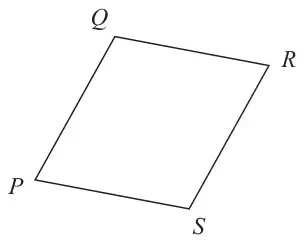
Figure 3 shows a sketch of a parallelogram \(PQRS\).
Given that
- \(\overrightarrow{PQ} = 2\mathbf{i} + 3\mathbf{j} - 4\mathbf{k}\)
- \(\overrightarrow{QR} = 5\mathbf{i} - 2\mathbf{k}\)
| Scheme | Marks | AO |
|---|---|---|
| Attempts both \(\left|\overrightarrow{PQ}\right| = \sqrt{2^2 + 3^2 + (-4)^2}\) and \(\left|\overrightarrow{QR}\right| = \sqrt{5^2 + (-2)^2}\) | M1 | 3.1a |
| States that \(\left|\overrightarrow{PQ}\right| = \left|\overrightarrow{QR}\right| = \sqrt{29}\) so \(PQRS\) is a rhombus | A1 | 2.4 |
| (2) |
Notes
(a) Do not award marks in part (a) from work in part (b).
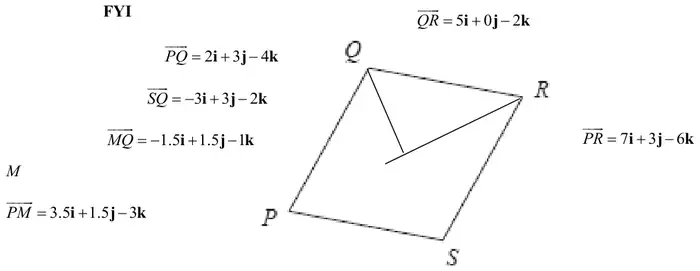
M1: Attempts both \(\left|\overrightarrow{PQ}\right| = \sqrt{2^2 + 3^2 + (\pm 4)^2}\) and \(\left|\overrightarrow{QR}\right| = \sqrt{5^2 + (\pm 2)^2}\) or \(PQ^2\) and \(QR^2\). For this mark only, condone just the correct answers \(\left|\overrightarrow{PQ}\right| = \sqrt{29}\) and \(\left|\overrightarrow{QR}\right| = \sqrt{29}\). Alternatively attempts \(\overrightarrow{PR} \bullet \overrightarrow{QS}\) or \(PM^2,\ MQ^2\) and \(PQ^2\) where \(M\) is the mid point of \(PR\)
A1: Shows that \(\left|\overrightarrow{PQ}\right| = \left|\overrightarrow{QR}\right| = \sqrt{29}\) (with calculations) and states \(PQRS\) is a rhombus.
Condone poor notation such as \(\overrightarrow{PQ} = \sqrt{29}\) here, So \(\overrightarrow{PQ} = \overrightarrow{QR} = \sqrt{29}\) hence rhombus.
Requires both a reason and a conclusion. The reason may be given at the start of their solution.
In the alternatives \(\overrightarrow{PR} \bullet \overrightarrow{QS} = (7\mathbf{i} + 3\mathbf{j} - 6\mathbf{k}) \bullet (3\mathbf{i} - 3\mathbf{j} + 2\mathbf{k}) = 21 - 9 - 12 = 0\) so diagonals cross at \(90^\circ\) so \(PQRS\) is a rhombus or \(PM^2 + MQ^2 = PQ^2 = 23.5 + 5.5 = 29 \Rightarrow \angle PMQ = 90^\circ \Rightarrow\) Rhombus
| Scheme | Marks | AO |
|---|---|---|
| Attempts BOTH \(\overrightarrow{PR} = \overrightarrow{PQ} + \overrightarrow{QR} = 7\mathbf{i} + 3\mathbf{j} - 6\mathbf{k}\) AND \(\overrightarrow{QS} = -\overrightarrow{PQ} + \overrightarrow{PS} = 3\mathbf{i} - 3\mathbf{j} + 2\mathbf{k}\) | M1 | 3.1a |
| Correct \(\overrightarrow{PR} = 7\mathbf{i} + 3\mathbf{j} - 6\mathbf{k}\) and \(\overrightarrow{QS} = 3\mathbf{i} - 3\mathbf{j} + 2\mathbf{k}\) | A1 | 1.1b |
| Correct method for area \(PQRS\). E.g. \(\dfrac{1}{2} \times \left|\overrightarrow{PR}\right| \times \left|\overrightarrow{QS}\right|\) | dM1 | 2.1 |
| \(= \sqrt{517}\) | A1 | 1.1b |
| (4) | ||
| (6 marks) |
Notes
Alt (b) Example using the cosine rule
| Scheme | Marks | AO |
|---|---|---|
| Attempts \(\left|\overrightarrow{QS}\right| = \sqrt{3^2 + (-3)^2 + 2^2} = \sqrt{22}\) and so \(22 = 29 + 29 - 2\sqrt{29}\sqrt{29}\cos SPQ\) | M1 | 3.1a |
| \(\cos PQR = -\dfrac{18}{29}\) or \(\cos SPQ = \dfrac{18}{29}\) Condone angles in degrees 51.6, 128.4 (1dp) or radians 2.24, 0.901 (3sf) here | A1 | 1.1b |
| Correct method for area \(PQRS\). E.g. \(PQ \times QR\sin PQR = \sqrt{2^2 + 3^2 + (-4)^2} \times \sqrt{5^2 + (-2)^2} \times \dfrac{\sqrt{517}}{29}\) | dM1 | 2.1 |
| \(= \sqrt{517}\) | A1 | 1.1b |
| (4) |
(b) Candidates can transfer answers from (a) to use in part (b) to find the area
Look through their complete solution first. The first two marks are for finding the elements that are required to calculate the area. The second set of two marks is for combining these elements correctly. If the method is NOT shown on how to find vector it can be implied by two correct components. Allow as column vectors.
M1: For a key step in solving the problem. It is scored for attempting to find both key vectors.
Attempts both \(\overrightarrow{PR} = \overrightarrow{PQ} + \overrightarrow{QR} = (7\mathbf{i} + 3\mathbf{j} - 6\mathbf{k})\) AND \(\overrightarrow{QS} = -\overrightarrow{PQ} + \overrightarrow{PS} = (3\mathbf{i} - 3\mathbf{j} + 2\mathbf{k})\)
You may see \(\overrightarrow{PM} = \dfrac{1}{2}\overrightarrow{PQ} + \dfrac{1}{2}\overrightarrow{QR} = \left(\dfrac{7}{2}\mathbf{i} + \dfrac{3}{2}\mathbf{j} - 3\mathbf{k}\right)\) AND \(\overrightarrow{QM} = -\dfrac{1}{2}\overrightarrow{PQ} + \dfrac{1}{2}\overrightarrow{PS} = \left(\dfrac{3}{2}\mathbf{i} - \dfrac{3}{2}\mathbf{j} + 1\mathbf{k}\right)\)
A1: Accurately finds both key vectors whose lengths are required to solve the problem.
Score for both \(\overrightarrow{PR} = 7\mathbf{i} + 3\mathbf{j} - 6\mathbf{k}\) and \(\overrightarrow{QS} = 3\mathbf{i} - 3\mathbf{j} + 2\mathbf{k}\) (Allow either way around.)
or both \(\overrightarrow{PM} = \dfrac{7}{2}\mathbf{i} + \dfrac{3}{2}\mathbf{j} - 3\mathbf{k}\) and \(\overrightarrow{QM} = \dfrac{3}{2}\mathbf{i} - \dfrac{3}{2}\mathbf{j} + 1\mathbf{k}\) (Allow either way around.)
dM1: Constructs a rigorous method leading to the area \(PQRS\). Dependent upon previous M.
E.g. See scheme. Alt: the sum of the area of four right angled triangles e.g. \(4 \times \dfrac{1}{2} \times \left|\overrightarrow{PM}\right| \times \left|\overrightarrow{QM}\right|\),
A1: \(\sqrt{517}\)
Alternatives for (b). Two such ways are set out below
Alt 1-Examples via cosine rule but you may see use of scalar product via a Further Maths method.
M1: For a key step in solving the problem. In this case it for an attempt at \(\cos PQR\) or \(\cos SPQ\).
Don’t be too concerned with the labelling of the angle which may appear as \(\theta\).
Attempts \(\pm\begin{pmatrix}2\\3\\-4\end{pmatrix} \bullet \pm\begin{pmatrix}5\\0\\-2\end{pmatrix} = \sqrt{2^2 + 3^2 + (-4)^2} \times \sqrt{5^2 + (-2)^2}\cos PQR\)
A1: Finds the cosine of one of the angles in the Figure.
Look for \(\cos\ldots = -\dfrac{18}{29}\) or \(\cos\ldots = \dfrac{18}{29}\) which may have been achieved via the cosine rule.
Accept rounded answers and the angles in degrees 51.6, 128.4 (1dp) or radians 2.24, 0.901 (3sf) here.
dM1: Constructs a rigorous method leading to the area \(PQRS\). Implied by awrt 22.7
E.g. \(PQ \times QR\sin PQR = \sqrt{2^2 + 3^2 + (-4)^2} \times \sqrt{5^2 + (-2)^2} \times \dfrac{\sqrt{517}}{29}\)
A1: \(\sqrt{517}\)
Alt 2-Example via vector product via a Further Maths method.
M1: For a key step in solving the problem. In this case it for an attempt at \(\pm\overrightarrow{PQ} \times \overrightarrow{QR}\)
E.g. \(\overrightarrow{PQ} \times \overrightarrow{QR} = \begin{pmatrix} \mathbf{i} & \mathbf{j} & \mathbf{k} \\ 2 & 3 & -4 \\ 5 & 0 & -2 \end{pmatrix} = (3 \times -2 - 0 \times -4)\mathbf{i} - (2 \times -2 - 5 \times -4)\mathbf{j} + (2 \times 0 - 3 \times 5)\mathbf{k}\)
A1: E.g. \(\overrightarrow{PQ} \times \overrightarrow{QR} = -6\mathbf{i} - 16\mathbf{j} - 15\mathbf{k}\)
dM1: Constructs a rigorous method leading to the area \(PQRS\). In this case \(\left|\overrightarrow{PQ} \times \overrightarrow{QR}\right|\)
A1: \(= \sqrt{(-6)^2 + (-16)^2 + (-15)^2} = \sqrt{517}\)