
October 2021 Paper 1 Q6
6.
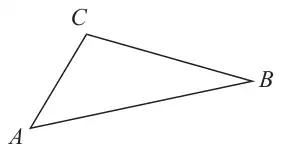
Figure 1 shows a sketch of triangle \(ABC\).
Given that
- \(\overrightarrow{AB} = -3\mathbf{i} - 4\mathbf{j} - 5\mathbf{k}\)
- \(\overrightarrow{BC} = \mathbf{i} + \mathbf{j} + 4\mathbf{k}\)
| Scheme | Marks | AO |
|---|---|---|
| \(\overrightarrow{AC} = \overrightarrow{AB} + \overrightarrow{BC} = -3\mathbf{i} - 4\mathbf{j} - 5\mathbf{k} + \mathbf{i} + \mathbf{j} + 4\mathbf{k} = \ldots\) | M1 | 1.1b |
| \(= -2\mathbf{i} - 3\mathbf{j} - \mathbf{k}\) | A1 | 1.1b |
| (2) |
Notes
M1: Attempts \(\overrightarrow{AC} = \overrightarrow{AB} + \overrightarrow{BC}\)
There must be attempt to add not subtract.
If no method shown it may be implied by two correct components
A1: Correct vector. Allow \(-2\mathbf{i} - 3\mathbf{j} - \mathbf{k}\) and \(\begin{pmatrix}-2\\-3\\-1\end{pmatrix}\) but not \(\begin{pmatrix}-2\mathbf{i}\\-3\mathbf{j}\\-1\mathbf{k}\end{pmatrix}\)
| Scheme | Marks | AO |
|---|---|---|
| At least 2 of \(\left(AC^2\right) = \text{``}2^2 + 3^2 + 1^2\text{''},\ \left(AB^2\right) = 3^2 + 4^2 + 5^2,\ \left(BC^2\right) = 1^2 + 1^2 + 4^2\) | M1 | 1.1b |
| \(2^2 + 3^2 + 1^2 = 3^2 + 4^2 + 5^2 + 1^2 + 1^2 + 4^2 - 2\sqrt{3^2 + 4^2 + 5^2}\sqrt{1^2 + 1^2 + 4^2}\cos ABC\) | M1 | 3.1a |
| \(14 = 50 + 18 - 2\sqrt{50}\sqrt{18}\cos ABC\) \(\Rightarrow \cos ABC = \dfrac{50 + 18 - 14}{2\sqrt{50}\sqrt{18}} = \dfrac{9}{10}\,*\) | A1* | 2.1 |
| (3) | ||
| (5 marks) |
Notes
M1: Attempts to "square and add" for at least 2 of the 3 sides. Follow through on their \(\overrightarrow{AC}\)
Look for an attempt at either \(a^2 + b^2 + c^2\) or \(\sqrt{a^2 + b^2 + c^2}\)
M1: A correct attempt to apply a correct cosine rule to the given problem; Condone slips on the lengths of the sides but the sides must be in the correct position to find angle \(ABC\)
A1*: Correct completion with sufficient intermediate work to establish the printed result.
Condone different labelling, e.g. \(ABC \leftrightarrow \theta\) as long as it is clear what is meant
It is OK to move from a correct cosine rule \(14 = 50 + 18 - 2\sqrt{50}\sqrt{18}\cos ABC\)
via \(\cos ABC = \dfrac{54}{2\sqrt{50}\sqrt{18}}\) o.e. such as \(\cos ABC = \dfrac{\left(5\sqrt{2}\right)^2 + \left(3\sqrt{2}\right)^2 - \left(\sqrt{14}\right)^2}{2 \times 5\sqrt{2} \times 3\sqrt{2}}\) to \(\cos ABC = \dfrac{9}{10}\)
(b) Alternative
| Scheme | Marks | AO |
|---|---|---|
| \(AB^2 = 3^2 + 4^2 + 5^2,\ BC^2 = 1^2 + 1^2 + 4^2\) | M1 | 1.1b |
| \(\overrightarrow{BA}.\overrightarrow{BC} = (3\mathbf{i} + 4\mathbf{j} + 5\mathbf{k})\bullet(\mathbf{i} + \mathbf{j} + 4\mathbf{k}) = 27 = \sqrt{3^2 + 4^2 + 5^2}\sqrt{1^2 + 1^2 + 4^2}\cos ABC\) | M1 | 3.1a |
| \(27 = \sqrt{50}\sqrt{18}\cos ABC \Rightarrow \cos ABC = \dfrac{27}{\sqrt{50}\sqrt{18}} = \dfrac{9}{10}\,*\) | A1* | 2.1 |
M1: Correct application of Pythagoras for sides \(AB\) and \(BC\) or their squares
M1: Recognises the requirement for and applies the scalar product
A1*: Correct completion with sufficient intermediate work to establish the printed result