
June 2022 Paper 2 Q13
13. Relative to a fixed origin \(O\)
- the point \(A\) has position vector \(4\mathbf{i} - 3\mathbf{j} + 5\mathbf{k}\)
- the point \(B\) has position vector \(4\mathbf{j} + 6\mathbf{k}\)
- the point \(C\) has position vector \(-16\mathbf{i} + p\mathbf{j} + 10\mathbf{k}\)
where \(p\) is a constant.
Given that \(A\), \(B\) and \(C\) lie on a straight line,
The line segment \(OB\) is extended to a point \(D\) so that \(\overrightarrow{CD}\) is parallel to \(\overrightarrow{OA}\)
| Scheme | Marks | AO |
|---|---|---|
| Attempts two of the relevant vectors \(\pm\overrightarrow{AB} = \pm(-4\mathbf{i} + 7\mathbf{j} + \mathbf{k})\) \(\pm\overrightarrow{AC} = \pm(-20\mathbf{i} + (p + 3)\mathbf{j} + 5\mathbf{k})\) \(\pm\overrightarrow{BC} = \pm(-16\mathbf{i} + (p - 4)\mathbf{j} + 4\mathbf{k})\) | M1 | 3.1a |
| Uses two of the three vectors in such a way as to find the value of \(p\). E.g. \(p + 3 = 5 \times 7\) | dM1 | 2.1 |
| \(p = 32\) | A1 | 1.1b |
| (3) |
(a) Alternative:
| Scheme | Marks | AO |
|---|---|---|
| \(\mathbf{r}_{AB} = 4\mathbf{i} - 3\mathbf{j} + 5\mathbf{k} + \lambda(-4\mathbf{i} + 7\mathbf{j} + \mathbf{k})\) | M1 | 3.1a |
| \(4\mathbf{i} - 3\mathbf{j} + 5\mathbf{k} + \lambda(-4\mathbf{i} + 7\mathbf{j} + \mathbf{k}) = -16\mathbf{i} + p\mathbf{j} + 10\mathbf{k} \Rightarrow \lambda = 5\) \(4\mathbf{i} - 3\mathbf{j} + 5\mathbf{k} + \lambda(-4\mathbf{i} + 7\mathbf{j} + \mathbf{k}) = -16\mathbf{i} + p\mathbf{j} + 10\mathbf{k} \Rightarrow p = 35 - 3\) | dM1 | 2.1 |
| \(p = 32\) | A1 | 1.1b |
Notes
M1: Attempts two of the three relevant vectors by subtracting either way around. See scheme.
Allow equivalent work e.g. \(\pm\overrightarrow{AB} = \pm\left(\overrightarrow{OB} + \overrightarrow{AO}\right)\)
If no working is shown, method can be implied by 2 correct components.
dM1: For the key step in using the fact that if the vectors are parallel, they will be multiples of each other (where the multiple is something other than 1) to find \(p\).
E.g. \(p + 3 = 5 \times 7\), \(p - 4 = \dfrac{4}{5}(p + 3)\), \(p - 4 = 4 \times 7\)
A1: \(p = 32\) (Condone \(32\mathbf{j}\))
For reference, \(\overrightarrow{BC} = 4\overrightarrow{AB}, \overrightarrow{AC} = 5\overrightarrow{AB}, \overrightarrow{BC} = \dfrac{4}{5}\overrightarrow{AC}, \overrightarrow{AC} = \dfrac{5}{4}\overrightarrow{BC}\)
Note that candidates generally only need to use 2 components to find \(p\) and if the 3rd component has errors but is not used, full marks can be awarded.
Alternative:
M1: Forms the vector equation using \(A\) or \(B\) as position and \(\pm\overrightarrow{AB}\) as the direction
dM1: For the key step in using the fact that \(C\) lies on the line to find \(p\)
A1: \(p = 32\) (Condone \(32\mathbf{j}\))
For reference, \(\overrightarrow{BC} = 4\overrightarrow{AB}, \overrightarrow{AC} = 5\overrightarrow{AB}, \overrightarrow{BC} = \dfrac{4}{5}\overrightarrow{AC}, \overrightarrow{AC} = \dfrac{5}{4}\overrightarrow{BC}\)
Note that candidates generally only need to use 2 components to find \(p\) and if the 3rd component has errors but is not used, full marks can be awarded.
There will be other approaches e.g. using “gradients” and “ratios” and the method marks can be implied – if you are unsure if such attempts deserve credit use Review
| Scheme | Marks | AO |
|---|---|---|
| Deduces that \(\overrightarrow{OD} = \lambda\overrightarrow{OB} = 4\lambda\mathbf{j} + 6\lambda\mathbf{k}\) and attempts \(\overrightarrow{CD} = 16\mathbf{i} + (4\lambda - \text{``}32\text{''})\mathbf{j} + (6\lambda - 10)\mathbf{k}\) | M1 | 3.1a |
| Correct attempt at \(\lambda\) using the fact that \(\overrightarrow{CD}\) is parallel to \(\overrightarrow{OA}\) \(\overrightarrow{CD} = 16\mathbf{i} + (4\lambda - \text{``}32\text{''})\mathbf{j} + (6\lambda - 10)\mathbf{k}\) \(\overrightarrow{OA} = 4\mathbf{i} - 3\mathbf{j} + 5\mathbf{k}\) \(4\lambda - 32 = -12 \Rightarrow \lambda = \ldots\) OR \(6\lambda - 10 = 20 \Rightarrow \lambda = \ldots\) | dM1 | 1.1b |
| \(\left\lvert\overrightarrow{OD}\right\rvert = 5 \times \sqrt{4^2 + 6^2} = 10\sqrt{13}\) | A1 | 1.1b |
| (3) | ||
| (6 marks) |
(b) Alternative:
| Scheme | Marks | AO |
|---|---|---|
| Deduces that \(\overrightarrow{OD} = \lambda\overrightarrow{OB} = 4\lambda\mathbf{j} + 6\lambda\mathbf{k}\) and attempts \(\overrightarrow{OD} = \overrightarrow{OC} + \mu\overrightarrow{OA} = -16\mathbf{i} + 32\mathbf{j} + 10\mathbf{k} + \mu(4\mathbf{i} - 3\mathbf{j} + 5\mathbf{k})\) | M1 | 3.1a |
| Correct attempt at \(\lambda\) or \(\mu\) using the fact that \(\lambda\overrightarrow{OB} = \overrightarrow{OC} + \mu\overrightarrow{OA}\) E.g. \(-16 + 4\mu = 0 \Rightarrow \mu = 4\) | dM1 | 1.1b |
| \(\left\lvert\overrightarrow{OD}\right\rvert = 5 \times \sqrt{4^2 + 6^2} = 10\sqrt{13}\) | A1 | 1.1b |
| (3) |
Notes
(b) Vector approach
M1: Deduces that \(\overrightarrow{OD} = \lambda\overrightarrow{OB} = 4\lambda\mathbf{j} + 6\lambda\mathbf{k}\) and attempts \(\overrightarrow{CD} = 16\mathbf{i} + (4\lambda - \text{``}32\text{''})\mathbf{j} + (6\lambda - 10)\mathbf{k}\)
dM1: Correct attempt at finding \(\lambda\) using the fact that \(\overrightarrow{CD}\) is parallel to \(\overrightarrow{OA}\)
E.g. \(16\mathbf{i} + (4\lambda - \text{``}32\text{''})\mathbf{j} + (6\lambda - 10)\mathbf{k} = 4\alpha\mathbf{i} - 3\alpha\mathbf{j} + 5\alpha\mathbf{k} \Rightarrow \alpha = 4 \Rightarrow 4\lambda - \text{``}32\text{''} = -3 \times \text{``}4\text{''} \Rightarrow \lambda = \ldots\)
A1: \(\left\lvert\overrightarrow{OD}\right\rvert = 10\sqrt{13}\)
Alternative:
M1: Deduces that \(\overrightarrow{OD} = \lambda\overrightarrow{OB} = 4\lambda\mathbf{j} + 6\lambda\mathbf{k}\) and attempts
\(\overrightarrow{OD} = \overrightarrow{OC} + \mu\overrightarrow{OA} = -16\mathbf{i} + 32\mathbf{j} + 10\mathbf{k} + \mu(4\mathbf{i} - 3\mathbf{j} + 5\mathbf{k})\)
dM1: Correct attempt at finding \(\lambda\) or \(\mu\) using the fact that \(\lambda\overrightarrow{OB} = \overrightarrow{OC} + \mu\overrightarrow{OA}\)
E.g. \((-16 + 4\mu)\mathbf{i} + (\text{``}32\text{''} - 3\mu)\mathbf{j} + (10 + 5\mu)\mathbf{k} = 4\lambda\mathbf{j} + 6\lambda\mathbf{k} \Rightarrow -16 + 4\mu = 0 \Rightarrow \mu = \ldots\)
May also solve simultaneously using \(y\) and \(z\) components to find \(\lambda\) or \(\mu\)
A1: \(\left\lvert\overrightarrow{OD}\right\rvert = 10\sqrt{13}\)
Note that the correct vector is \(20\mathbf{j} + 30\mathbf{k}\)
(b) Similar triangle approach
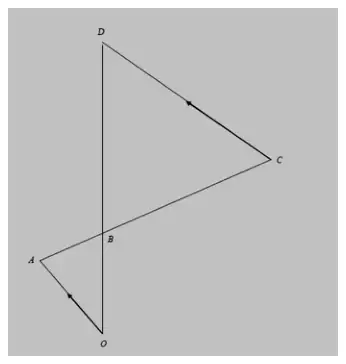
M1: For the key step in recognising that triangle \(BCD\) and triangle \(BAO\) are similar with a ratio of lengths of 4:1
dM1: States or uses the fact that \(\left\lvert\overrightarrow{OD}\right\rvert = 5 \times \left\lvert\overrightarrow{OB}\right\rvert\)
Stating this will score M1 dM1 provided there is no evidence of incorrect work
Note that they may establish this result using the work from (a) but must be used here to score.
A1: \(\left\lvert\overrightarrow{OD}\right\rvert = 10\sqrt{13}\)