
June 2022 Paper 1 Q15
15.
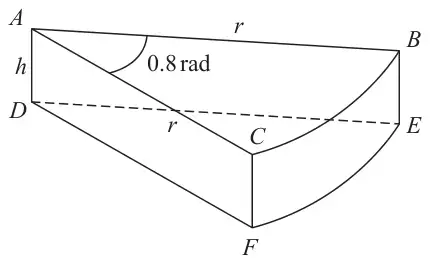
A company makes toys for children.
Figure 5 shows the design for a solid toy that looks like a piece of cheese.
The toy is modelled so that
- face \(ABC\) is a sector of a circle with radius \(r\) cm and centre \(A\)
- angle \(BAC = 0.8\) radians
- faces \(ABC\) and \(DEF\) are congruent
- edges \(AD\), \(CF\) and \(BE\) are perpendicular to faces \(ABC\) and \(DEF\)
- edges \(AD\), \(CF\) and \(BE\) have length \(h\) cm
Given that the volume of the toy is \(240\,\mathrm{cm}^3\)
Using algebraic differentiation,
| Scheme | Marks | AO |
|---|---|---|
| Sets up an allowable equation using volume \(= 240\) E.g. \(\dfrac{1}{2}r^2 \times 0.8h = 240 \Rightarrow h = \dfrac{600}{r^2}\) o.e. | M1 A1 | 3.4 1.1b |
Attempts to substitute their \(h = \dfrac{600}{r^2}\) into \((S =)\,\dfrac{1}{2}r^2 \times 0.8 + \dfrac{1}{2}r^2 \times 0.8 + 2rh + 0.8rh\) | dM1 | 3.4 |
| \(S = 0.8r^2 + 2.8rh = 0.8r^2 + 2.8 \times \dfrac{600}{r} = 0.8r^2 + \dfrac{1680}{r}\) * | A1* | 2.1 |
| (4) |
Notes
Volume \(= 0.4r^2h\)
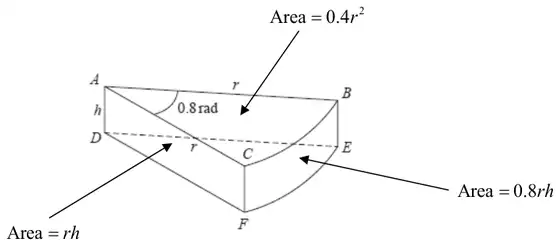
Total surface area \(= 2rh + 0.8r^2 + 0.8rh\)
M1: Attempts to use the fact that the volume of the toy is \(240\,\mathrm{cm}^3\)
Sight of \(\dfrac{1}{2}r^2 \times 0.8 \times h = 240\) leading to \(h = \ldots\) or \(rh = \ldots\) scores this mark
But condone an equation of the correct form so allow for \(kr^2h = 240 \Rightarrow h = \ldots\) or \(rh = \ldots\)
A1: A correct expression for \(h = \dfrac{600}{r^2}\) or \(rh = \dfrac{600}{r}\) which may be left unsimplified.
This may be implied when you see an expression for S or part of S E.g \(2rh = 2r \times \dfrac{600}{r^2}\)
dM1: Attempts to substitute their \(h = \dfrac{a}{r^2}\) o.e. such as \(hr = \dfrac{a}{r}\) into a correct expression for \(S\)
Sight of \(\dfrac{1}{2}r^2 \times 0.8 + \dfrac{1}{2}r^2 \times 0.8 + rh + rh + 0.8rh\) with an appropriate substitution
Simplified versions such as \(0.8r^2 + 2rh + 0.8rh\) used with an appropriate substitution is fine.
A1*: Correct work leading to the given result.
\(S =\), \(SA =\) or surface area \(=\) must be seen at least once in the correct place
The method must be made clear so expect to see evidence. For example
| Scheme | Marks | AO |
|---|---|---|
| \(\left(\dfrac{\mathrm{d}S}{\mathrm{d}r}\right) = 1.6r - \dfrac{1680}{r^2}\) | M1 A1 | 3.1a 1.1b |
| Sets \(\dfrac{\mathrm{d}S}{\mathrm{d}r} = 0 \Rightarrow r^3 = 1050\) \(r =\) awrt 10.2 | dM1 A1 | 2.1 1.1b |
| (4) |
Notes
(b) There is no requirement to see \(\dfrac{\mathrm{d}S}{\mathrm{d}r}\) in part (b). It may even be called \(\dfrac{\mathrm{d}y}{\mathrm{d}x}\).
M1: Achieves a derivative of the form \(pr \pm \dfrac{q}{r^2}\) where \(p\) and \(q\) are non- zero constants
A1: Achieves \(\left(\dfrac{\mathrm{d}S}{\mathrm{d}r}\right) = 1.6r - \dfrac{1680}{r^2}\)
dM1: Sets or implies that their \(\dfrac{\mathrm{d}S}{\mathrm{d}r} = 0\) and proceeds to \(mr^3 = n,\quad m \times n \gt 0\). It is dependent upon a correct attempt at differentiation. This mark may be implied by a correct answer to their \(pr - \dfrac{q}{r^2} = 0\)
A1: \(r =\) awrt 10.2 or \(\sqrt[3]{1050}\)
| Scheme | Marks | AO |
|---|---|---|
| Attempts to substitute their positive \(r\) into \(\left(\dfrac{\mathrm{d}^2S}{\mathrm{d}r^2}\right) = 1.6 + \dfrac{3360}{r^3}\) and considers its value or sign | M1 | 1.1b |
| E.g. Correct \(\dfrac{\mathrm{d}^2S}{\mathrm{d}r^2} = 1.6 + \dfrac{3360}{r^3}\) with \(\left.\dfrac{\mathrm{d}^2S}{\mathrm{d}r^2}\right|_{r = 10.2} = 5 \gt 0\) proving a minimum value of \(S\) | A1 | 1.1b |
| (2) | ||
| (10 marks) |
Notes
M1: Attempts to substitute their positive \(r\) (found in (b)) into \(\left(\dfrac{\mathrm{d}^2S}{\mathrm{d}r^2} =\right) e \pm \dfrac{f}{r^3}\) where \(e\) and \(f\) are non zero and finds its value or sign.
Alternatively considers the sign of \(\left(\dfrac{\mathrm{d}^2S}{\mathrm{d}r^2} =\right) e \pm \dfrac{f}{r^3}\) (at their positive \(r\) found in (b))
Condone the \(\dfrac{\mathrm{d}^2S}{\mathrm{d}r^2}\) to be \(\dfrac{\mathrm{d}^2y}{\mathrm{d}x^2}\) or being absent, but only for this mark.
A1: States that \(\dfrac{\mathrm{d}^2S}{\mathrm{d}r^2}\) or \(S^{\prime\prime} = 1.6 + \dfrac{3360}{r^3} =\) awrt \(5 \gt 0\) proving a minimum value of \(S\)
This is dependent upon having achieved \(r =\) awrt 10 and a correct \(\dfrac{\mathrm{d}^2S}{\mathrm{d}r^2} = 1.6 + \dfrac{3360}{r^3}\)
It can be argued without finding the value of \(\dfrac{\mathrm{d}^2S}{\mathrm{d}r^2}\). E.g. \(\dfrac{\mathrm{d}^2S}{\mathrm{d}r^2} = 1.6 + \dfrac{3360}{r^3} \gt 0\) as \(\underline{r \gt 0}\), so minimum value of \(S\). For consistency it is also dependent upon having achieved \(r =\) awrt 10
Do NOT allow \(\dfrac{\mathrm{d}^2y}{\mathrm{d}x^2}\) for this mark