
June 2022 Paper 1 Q11
11.
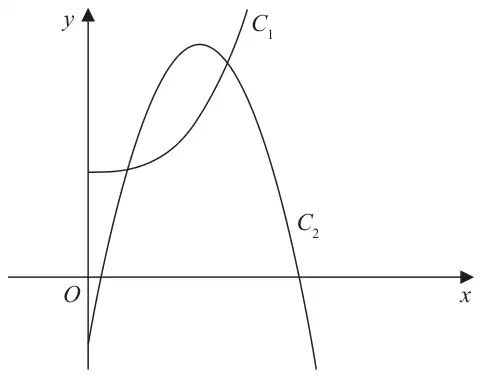
Figure 4 shows a sketch of part of the curve \(C_1\) with equation
\[y = 2x^3 + 10 \qquad x \gt 0\]and part of the curve \(C_2\) with equation
\[y = 42x - 15x^2 - 7 \qquad x \gt 0\]The curves intersect again at the point \(P\)
| Scheme | Marks | AO |
|---|---|---|
| Substitutes \(x = \dfrac{1}{2}\) into \(y = 2x^3 + 10\) and \(y = 42x - 15x^2 - 7\) and finds the \(y\) values for both | M1 | 1.1b |
| Achieves \(\dfrac{41}{4}\) o.e. for both and makes a valid conclusion. * | A1* | 2.4 |
| (2) |
Notes
M1: Substitutes \(x = \dfrac{1}{2}\) into both \(y = 2x^3 + 10\) and \(y = 42x - 15x^2 - 7\) and finds \(y\) values
Sight of just the \(y\) values at each is sufficient for this mark only.
Alternative: Sets \(42x - 15x^2 - 7 = 2x^3 + 10 \Rightarrow\) cubic and substitutes \(x = \dfrac{1}{2}\) into the expression, attempts \(\mathrm{f}\left(\dfrac{1}{2}\right)\) or else attempts to divide the cubic \(= 0\) by \((2x - 1)\) or \(\left(x - \dfrac{1}{2}\right)\). Condone \(\mathrm{f}\left(\dfrac{1}{2}\right) = 0\) without calculations for this mark only.
A1*: Correct calculations must be seen with a minimal conclusion that curves intersect (at \(x = \dfrac{1}{2}\)).
E.g. \(2\left(\dfrac{1}{2}\right)^3 + 10 = 10.25\) and \(42\left(\dfrac{1}{2}\right) - 15\left(\dfrac{1}{2}\right)^2 - 7 = 10.25\) so curves intersect.
Acceptable alternatives are:
\(\mathrm{f}(x) = 42x - 15x^2 - 7 - 2x^3 - 10,\ \mathrm{f}\left(\dfrac{1}{2}\right) = 42\left(\dfrac{1}{2}\right) - 15\left(\dfrac{1}{2}\right)^2 - 7 - 2\left(\dfrac{1}{2}\right)^3 - 10 = 0 \Rightarrow\) so curves intersect
\(\mathrm{f}(x) = 2x^3 + 15x^2 - 42x + 17 \Rightarrow \left(x - \dfrac{1}{2}\right)(2x^2 + 16x - 34)\) so \(x = \dfrac{1}{2}\) is a root so curves intersect
\(\mathrm{f}(x) = 2x^3 + 15x^2 - 42x + 17 \Rightarrow (2x - 1)(x^2 + 8x - 17)\) so \((2x - 1)\) is a factor hence curves intersect
Only accept verified, QED etc if there is a preamble mentioning intersection about how it will be shown.
Special case: Scores M1 A0 with or without a conclusion
This is presumably done using a calculator and requires all three roots exact or correct to 3sf
| Scheme | Marks | AO |
|---|---|---|
| Sets \(42x - 15x^2 - 7 = 2x^3 + 10 \Rightarrow 2x^3 + 15x^2 - 42x + 17 = 0\) | M1 | 1.1b |
| Deduces that \((2x - 1)\) is a factor and attempts to divide | dM1 | 2.1 |
| \(2x^3 + 15x^2 - 42x + 17 = (2x - 1)(x^2 + 8x - 17)\) | A1 | 1.1b |
| Solves their \(x^2 + 8x - 17 = 0\) using suitable method | M1 | 1.1b |
| Deduces \(x = -4 + \sqrt{33}\) (see note) | A1 | 2.2a |
| (5) | ||
| (7 marks) |
Notes
This part requires candidates to show all stages of their working.
Answers without working will not score any marks
A method must be seen which could be from part (a) which must then be continued in (b)
M1: Sets \(42x - 15x^2 - 7 = 2x^3 + 10\) and proceeds to 4 term cubic equation.
Condone slips, e.g. signs. Terms do not have to be on one side of the equation.
dM1: For the key step in attempting to "divide" the cubic by \((2x - 1)\)
If attempted via inspection look for correct first and last terms
E.g. \(2x^3 + 15x^2 - 42x + 17 = (2x - 1)(x^2 + \ldots \pm 17)\) if cubic expression is correct
If attempted via division look for correct first and second terms
It is acceptable for an attempt to divide by \(\left(x - \dfrac{1}{2}\right)\). It is easily marked using the same guidelines, e.g. \(2x^3 + 15x^2 - 42x + 17 = \left(x - \dfrac{1}{2}\right)(2x^2 + 16x\ldots)\)
A1: \(2x^3 + 15x^2 - 42x + 17 = (2x - 1)(x^2 + 8x - 17)\) o.e. \(\left(x - \dfrac{1}{2}\right)(2x^2 + 16x - 34)\)
This may be implied by sight of \((x^2 + 8x - 17)\) or \((2x^2 + 16x - 34)\) in a "division" sum.
M1: Solves their quadratic \(x^2 + 8x - 17 = 0\) using a suitable method including calculator. You may need to check this. It is not completely dependent upon the previous M’s but an attempt at a full method must have been seen. So look for
- the two equations being set equal to each other and some attempt made to combine
- some attempt to "divide" the result by \((2x - 1)\) o.e. allowing for flaws in the method
A1: Gives \(x = -4 + \sqrt{33}\) o.e. only. The \(x = -4 - \sqrt{33}\) must not be included in the final answer.
Allow exact unsimplified equivalents such as \(x = \dfrac{-8 + \sqrt{132}}{2}\). ISW for instance if they then put this in decimal form.