
June 2022 Paper 1 Q6
6.
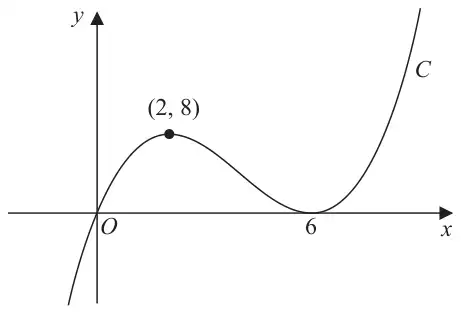
Figure 1 shows a sketch of a curve \(C\) with equation \(y = \mathrm{f}(x)\) where \(\mathrm{f}(x)\) is a cubic expression in \(x\).
The curve
- passes through the origin
- has a maximum turning point at \((2,\ 8)\)
- has a minimum turning point at \((6,\ 0)\)
The line with equation \(y = k\), where \(k\) is a constant, intersects \(C\) at only one point.
| Scheme | Marks | AO |
|---|---|---|
| \(2 \lt x \lt 6\) | B1 | 1.1b |
| (1) |
Notes
Watch for answers written by the question. If they are beside the question and in the answer space, the one in the answer space takes precedence
B1: Deduces \(2 \lt x \lt 6\) o.e. such as \(x \gt 2,\ x \lt 6\) \(x \gt 2\) and \(x \lt 6\) \(\{x : x \gt 2\} \cap \{x : x \lt 6\}\) \(x \in (2,\ 6)\)
Condone attempts in which set notation is incorrectly attempted but correct values can be seen or implied E.g. \(\{x \gt 2\} \cap \{x \lt 6\}\) \(\{x \gt 2,\ x \lt 6\}\). Allow just the open interval \((2,\ 6)\)
Do not allow for incorrect inequalities such as e.g. \(x \gt 2\) or \(x \lt 6\), \(\{x : x \gt 2\} \cup \{x : x \lt 6\}\) \(x \in [2,\ 6]\)
| Scheme | Marks | AO |
|---|---|---|
| States either \(k \gt 8\) or \(k \lt 0\) | M1 | 3.1a |
| States e.g. \(\{k : k \gt 8\} \cup \{k : k \lt 0\}\) | A1 | 2.5 |
| (2) |
Notes
Watch for answers written by the question. If they are beside the question and in the answer space, the one in the answer space takes precedence
M1: Establishes a correct method by finding one of the (correct) inequalities
States either \(k \gt 8\) (condone \(k \geqslant 8\)) or \(k \lt 0\) (condone \(k \leqslant 0\))
Condone for this mark \(y \leftrightarrow k\) or \(\mathrm{f}(x) \leftrightarrow k\) and \(8 \lt k \lt 0\)
A1: Fully correct solution in the form \(\{k : k \gt 8\} \cup \{k : k \lt 0\}\) or \(\{k \mid k \gt 8\} \cup \{k \mid k \lt 0\}\) either way around
but condone \(\{k \lt 0\} \cup \{k \gt 8\}\), \(\{k : k \lt 0 \cup k \gt 8\}\), \(\{k \lt 0 \cup k \gt 8\}\). It is not necessary to mention \(\mathbb{R}\), e.g. \(\{k : k \in \mathbb{R},\ k \gt 8\} \cup \{k : k \in \mathbb{R},\ k \lt 0\}\) Look for \(\{\ \}\) and \(\cup\)
Do not allow solutions not in set notation such as \(k \lt 0\) or \(k \gt 8\).
| Scheme | Marks | AO |
|---|---|---|
| Please see notes for alternatives | ||
| States \(y = ax(x - 6)^2\) or \(\mathrm{f}(x) = ax(x - 6)^2\) | M1 | 1.1b |
| Substitutes \((2,\ 8)\) into \(y = ax(x - 6)^2\) and attempts to find \(a\) | dM1 | 3.1a |
| \(y = \dfrac{1}{4}x(x - 6)^2\) or \(\mathrm{f}(x) = \dfrac{1}{4}x(x - 6)^2\) o.e | A1 | 2.1 |
| (3) | ||
| (6 marks) |
Notes
Watch for answers written by the question. If they are beside the question and in the answer space, the one in the answer space takes precedence
M1: Realises that the equation of \(C\) is of the form \(y = ax(x - 6)^2\). Condone with \(a = 1\) for this mark.
So award for sight of \(ax(x - 6)^2\) even with \(a = 1\)
dM1: Substitutes \((2,\ 8)\) into the form \(y = ax(x - 6)^2\) and attempts to find the value for \(a\).
It is dependent upon having an equation, which the (\(y =\)..) may be implied, of the correct form.
A1: Uses all of the information to form a correct equation for \(C\) \(y = \dfrac{1}{4}x(x - 6)^2\) o.e.
ISW after a correct answer. Condone \(\mathrm{f}(x) = \dfrac{1}{4}x(x - 6)^2\) but not \(C = \dfrac{1}{4}x(x - 6)^2\).
Allow this to be written down for all 3 marks
Examples of alternative methods
Alternative I part (c):
Using the form \(y = ax^3 + bx^2 + cx\) and setting up then solving simultaneous equations.
There are various versions of this but can be marked similarly
M1: Realises that the equation of \(C\) is of the form \(y = ax^3 + bx^2 + cx\) and forms two equations in \(a\), \(b\) and \(c\). Condone with \(a = 1\) for this mark.
Note that the form \(y = ax^3 + bx^2 + cx + d\) is M0 until \(d\) is set equal to 0.
There are four equations that could be formed, only two are necessary for this mark.
Condone slips
- Using \((6,\ 0) \Rightarrow 216a + 36b + 6c = 0\)
- Using \((2,\ 8) \Rightarrow 8a + 4b + 2c = 8\)
- Using \(\dfrac{\mathrm{d}y}{\mathrm{d}x} = 0\) at \(x = 2 \Rightarrow 12a + 4b + c = 0\)
- Using \(\dfrac{\mathrm{d}y}{\mathrm{d}x} = 0\) at \(x = 6 \Rightarrow 108a + 12b + c = 0\)
dM1: Forms and solves three different equations, one of which must be using \((2,\ 8)\) to find values for \(a\), \(b\) and \(c\). A calculator can be used to solve the equations
A1: Uses all of the information to form a correct equation for \(C\) \(y = \dfrac{1}{4}x^3 - 3x^2 + 9x\) o.e.
ISW after a correct answer. Condone \(\mathrm{f}(x) = \dfrac{1}{4}x^3 - 3x^2 + 9x\)
Alternative II part (c)
Using the gradient and integrating
M1: Realises that the gradient of \(C\) is zero at 2 and 6 so sets \(\mathrm{f}^{\prime}(x) = k(x - 2)(x - 6)\) oe and attempts to integrate. Condone with \(k = 1\)
dM1: Substitutes \(x = 2,\ y = 8\) into \(\mathrm{f}(x) = k\left(\ldots x^3 + \ldots x + \ldots\right)\) and finds a value for \(k\)
A1: Uses all of the information to form a correct equation for \(C\) \(y = \dfrac{3}{4}\left(\dfrac{1}{3}x^3 - 4x^2 + 12x\right)\) o.e.
ISW after a correct answer. Condone \(\mathrm{f}(x) = \dfrac{3}{4}\left(\dfrac{1}{3}x^3 - 4x^2 + 12x\right)\)