
June 2016 Paper 2 Q13
13 Here is a sketch of \(\quad y = a + bx - 2x^2 \quad\) where \(a\) and \(b\) are constants.
The graph intersects the \(x\)-axis at \((-1, 0)\) and \(\left(\dfrac{7}{2}, 0\right)\) and the \(y\)-axis at point \(P\).
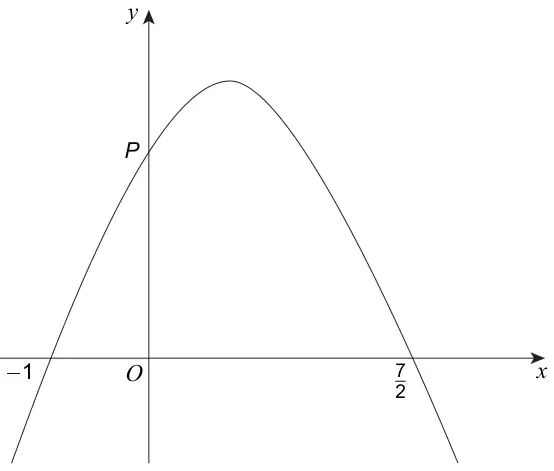
Not drawn accurately
Work out the coordinates of point \(P\).
You must show your working. [4 marks]
| Answer | Mark | Comments |
|---|---|---|
| Alternative method 1 | ||
| \(a - b - 2 = 0\) or \(a + \dfrac{7}{2}b - \dfrac{49}{2} = 0\) | M1 | oe equation Allow an unsimplified equation eg \(a + b \times (-1) - 2(-1)^2 = 0\) Missing brackets can be recovered |
| \(a - b - 2 = 0\) and \(a + \dfrac{7}{2}b - \dfrac{49}{2} = 0\) | M1 | oe two equations Allow unsimplified equations |
| \(\dfrac{7}{2}a + a = 7 + \dfrac{49}{2}\) or \(\dfrac{7}{2}b - -b = \dfrac{49}{2} - 2\) and \(a\) − their \(b - 2 = 0\) | M1dep | oe dep on first M1 Correct method to form an equation in \(a\) or correct method to form an equation in \(b\) and substitutes to form an equation in \(a\) Their two equations must both contain \(a\) and \(b\) |
| \((0, 7)\) | A1 | SC4 Answer \((0, 7)\) from \((2x - 7)(1 + x)\) or \(2x^2 + 2x - 7x - 7\) or \(2x^2 - 5x - 7\) |
| Alternative method 2 | ||
| \((7 - 2x)\) or \((1 + x)\) or \((2x - 7)\) or \((-1 - x)\) or \((x - 3.5)\) or \((3.5 - x)\) or \(2x^2 + 2x - 7x - 7\) or \(2x^2 - 5x - 7\) | M1 | oe Brackets not needed |
| \((7 - 2x)(1 + x)\) or \((2x - 7)(-1 - x)\) or \(7 + 7x - 2x - 2x^2\) or \(7 + 5x - 2x^2\) | M1 | oe eg \(-(2x^2 - 5x - 7)\) \(y =\) not needed Expansion not needed |
| Substitutes \(x = 0\) in their quadratic or selects the constant term from their quadratic | M1dep | dep on first M1 Expansion not needed for their quadratic but must be correct if attempted May be implied by the final answer |
| \((0, 7)\) | A1 | SC4 Answer \((0, 7)\) from \((2x - 7)(1 + x)\) or \(2x^2 + 2x - 7x - 7\) or \(2x^2 - 5x - 7\) |
| Alternative method 3 | ||
| \(b - 2 \times 2x\) or \(b - 4x\) | M1 | Differentiates correctly |
| \(b - 2 \times 2 \times 1.25 = 0\) or \(b - 4 \times 1.25 = 0\) or \(b = 5\) | M1 | |
| \(a\) + their \(b \times (-1) - 2 \times (-1)^2 = 0\) or \(a\) + their \(b \times \left(\dfrac{7}{2}\right) - 2 \times \left(\dfrac{7}{2}\right)^2 = 0\) | M1dep | oe dep on first M1 Must have substituted a value into \(b - 4x\) and equated to 0 Missing brackets can be recovered |
| \((0, 7)\) | A1 | SC4 Answer \((0, 7)\) from \((2x - 7)(1 + x)\) or \(2x^2 + 2x - 7x - 7\) or \(2x^2 - 5x - 7\) |
| Alternative method 4 | ||
| \(-2\left\{\left(x - \dfrac{b}{4}\right)^2 \ldots\ldots\right\}\) | M1 | oe completed square |
| \(\dfrac{b}{4} = 1.25\) or \(b = 5\) | M1 | |
| \(a\) + their \(b \times (-1) - 2 \times (-1)^2 = 0\) or \(a\) + their \(b \times \left(\dfrac{7}{2}\right) - 2 \times \left(\dfrac{7}{2}\right)^2 = 0\) | M1dep | oe dep on first M1 Must have equated \(\dfrac{b}{4}\) to a value Missing brackets can be recovered |
| \((0, 7)\) | A1 | SC4 Answer \((0, 7)\) from \((2x - 7)(1 + x)\) or \(2x^2 + 2x - 7x - 7\) or \(2x^2 - 5x - 7\) |
Additional guidance
| Answer \((7, 0)\) | A0 |
| Answer only \((0, 7)\) | M3 A1 |
| Alt 1 3rd M1 Follow correct method rules as in Q4 Alt 1 2nd M1 | |
| Answer \((0, 7)\) with working may not score full marks Check the working each time eg (Alt 2) \(2x^2 - 3x + 7\) (no method seen) Answer \((0, 7)\) | Zero |