
June 2020 Paper 2 Q9
9 A cylinder is to be cut out of the circular face of a solid hemisphere.
The cylinder and the hemisphere have the same axis of symmetry.
The cylinder has height \(h\) and the hemisphere has a radius of \(R\).
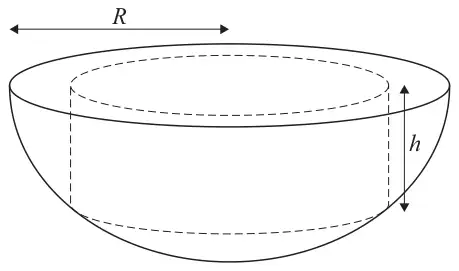
(a) Show that the volume, \(V\), of the cylinder is given by\[V = \pi R^2 h - \pi h^3\] [3 marks]
(b) Find the maximum volume of the cylinder in terms of \(R\).
Fully justify your answer. [7 marks]
| Scheme | Marks | AO |
|---|---|---|
| Identifies and clearly defines variable for radius of cylinder. Can be shown on diagram or can be implied by use in \(V = \pi r^2 h\) | B1 | 2.5 |
| Uses Pythagoras to connect \(h\), \(r\) and \(R\) | M1 | 3.1a |
| Eliminates the radius variable to form an expression for the volume of the cylinder in terms of \(h\), completing argument to show given result. Condone undefined \(r\) | R1 | 2.1 |
| (3) |
Typical solution
Radius of cylinder = \(r\)
\[h^2 + r^2 = R^2\]\[V = \pi r^2 h\]\[V = \pi\left(R^2 - h^2\right)h\]\[= \pi R^2 h - \pi h^3\]| Scheme | Marks | AO |
|---|---|---|
| Differentiates the expression for volume w.r.t. \(h\) with at least one term correct. | M1 | 3.1a |
| Obtains correct \(\dfrac{\mathrm{d}V}{\mathrm{d}h}\) | A1 | 1.1b |
| Explains that their derivative w.r.t \(h\) equals zero for a maximum or stationary point | E1 | 2.4 |
| Equates volume derivative w.r.t. \(h\) to zero and correctly obtains a value for \(h\) in terms of \(R\) | M1 | 1.1a |
| Substitutes their \(h\), in terms of \(R\), from derivative w.r.t. \(h\) into volume formula. | M1 | 1.1a |
| Obtains the correct max volume in the form \(kR^3 - pR^3\) or better | A1 | 3.2a |
| Justifies correct volume in the form \(kR^3 - pR^3\) or better form is the maximum eg:
| R1 | 2.1 |
| (7) | ||
| (10 marks) |
Typical solution
\[\frac{\mathrm{d}V}{\mathrm{d}h} = \pi R^2 - 3\pi h^2\]For maximum volume \(\dfrac{\mathrm{d}V}{\mathrm{d}h} = 0\)
\[\Rightarrow R^2 - 3h^2 = 0\]\[h^2 = \frac{R^2}{3} \Rightarrow h = \frac{R}{\sqrt{3}}\]Hence volume
\[V = \pi R^2\frac{R}{\sqrt{3}} - \pi\left(\frac{R}{\sqrt{3}}\right)^3\]\[= \frac{2\sqrt{3}\pi R^3}{9}\]\[\frac{\mathrm{d}^2V}{\mathrm{d}h^2} = -6\pi h\]When \(h = \dfrac{R}{\sqrt{3}}\)
\(\dfrac{\mathrm{d}^2V}{\mathrm{d}h^2} \lt 0\) Therefore maximum
Notes
In the typical solution, the second term is \(\pi\left(\dfrac{R}{\sqrt{3}}\right)^3\) (corrected from the printed mark scheme, which omits the power 3).