
June 2020 Paper 1 Q11
11 The region \(R\) enclosed by the lines \(x = 1\), \(x = 6\), \(y = 0\) and the curve
\[y = \ln(8 - x)\]is shown shaded in Figure 3 below.
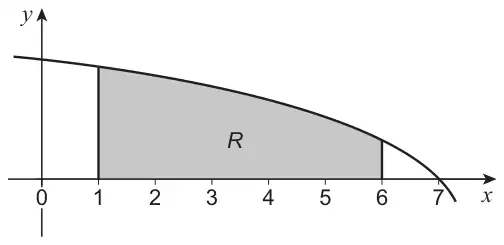
All distances are measured in centimetres.
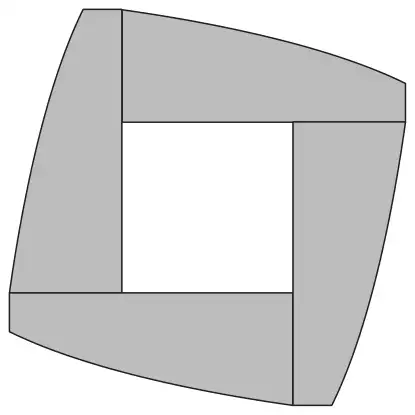
Shape \(B\) is cut from metal of thickness 2 mm
The metal has a density of 10.5 g/cm3
Use the trapezium rule with six ordinates to calculate an approximate value of the mass of Shape \(B\).
Give your answer to the nearest gram. [5 marks]
| Scheme | Marks | AO |
|---|---|---|
| Evaluates f(1) and f(6) using exact logs or decimals Award if seen embedded in calculations using more than one trapezium | M1 | 1.1a |
| Evaluates an approximate value of the area of \(R\) AWRT 6.60 Condone omission of units | A1 | 1.1b |
| (2) |
Typical solution
f(1) = 1.945910149..
f(6) = 0.69314718..
A = \(\frac{5}{2}\)(1.9459 + 0.6931)
= 6.5976…
= 6.60 cm2
| Scheme | Marks | AO |
|---|---|---|
| Writes or uses the six ordinates as ln 7, ln 6, ln 5, ln 4, ln 3 ln 2 or Obtains the values of the correct six ordinates in decimal form | B1 | 1.1b |
| Uses the correct formula for the trapezium rule with their six ordinates and \(h = 1\) Award this mark if seven ordinates used with \(h = \frac{5}{6}\) Answer for seven = 7.2145648.. | M1 | 1.1a |
| Evaluates an approximate value for the area of \(R\). Must have used six ordinates AWRT 7.2 PI by correct final answer | A1 | 1.1b |
| Forms an expression for the mass of either one section or all four sections using ‘their’ area and consistent units PI by correct final answer | M1 | 3.1b |
| Obtains an approximate value for the correct mass of Shape \(B\) Must state units If seven ordinates used this mark can be awarded as answer would be 61g CAO | A1 | 3.2a |
| (5) |
Typical solution
| \(x\) | f(\(x\)) |
|---|---|
| 1 | 1.9459 |
| 2 | 1.7918 |
| 3 | 1.6094 |
| 4 | 1.3863 |
| 5 | 1.0986 |
| 6 | 0.6931 |
Area = \(\frac{1}{2}\) × 1 × (1.9459 + 0.6931 + 2(1.7918 + 1.6094 + 1.3863 + 1.0986))
Area = 7.205633 cm2
Volume of Shape \(B\)
= 4 × 7.205633 × 0.2
= 5.7645… cm3
Mass of Shape \(B\) =
5.7645 cm3 × 10.5 g/cm3
= 60.52731 g
= 61 g
| Scheme | Marks | AO |
|---|---|---|
| (i) Explains that the trapezia are all below the curve or Explains that the curve is concave or Draws a diagram and indicates the gaps | E1 | 3.5a |
| (1) | ||
| (ii) Explains that numbers have been rounded | E1 | 3.5a |
| (1) | ||
| (9 marks) |
Typical solution
(i)
The trapezia are all below the curve
(ii)
Numbers in the calculation have been rounded