
June 2018 Paper 1 Q14
14 Some students are trying to prove an identity for \(\sin(A + B)\).
They start by drawing two right-angled triangles \(ODE\) and \(OEF\), as shown.
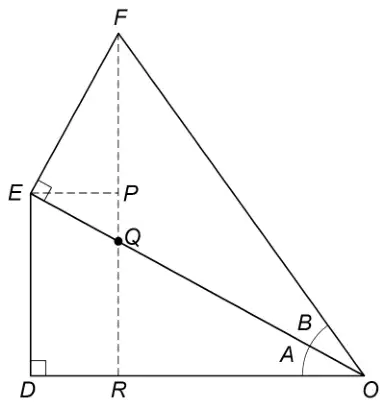
The students’ incomplete proof continues,
Let angle \(DOE = A\) and angle \(EOF = B\).
In triangle \(OFR\),
| Line 1 | \(\sin(A + B) = \dfrac{RF}{OF}\) |
| Line 2 | \(= \dfrac{RP + PF}{OF}\) |
| Line 3 | \(= \dfrac{DE}{OF} + \dfrac{PF}{OF}\) since \(DE = RP\) |
| Line 4 | \(= \dfrac{DE}{\ldots\ldots} \times \dfrac{\ldots\ldots}{OF} + \dfrac{PF}{EF} \times \dfrac{EF}{OF}\) |
| Line 5 | \(= \ldots\ldots\ldots\ldots + \cos A\sin B\) |
| Line 4 | \(= \dfrac{DE}{\ldots\ldots} \times \dfrac{\ldots\ldots}{OF} + \dfrac{PF}{EF} \times \dfrac{EF}{OF}\) |
| Line 5 | \(= \ldots\ldots\ldots\ldots\ldots\ldots\ldots\ldots + \cos A\sin B\) |
Assuming the identity for \(\sin(A + B)\) is correct for all values of \(A\) and \(B\), prove a similar result for \(\sin(A - B)\). [3 marks]
| Scheme | Marks | AO |
|---|---|---|
| Explains why \(\angle EFQ = A\) Must be a fully correct explanation with reasons which may include: Vertically opposite angles and right angle implies similar triangles. | E1 | AO2.4 |
| Deduces \(\dfrac{PF}{EF} = \cos(A)\) AND \(\dfrac{EF}{OF} = \sin(B)\) Must have at least stated or implied that \(\angle EFQ = A\) through similarity | R1 | AO2.2a |
Typical solution
\(\angle OQR = \angle FQE\) vertically opposite angles
\(\angle ORQ = \angle FEQ = 90^\circ\)
So \(\angle EFQ = A\)
Since \(\angle EFQ = A\)
\[\frac{PF}{EF} = \cos(A)\]And \(\dfrac{EF}{OF} = \sin(B)\) in triangle OEF
| Scheme | Marks | AO |
|---|---|---|
| Completes proof | B1 | AO2.2a |
Typical solution
\[\frac{DE}{\boldsymbol{OE}} \times \frac{\boldsymbol{OE}}{OF} + \frac{PF}{EF} \times \frac{EF}{OF}\]\[= \boldsymbol{\sin A\cos B} + \cos A\sin B\]| Scheme | Marks | AO |
|---|---|---|
| Explains that the proof is based on right angled triangles which limits A and B to acute angles | E1 | AO2.3 |
Typical solution
Since the proof is based on the diagram which uses right-angled triangles it is assumed that \(A\) and \(B\) are acute. Therefore, the proof only holds for acute angles.
| Scheme | Marks | AO |
|---|---|---|
| Substitutes \(-B\) into identity for \(\sin(A + B)\) to give \(\sin(A - B)\) | R1 | AO2.1 |
| Recalls at least one of the identities \(\sin(-B) = -\sin(B)\) \(\cos(-B) = \cos(B)\) Must be explicitly stated | B1 | AO1.2 |
| Deduces correct identity with no errors. This must be clearly deduced from a correct argument and not simply stated. | R1 | AO2.2a |
| (7 marks) |
Typical solution
\[\sin\left(A - B\right) = \sin A\cos(-B) + \cos A\sin(-B)\]\[\sin(-B) = -\sin(B)\]\[\cos(-B) = \cos(B)\]Hence
\[\sin\left(A - B\right) = \sin A\cos B - \cos A\sin B\]