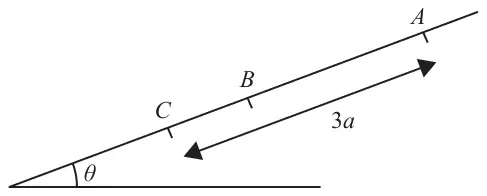
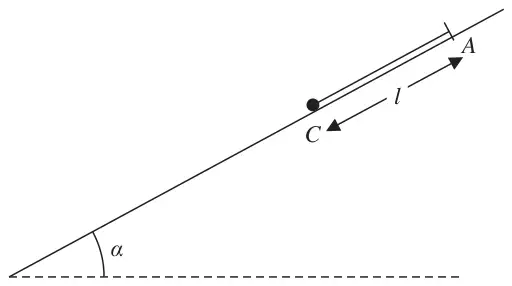
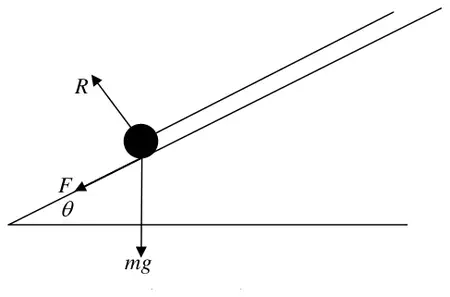
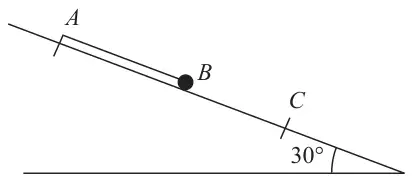
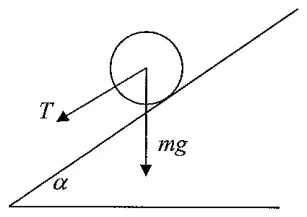
A smooth plane is inclined at an angle \(\theta\) to horizontal ground, where \(\sin\theta = \dfrac{1}{3}\)
The points \(A\), \(B\) and \(C\) lie on a line of greatest slope of the plane, with \(B\) between \(A\) and \(C\), with \(A\) above \(B\) and \(AC = 3a\), as shown in Figure 3.
A light elastic string of natural length \(2a\) has one end attached to the fixed point \(A\). The other end of the string is attached to a parcel \(P\) of mass \(m\).
The modulus of elasticity of the string is \(\dfrac{8}{3}mg\)
The parcel rests in equilibrium on the plane at the point \(B\).
The parcel is modelled as a particle.
(a) Show that \(AB = \dfrac{9}{4}a\) (4)
The parcel is now held at \(C\) and released from rest.
(b) Find the elastic potential energy lost by the string when \(P\) moves from \(C\) to \(B\). (3)
(c) Use the principle of conservation of mechanical energy to find the speed of \(P\) at the instant it passes \(B\). (3)
Mark scheme (a)
Scheme
Marks
AO
Correct use of Hooke’s law \(T = \dfrac{\frac{8}{3}mge}{2a}\) or \(T = \dfrac{\frac{8}{3}mg(AB - 2a)}{2a}\)
\(\Rightarrow e = \dfrac{2a}{8}\left(= \dfrac{a}{4}\right)\), \(AB = \dfrac{9}{4}a\) * OR \(\Rightarrow AB - 2a = \dfrac{2a}{8}\left(= \dfrac{a}{4}\right)\), \(AB = \dfrac{9}{4}a\) *
A1*
2.2a
(4)
Notes
M1: Correct use of Hooke’s law with \(\dfrac{8mg}{3}\) and \(2a\) substituted.
M1: Resolve parallel to the slope with all required terms and no extras. Dimensionally correct. Weight must be resolved but condone sin/cos confusion. \(T\) does not need to be replaced.
A1: Correct unsimplified equilibrium equation, \(T\) does not need to be replaced.
A1*: A complete and correct method using Hooke’s law with the parallel equilibrium equation to obtain the given answer. There must be at least one line of working between the initial equations and the given answer. Must see ‘\(AB = \ldots\)’ Accept fractions \(\dfrac{9a}{4}\) or \(\dfrac{9}{4}a\).
M1: Correct method for difference in EPE at \(B\) and \(C\), allow either way round. Dimensionally correct and of the correct structure. No need to substitute \(\lambda\). For M mark, condone denominator of \(2a\). Must use extensions \((3a - 2a)\) and \(\left(\dfrac{9a}{4} - 2a\right).\)
A1: Correct unsimplified expression for change in EPE. Allow \(\pm\)
A1: Correct answer, o.e. ISW. Accept \(0.625mga\) and \(0.63mga\). Must be positive but allow a negative expression to change to a positive expression without justification.
M1: Use of conservation of energy principle from \(C\) to \(B\) to form an equation with all terms of the correct structure and dimensionally correct. Condone sign errors. Condone sin/cos confusion on vertical height. For GPE, \(mg\left(3a - \dfrac{9a}{4}\right)\sin\theta\) o.e for example \(mg\dfrac{3a}{4}\sin\theta,\ \ mg\dfrac{3a}{4}\left(\dfrac{1}{3}\right),\ \ mg\dfrac{a}{4}\) For EPE change, may use their answer from (b) if dimensionally correct (of the form \(kma\) where \(k\) is a constant) or start again with 2 EPE terms: \(\dfrac{\frac{8mg}{3}(3a - 2a)^2}{2(2a)}\) and \(\dfrac{\frac{8mg}{3}\left(\frac{9}{4}a - 2a\right)^2}{2(2a)}\). For M mark, condone denominator of \(2a\). (Corrected from the printed mark scheme: the second EPE term is printed with \(\left(3a - \frac{9}{4}a\right)^2\); the extension at \(B\) is \(\frac{9}{4}a - 2a\).)
A1ft: Correct unsimplified equation. Terms must be correct when the equation is formed but follow their answer to (b) for EPE if used.
A1: Correct answer in terms of \(\sqrt{ag}\) ISW. Accept eg \(\dfrac{1}{2}\sqrt{3ag}\), \(0.87\sqrt{ag}\) or better. N.B. If the final mark in (b) is A0 due to substituting \(g = 9.8\ \text{m s}^{-2}\), do not penalise again for the same reason here.
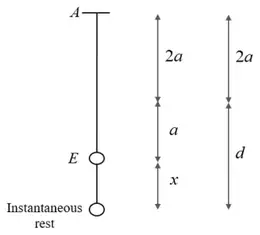
5. A light elastic string has natural length \(2a\) and modulus of elasticity \(2mg\). One end of the string is attached to a fixed point \(A\) on a horizontal ceiling. The other end is attached to a particle \(P\) of mass \(m\).
The particle \(P\) hangs in equilibrium at the point \(E\), where \(AE = 3a\).
The particle \(P\) is then projected vertically downwards from \(E\) with speed \(\dfrac{3}{2}\sqrt{ag}\)
Air resistance is assumed to be negligible.
Find the elastic energy stored in the string, when \(P\) first comes to instantaneous rest. Give your answer in the form \(kmga\), where \(k\) is a constant to be found. (7)
Mark scheme
Scheme
Marks
AO
GPE from \(E\) to instantaneous rest eg \(mgx\), \(mg(d - a)\)
\(\dfrac{1}{2}m\dfrac{9ag}{4} + mg(d - a) = \dfrac{2mgd^2}{2(2a)} - \dfrac{2mga^2}{2(2a)}\) oe
Accept equivalent rearrangements in one unknown length
A1 A1
1.1b 1.1b
\(x = \dfrac{3a}{2}\) or \(d = \dfrac{5a}{2}\)
A1
1.1b
Use of EPE formula
M1
2.1
\(\dfrac{25mga}{8}\)
A1
2.2a
(7)
(7 marks)
Notes
M1: Use of GPE for unknown distance from \(E\) to instantaneous rest. May be implied by a difference of 2 GPE terms.
M1: Use of conservation of energy principle to form an equation with one KE term, one GPE term, two EPE terms. For the method mark only we will, condone only one EPE term. However, all terms are required for A marks. Dimensionally correct energy equation (energy terms must have the correct structure). Note there are common rearrangements. Eg Initial Energy = Final Energy, Energy Loss = Energy Gain oe Condone \(\pm\) sign errors. M0 for use of suvat. M0 if ‘E’ or similar is used to represent unknown EPE unless recovered.
A1: All 4 terms present in an energy equation with one unknown length. At most one error. A0 if an energy term is missing.
A1: Fully correct equation in one unknown length.
A1: cao
M1: Use of EPE formula at least once. May be seen here or in earlier working. EPE must have the form \(\dfrac{\lambda x^2}{ka}\) where \(\lambda\) is modulus of elasticity, \(k\) is a constant and \(x\) is extension.
4. A light elastic string has natural length \(2a\) and modulus of elasticity \(4mg\).
One end of the elastic string is attached to a fixed point \(O\). A particle \(P\) of mass \(m\) is attached to the other end of the elastic string.
The particle \(P\) hangs freely in equilibrium at the point \(E\), which is vertically below \(O\)
(a) Find the length \(OE\). (4)
Particle \(P\) is now pulled vertically downwards to the point \(A\), where \(OA = 4a\), and released from rest. The resistance to the motion of \(P\) is a constant force of magnitude \(\dfrac{1}{4}mg\).
(b) Find, in terms of \(a\) and \(g\), the speed of \(P\) after it has moved a distance \(a\). (7)
Particle \(P\) is now held at \(O\)
Particle \(P\) is released from rest and reaches its maximum speed at the point \(B\).
The resistance to the motion of \(P\) is again a constant force of magnitude \(\dfrac{1}{4}mg\).
(c) Find the distance \(OB\). (4)
Mark scheme (a)
Scheme
Marks
AO
\(T = \dfrac{4mge}{2a}\)
B1
3.3
\(T = mg\)
M1
3.1a
\(e = \dfrac{1}{2}a\)
A1
1.1b
\(OE = \dfrac{5a}{2}\)
A1
1.1b
(4)
Notes
B1: Hooke’s Law seen with \(4mg\) and \(2a\) substituted.
M1: Resolving vertically. Correct number of terms.
A1: cao for extension.
A1: cao for \(OE\). Note that if the extension is \((OE - 2a)\) in their equation, \(OE\) can be found directly and both A’s can be earned together.
Mark scheme (b)
Scheme
Marks
AO
GPE term, \(\pm\, mga\)
B1
3.4
Work done against resistance, \(\pm\, \dfrac{1}{4}mga\)
B1: Work term seen \(\dfrac{mga}{4}\), ignore sign. Allow B1 for the case where WD = \(\dfrac{5mga}{4}\). This is a special case where the work done against resistance is included within the term. \(\dfrac{5mga}{4}\) = WD against resistance + WD against weight.
M1: Use of EPE formula. Accept EPE in the form \(\dfrac{\lambda x^2}{ka}\)
A1: Difference between two correct EPE terms seen, unsimplified.
M1: Work-energy equation is formed with all relevant terms and no extras.: KE, GPE, 2EPE, WD. Condone sign errors. M0: For work-energy equation with WD = \(\dfrac{5mga}{4}\) and a GPE term. This is because weight is considered twice and so the equation contains an extra term.
A1: Correct unsimplified equation
A1: Correct answer in terms of \(a\) and \(g\), do not allow 9.8 for \(g\) \(\quad v = \sqrt{\dfrac{7ag}{2}}\), \(\ v = \dfrac{1}{2}\sqrt{14ag}\)
Mark scheme (c)
Scheme
Marks
AO
\(mg - T - \dfrac{1}{4}mg = 0\)
M1
3.1a
\(mg - \dfrac{4mgx}{2a} - \dfrac{1}{4}mg = 0\)
A1
1.1b
\(x = \dfrac{3a}{8}\)
A1
1.1b
\(OB = \dfrac{19a}{8}\) oe
A1
1.1b
(4)
(15 marks)
Notes
M1: Vertical equilibrium equation or equation of motion with \(a = 0\). Condone sign errors. Correct no. of terms - all 3 forces must be included although \(\left(mg \pm \dfrac{mg}{4}\right)\) may already be simplified. Hooke’s Law does not need to be substituted but M0 if the equilibrium position from (a) is used.
A1: Correct equation in one unknown.
A1: cao
A1: cao Note that if the extension is \((OB - 2a)\) in their equation, \(OB\) can be found directly and both A’s can be earned together.
4(c) Alt 1: Using differentiation with a Work - energy equation from the point of release
M1: Forming work-energy equation with the usual rules: all relevant terms to be included and of the correct form and no extra terms. \(\dfrac{1}{2}mv^2 = mgh - \dfrac{4mg(h - 2a)^2}{2(2a)} - \dfrac{mgh}{4}\)
A1: Correct equation for \(v^2\) and \(h\) (may use a different letter)
A1: Correct equation after differentiating \(v^2\) or \(v\) with respect to \(h\) and setting it equal to zero. \(\dfrac{\mathrm{d}}{\mathrm{dh}}\left(v^2\right) = 0 \quad \rightarrow \quad \dfrac{3g}{2} = \dfrac{4g(h - 2a)}{a}\) oe
7. A spring of natural length \(a\) has one end attached to a fixed point \(A\). The other end of the spring is attached to a package \(P\) of mass \(m\). The package \(P\) is held at rest at the point \(B\), which is vertically below \(A\) such that \(AB = 3a\). After being released from rest at \(B\), the package \(P\) first comes to instantaneous rest at \(A\). Air resistance is modelled as being negligible.
By modelling the spring as being light and modelling \(P\) as a particle,
(a) show that the modulus of elasticity of the spring is \(2mg\) (5)
(b)
(i) Show that \(P\) attains its maximum speed when the extension of the spring is \(\dfrac{1}{2}a\)
(ii) Use the principle of conservation of mechanical energy to find the maximum speed, giving your answer in terms of \(a\) and \(g\).
(6)
In reality, the spring is not light.
(c) State one way in which this would affect your energy equation in part (b). (1)
Mark scheme (a)
Scheme
Marks
AO
EPE at \(A = \dfrac{\lambda a^2}{2a}\) or EPE at \(B = \dfrac{\lambda(2a)^2}{2a}\)
M1: Correct method for EPE seen or implied Need something of the form \(\dfrac{1}{2}kx^2\) where \(k = \dfrac{\lambda}{a}\) Must be using the formula for EPE correctly at least once
M1: Require all terms. Dimensionally correct. Condone their EPE. Condone sign errors
A1 A1: Unsimplified equation with at most one error. A repeated error in EPE formula is one error Correct unsimplified equation.
A1*: Obtain given answer from correct working
Mark scheme (b)
Scheme
Marks
AO
Extension at equilibrium:
M1
2.1
\(\dfrac{2mgx}{a} = mg \Rightarrow x = \dfrac{a}{2}\) *
M1: Use correct method for tension to find the extension at equilibrium. Need to see the formula for tension used. Allow verification with an appropriate conclusion If they use SHM they must use \(F = ma\) to prove that \(P\) is moving with SHM, otherwise 0/2.
A1*: Correct answer from correct work Allow verification with an appropriate conclusion
M1: Use given \(x\) to form work-energy equation. Need all terms, and dimensionally correct. Condone sign errors. Accept with values of \(\lambda\) and \(x\) not substituted
A1 A1: Unsimplified equation with at most one error. Need given \(\lambda\) and given \(x\) substituted at some point. A repeated error in the formula for EPE is one error. Correct unsimplified equation with given \(\lambda\) and given \(x\) substituted at some point
A1: Use correct method for tension to find the extension at equilibrium. Any equivalent form. \(2.1\sqrt{ag}\) or better
Alternative for the first M1A1
Scheme
Marks
AO
Use the work-energy equation to obtain \(\dfrac{\mathrm{d}V^2}{\mathrm{d}x}\) and set the derivative equal to zero
Alt: M1: Or an equivalent method for finding the turning point of a quadratic
Alt: A1*: Correct answer from correct work
Mark scheme (c)
Scheme
Marks
AO
e.g. for B1 Need to include the GPE of the spring The extension of the spring at equilibrium will be different The spring will have KE You would need to include the KE of the spring in the energy equation You would need to include the GPE of the spring in the energy equation The GPE of the system changes It would take work to raise the spring so the package would have less KE If the spring has mass then GPE of the spring would need to be included
B1
3.5b
(1)
(12 marks)
Notes
B1: Any valid response. B0 if answer includes an additional incorrect factor. Must be specific e.g. not just “the GPE changes”, but the GPE of the system changes is OK. Must relate to an effect on the energy equation E.g. for B0 The extension changes \(AB\) will increase The tension/energy/GPE/work done etc would increase The KE/GPE/EPE/acceleration/extension/velocity changes The mass of the spring would drag down and the EPE would change The EPE/KE/GPE etc would be variable There would be tension in the spring as well It has weight The velocity would decrease as energy is converted
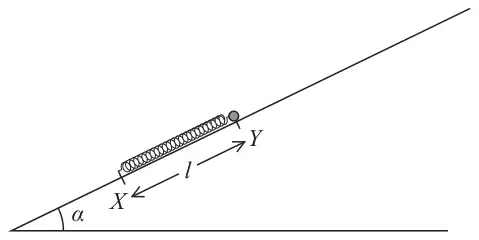
A light elastic spring has natural length \(3l\) and modulus of elasticity \(3mg\).
One end of the spring is attached to a fixed point \(X\) on a rough inclined plane.
The other end of the spring is attached to a package \(P\) of mass \(m\).
The plane is inclined to the horizontal at an angle \(\alpha\) where \(\tan\alpha = \dfrac{3}{4}\)
The package is initially held at the point \(Y\) on the plane, where \(XY = l\). The point \(Y\) is higher than \(X\) and \(XY\) is a line of greatest slope of the plane, as shown in Figure 2.
The package is released from rest at \(Y\) and moves up the plane.
The coefficient of friction between \(P\) and the plane is \(\dfrac{1}{3}\)
By modelling \(P\) as a particle,
(a) show that the acceleration of \(P\) at the instant when \(P\) is released from rest is \(\dfrac{17}{15}g\) (5)
(b) find, in terms of \(g\) and \(l\), the speed of \(P\) at the instant when the spring first reaches its natural length of \(3l\). (6)
Mark scheme (a)
Scheme
Marks
AO
Thrust in the spring \(= \dfrac{3mg\,2l}{3l}\ \ (= 2mg)\)
6. A light elastic string with natural length \(l\) and modulus of elasticity \(kmg\) has one end attached to a fixed point \(A\) on a rough inclined plane. The other end of the string is attached to a package of mass \(m\).
The plane is inclined at an angle \(\theta\) to the horizontal, where \(\tan\theta = \dfrac{5}{12}\)
The package is initially held at \(A\). The package is then projected with speed \(\sqrt{6gl}\) up a line of greatest slope of the plane and first comes to rest at the point \(B\), where \(AB = 3l\).
The coefficient of friction between the package and the plane is \(\dfrac{1}{4}\)
By modelling the package as a particle,
(a) show that \(k = \dfrac{15}{26}\) (6)
(b) find the acceleration of the package at the instant it starts to move back down the plane from the point \(B\). (5)
Mark scheme (a)
Scheme
Marks
AO
Work done against friction \(= 3l \times \mu mg\cos\theta\ \ \left(= \dfrac{9mgl}{13}\right)\) Gain in EPE \(= \dfrac{kmg \times 4l^2}{2l}\ \ (= 2kmgl)\) Gain in GPE \(= mg \times 3l\sin\theta\ \ \left(= \dfrac{15mgl}{13}\right)\)
M1: Use conservation of energy with EPE \(= \dfrac{\lambda x^2}{2a}\). (Condone EPE \(= \dfrac{\lambda x^2}{a}\) here). All three terms required. Must be dimensionally correct. Condone sign errors.
M1: Maximum speed at equilibrium seen or implied, and correct method to find \(e\)
A1: Correct \(e\)
Alternative: form energy equation for movement through a height of \(h\) and differentiate \(v^2\) wrt \(h\) to find \(h\) for max \(v\) M1 \(h = \dfrac{5a}{4}\) A1
M1: Form energy equation for movement from \(A\) to equilibrium position. Need all 4 terms. Correct form for EPE. Dimensionally correct. Condone sign errors. Allow in \(a\), \(g\) and \(e\) (with \(e\) defined)
A1ft A1ft: Unsimplified equation in their \(e\) with at most one error Correct unsimplified equation (using their \(e\)) for \(v\)
A1: Any equivalent form. Accept \(1.44\sqrt{ag}\) or \(1.4\sqrt{ag}\)
SHM is not on this specification, but you might see some candidates using it. See below for SHM alternative for parts (b) and (c)
SHM alternative for parts (b) and (c)
Scheme
Marks
AO
At equilibrium, \(\dfrac{4mge}{3a} = mg\), \(e = \dfrac{3a}{4}\) Equation of motion: \(mg - \dfrac{4mg}{3a}(e + x) = m\ddot{x}\), so \(\ddot{x} = -\dfrac{4g}{3a}x\) Hence SHM They need to start by showing that they have SHM in order to justify using the standard results. No marks scored for this at this stage.
(b) Use of \(x = \dfrac{5a}{4}\) and their \(\omega^2\) Substitute to find acceleration
M1
\(\ddot{x} = -\dfrac{4g}{3a} \times \dfrac{5a}{4} = -\dfrac{5g}{3}\), \(|\ddot{x}| = \dfrac{5g}{3}\) Correct only ISW. Condone \(1.7g\) or better
A1
(2)
(c) \(\dfrac{4mge}{3a} = mg\),
M1
\(e = \dfrac{3a}{4}\) This work now scores the two marks provided it is used in part (c)
A1
Use of \(v_{\max} = \omega a\) Correct method to find max \(v\)
M1
\(v_{\max} = \sqrt{\dfrac{4g}{3a}} \times \dfrac{5a}{4}\) Follow their \(e\) and \(\omega\)
A2ft
\(v_{\max} = \dfrac{5}{2}\sqrt{\dfrac{ga}{3}}\) Any equivalent form. Accept \(1.44\sqrt{ag}\) or \(1.4\sqrt{ag}\)
4. One end of a light elastic string, of modulus of elasticity \(2mg\) and natural length \(l\), is fixed to a point \(O\) on a rough plane. The plane is inclined at angle \(\alpha\) to the horizontal, where \(\sin\alpha = \dfrac{3}{5}\). The other end of the string is attached to a particle \(P\) of mass \(m\) which is held at rest on the plane at the point \(O\). The coefficient of friction between \(P\) and the plane is \(\dfrac{1}{4}\). The particle is released from rest and slides down the plane, coming to instantaneous rest at the point \(A\), where \(OA = kl\).
Given that \(k > 1\), find, to 3 significant figures, the value of \(k\). (7)
Mark scheme
Scheme
Marks
Elastic energy \(= \dfrac{1}{2} \times 2mg\dfrac{x^2}{l}\)
B1
Work done by friction = \((l + x)\mu mg\cos\alpha\)
B1
Energy from release: \((l + x)\mu mg\cos\alpha + \dfrac{1}{2} \times 2mg\dfrac{x^2}{l} = (l + x)mg\sin\alpha\)
M1 Attempt a work-energy equation. Must have 3 terms: work done by friction, elastic energy, GPE. EPE term must be of the form \(= k\lambda\dfrac{x^2}{l}\) \(k = 1, 2\) or \(\dfrac{1}{2}\) Work done term must be of the form distance \(\times\ \mu mg\cos\) or \(\sin\alpha\)
A1ft Correct equation, ft their EPE and work terms
dM1 Solve their 3 term quadratic to obtain a value for the extension as a multiple of \(l\). Award if correct answer follows a correct quadratic. If the quadratic is incorrect award only if working shown (ie general formula shown explicitly and used or by implication through substitution correct for their equation, pos root only needed)
A1 Correct extension decimal or exact
A1 Complete by adding 1 to the numerical multiple of \(l\) Must be 3 significant figures.
(Corrected from the printed mark scheme: the fifth line is printed as \(l^2 + 4lx + 5x^2 = 3l^2 + 3lx\).)
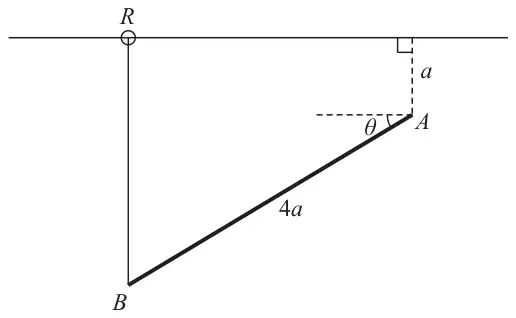
A uniform rod \(AB\) has mass \(m\) and length \(4a\). The end \(A\) of the rod is freely hinged to a fixed point. One end of a light elastic string, of natural length \(a\) and modulus \(\dfrac{1}{4}mg\), is attached to the end \(B\) of the rod. The other end of the string is attached to a small light smooth ring \(R\). The ring can move freely on a smooth horizontal wire which is fixed at a height \(a\) above \(A\), and in a vertical plane through \(A\). The angle between the rod and the horizontal is \(\theta\), where \(0 \lt \theta \lt \dfrac{\pi}{2}\), as shown in Figure 1. Given that the elastic string is vertical,
(a) show that the potential energy of the system is \[2mga(\sin^2\theta - \sin\theta) + \text{constant}\] (4)
(b) Show that when \(\theta = \dfrac{\pi}{6}\) the rod is in stable equilibrium. (7)
Mark scheme (a)
Scheme
Marks
For the rod: GPE \(= -2mga\sin\theta\) Must be working from a fixed point
B1
Extension in the string \(= 4a\sin\theta\)
B1
GPE in the string \(= \dfrac{\frac{1}{4}mgx^2}{2a}\)
M1
Total \(\dfrac{mg}{8a}\times(4a\sin\theta)^2 - 2mga\sin\theta = 2mga\left(\sin^2\theta - \sin\theta\right) +\) constant Given Answer
Second derivative: \(\dfrac{\mathrm{d}^2V}{\mathrm{d}\theta^2} = 2amg\left(2\cos^2\theta - 2\sin^2\theta + \sin\theta\right)\)
M1A1
Substitute \(\theta = \dfrac{\pi}{6}\) in both:
M1
\(\dfrac{\mathrm{d}V}{\mathrm{d}\theta} = 2mga\left(2\times\dfrac{1}{2}\cos\theta - \cos\theta\right) = 0\) hence equilibrium cso Allow from working to find solutions for \(\theta\)
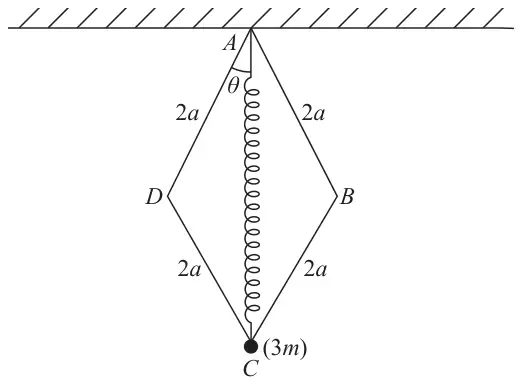
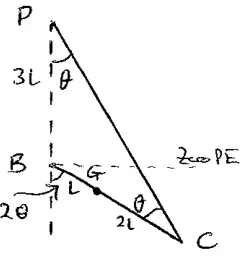
Figure 2 shows four uniform rods, each of mass \(m\) and length \(2a\). The rods are freely hinged at their ends to form a rhombus \(ABCD\). Point \(A\) is attached to a fixed point on a ceiling and the rhombus hangs freely with \(C\) vertically below \(A\). A light elastic spring of natural length \(2a\) and modulus of elasticity \(7mg\) connects the points \(A\) and \(C\). A particle of mass \(3m\) is attached to point \(C\).
(a) Show that, when \(AD\) is at an angle \(\theta\) to the downward vertical, the potential energy \(V\) of the system is given by \[V = 28mga\cos^2\theta - 48mga\cos\theta + \text{constant}\] (5)
Given that \(\theta \gt 0\)
(b) find the value of \(\theta\) for which the system is in equilibrium, (4)
(c) determine the stability of this position of equilibrium. (4)
Mark scheme (a)
Scheme
Marks
Relative to the fixed point A, PE of mass at C \(= -3mg\times 4a\cos\theta\)
B1
PE of rods \(= -2mg\times a\cos\theta - 2mg\times 3a\cos\theta\)
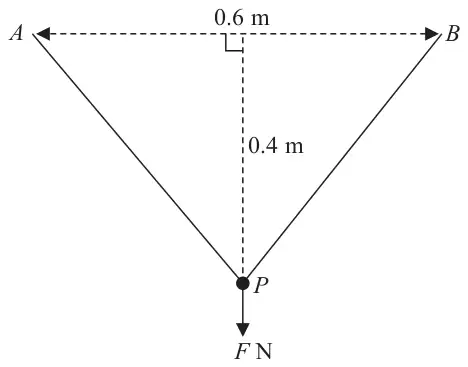
6. The ends of a light elastic string, of natural length 0.4 m and modulus of elasticity \(\lambda\) newtons, are attached to two fixed points \(A\) and \(B\) which are 0.6 m apart on a smooth horizontal table. The tension in the string is 8 N.
(a) Show that \(\lambda = 16\) (3)
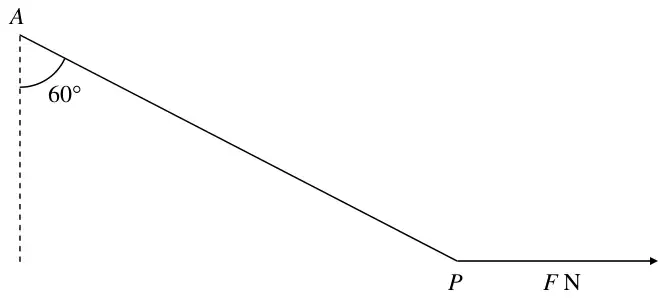
A particle \(P\) is attached to the midpoint of the string. The particle \(P\) is now pulled horizontally in a direction perpendicular to \(AB\) to a point 0.4 m from the midpoint of \(AB\). The particle is held at rest by a horizontal force of magnitude \(F\) newtons acting in a direction perpendicular to \(AB\), as shown in Figure 5 below.
Figure 5
(b) Find the value of \(F\). (4)
The particle is released from rest. Given that the mass of \(P\) is 0.3 kg,
(c) find the speed of \(P\) as it crosses the line \(AB\). (6)
Mark scheme (a)
Scheme
Marks
\(8 = \dfrac{\lambda \times 0.20}{0.40}\)
M1A1
\(\lambda = 16\) *
A1cso
(3)
Notes
M1 Attempt Hooke's Law using the whole string or a half string.
A1 Correct equation.
A1cso Correct given value of \(\lambda\) obtained with no errors seen.
M1 Use Hooke's Law with the new longer length for the string or half string. \(\lambda\) must be 16, but length need not be correct but use of 0.2 for extension of full string or 0.1 for extension of half string scores M0.
A1 Obtain \(T = 24\)
M1 Resolve parallel to \(F\) or in another direction which gives an equation connecting \(T\) and \(F\).
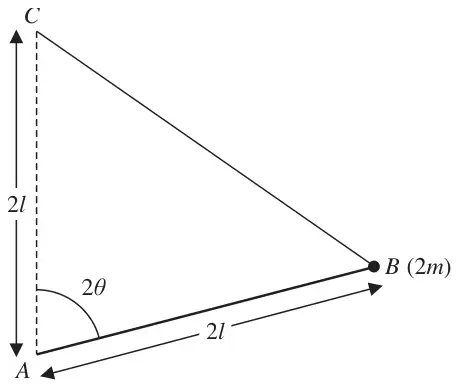
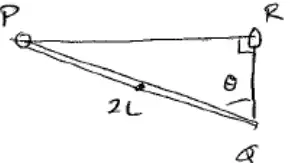
Figure 3 shows a uniform rod \(AB\), of length \(2l\) and mass \(4m\). A particle of mass \(2m\) is attached to the rod at \(B\). The rod can turn freely in a vertical plane about a fixed smooth horizontal axis through \(A\). One end of a light elastic spring, of natural length \(2l\) and modulus of elasticity \(kmg\), where \(k \gt 4\), is attached to the rod at \(B\). The other end of the spring is attached to a fixed point \(C\) which is vertically above \(A\), where \(AC = 2l\). The angle \(BAC\) is \(2\theta\), where \(\dfrac{\pi}{6} \lt \theta \leqslant \dfrac{\pi}{2}\)
(a) Show that the potential energy of the system is \[4mgl\{(k - 4)\sin^2\theta - k\sin\theta\} + \text{constant}\] (6)
Given that there is a position of equilibrium with \(\theta \neq \dfrac{\pi}{2}\)
(b) show that \(k \gt 8\) (6)
Given that \(k = 10\)
(c) determine the stability of this position of equilibrium. (4)
3. One end of a light elastic string, of natural length 1.5 m and modulus of elasticity 14.7 N, is attached to a fixed point \(O\) on a ceiling. A particle \(P\) of mass 0.6 kg is attached to the free end of the string. The particle is held at \(O\) and released from rest. The particle comes to instantaneous rest for the first time at the point \(A\).
Find
(a) the distance \(OA\), (6)
(b) the magnitude of the instantaneous acceleration of \(P\) at \(A\). (3)
1. A particle \(P\) of mass 0.5 kg is attached to one end of a light elastic spring, of natural length 1.2 m and modulus of elasticity \(\lambda\) newtons. The other end of the spring is attached to a fixed point \(A\) on a ceiling. The particle is hanging freely in equilibrium at a distance 1.5 m vertically below \(A\).
(a) Find the value of \(\lambda\). (3)
The particle is now raised to the point \(B\), where \(B\) is vertically below \(A\) and \(AB = 0.8\) m. The spring remains straight. The particle is released from rest and first comes to instantaneous rest at the point \(C\).
(b) Find the distance \(AC\). (4)
Mark scheme (a)
Scheme
Marks
\(0.5g = T = \dfrac{\lambda \times 0.3}{1.2}\)
M1A1
\(\lambda = 2g = 19.6\)
A1
(3)
Notes
M1 Use Hooke's law to obtain the tension and equate to the weight
A1 Correct equation
A1 Solve to get \(\lambda = 19.6\) Accept 20 or \(2g\)
3. One end \(A\) of a light elastic string \(AB\), of modulus of elasticity \(mg\) and natural length \(a\), is fixed to a point on a rough plane inclined at an angle \(\theta\) to the horizontal. The other end \(B\) of the string is attached to a particle of mass \(m\) which is held at rest on the plane. The string \(AB\) lies along a line of greatest slope of the plane, with \(B\) lower than \(A\) and \(AB = a\). The coefficient of friction between the particle and the plane is \(\mu\), where \(\mu < \tan\theta\). The particle is released from rest.
(a) Show that when the particle comes to rest it has moved a distance \(2a(\sin\theta - \mu\cos\theta)\) down the plane. (6)
(b) Given that there is no further motion, show that \(\mu \geqslant \dfrac{1}{3}\tan\theta\). (5)
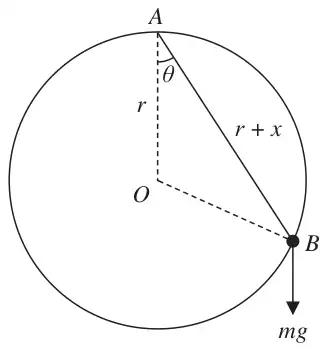
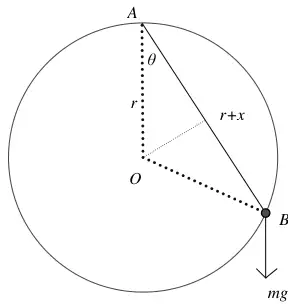
A bead \(B\) of mass \(m\) is threaded on a smooth circular wire of radius \(r\), which is fixed in a vertical plane. The centre of the circle is \(O\), and the highest point of the circle is \(A\). A light elastic string of natural length \(r\) and modulus of elasticity \(kmg\) has one end attached to the bead and the other end attached to \(A\). The angle between the string and the downward vertical is \(\theta\), and the extension in the string is \(x\), as shown in Figure 2.
Given that the string is taut,
(a) show that the potential energy of the system is \[2mgr\{(k - 1)\cos^2\theta - k\cos\theta\} + \text{constant}\] (6)
Given also that \(k = 3\),
(b) find the positions of equilibrium and determine their stability. (9)
Mark scheme (a)
Scheme
Marks
Measuring GPE from A, GPE \(= -mg\cos\theta(r + x)\)
B1
EPE \(= \dfrac{kmgx^2}{2r}\)
B1
From the isosceles triangle, \(\cos\theta = \dfrac{x + r}{2r}\)
One end of a light elastic string, of natural length \(l\) and modulus of elasticity \(3mg\), is fixed to a point \(A\) on a fixed plane inclined at an angle \(\alpha\) to the horizontal, where \(\sin\alpha = \dfrac{3}{5}\)
A small ball of mass \(2m\) is attached to the free end of the string. The ball is held at a point \(C\) on the plane, where \(C\) is below \(A\) and \(AC = l\) as shown in Figure 3. The string is parallel to a line of greatest slope of the plane. The ball is released from rest. In an initial model the plane is assumed to be smooth.
(a) Find the distance that the ball moves before first coming to instantaneous rest. (5)
In a refined model the plane is assumed to be rough. The coefficient of friction between the ball and the plane is \(\mu\). The ball first comes to instantaneous rest after moving a distance \(\dfrac{2}{5}l\).
(b) Find the value of \(\mu\). (6)
Mark scheme (a)
Scheme
Marks
\(\dfrac{3mgx^2}{2l} = 2mgx\sin\alpha\)
M1A1 B1(A1 on e-pen)
\(3x^2 = 4xl \times \dfrac{3}{5}\)
\(5x^2 = 4xl\)
\(x = \dfrac{4}{5}l\)
DM1A1
(5)
Notes
M1 for an energy equation with an EPE term of the form \(\dfrac{kmgx^2}{l}\) and a GPE term. If a KE term is included it must become 0 later.
A1 for a correct EPE term
B1 for a correct GPE term. This can be in terms of the distance moved down the plane or the vertical distance fallen
M1 dep for solving their equation to obtain the distance moved or using the vertical distance and obtaining the distance moved along the plane.
A1 for \(x = \dfrac{4}{5}l\) oe eg \(x = \dfrac{12}{15}l\)
If \(m\) used instead of \(2m\), assuming correct otherwise: (a) M1A1B0M1A0 (so 2 penalties for mis-read)
B1 for resolving perpendicular to the plane to obtain \(R = 2mg\cos\alpha\). May only be seen in an equation.
M1 for an work-energy equation with an EPE term of the form \(\dfrac{kmgx^2}{l}\), a GPE term and the work done against friction. The work term must include a distance along the plane.
A1 for EPE and GPE terms correct and work subtracted from the GPE
B1 ft for the work term ft their \(R\)
M1 dep for solving to obtain a value for \(\mu\)
A1 cso for \(\mu = \dfrac{3}{8}\) oe inc 0.375 but not 0.38
If \(m\) used instead of \(2m\), assuming correct otherwise:
(b) B1 \(R = mg\cos\alpha\)
M1, A1 Equation, with EPE correct and \(mg \times \dfrac{2}{5}l \times \dfrac{3}{5}\)
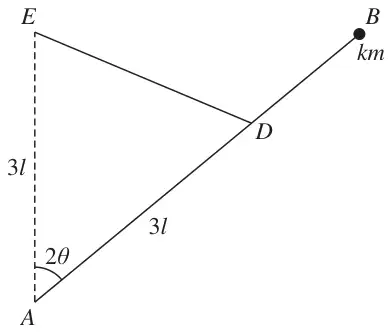
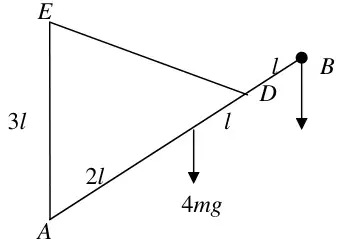
A uniform rod \(AB\) has mass \(4m\) and length \(4l\). The rod can turn freely in a vertical plane about a fixed smooth horizontal axis through \(A\). A particle of mass \(km\), where \(k < 7\), is attached to the rod at \(B\). One end of a light elastic string, of natural length \(l\) and modulus of elasticity \(4mg\), is attached to the point \(D\) of the rod, where \(AD = 3l\). The other end of the string is attached to a fixed point \(E\) which is vertically above \(A\), where \(AE = 3l\), as shown in Figure 2. The angle between the rod and the upward vertical is \(2\theta\), where \(\arcsin\left(\dfrac{1}{6}\right) < \theta \leqslant \dfrac{\pi}{2}\).
(a) Show that, while the string is stretched, the potential energy of the system is \[8mgl\{(7 - k)\sin^2\theta - 3\sin\theta\} + \text{constant}\] (6)
There is a position of equilibrium with \(\theta \leqslant \dfrac{\pi}{6}\).
(b) Show that \(k \leqslant 4\) (5)
Given that \(k = 4\),
(c) show that this position of equilibrium is stable. (5)
Mark scheme (a)
Scheme
Marks
Length of string \(= 2 \times 3l\sin\theta\)
B1
Extension \(= 6l\sin\theta - l\)
E.P.E. \(= \dfrac{4mg}{2l}(6l\sin\theta - l)^2\)
G.P.E. of rod \(= 4mg \times 2l\cos 2\theta\)
G.P.E. of mass at \(B\) \(= kmg \times 4l\cos 2\theta\)
3. A particle \(P\) of mass 0.5 kg is attached to one end of a light elastic spring, of natural length 2 m and modulus of elasticity 20 N. The other end of the spring is attached to a fixed point \(A\). The particle \(P\) is held at rest at the point \(B\), which is 1 m vertically below \(A\), and then released.
(a) Find the acceleration of \(P\) immediately after it is released from rest. (4)
The particle comes to instantaneous rest for the first time at the point \(C\).
(b) Find the distance \(BC\). (6)
Mark scheme (a)
Scheme
Marks
Weight + thrust = mass x accn.
M1
\(0.5 \times g + \dfrac{20 \times 1}{2} = 0.5a\)
B1(thrust) A1ft
\(a = g + 20 = 29.8 \approx 30\) (m s\(^{-2}\))
A1
(4)
Mark scheme (b)
Scheme
Marks
Change in GPE \(= mg(x + 1)\)
B1
EPE at B \(= \dfrac{20 \times 1^2}{2 \times 2}\) or EPE at C \(= \dfrac{20 \times x^2}{2 \times 2}\)
4. A particle \(P\) of mass 2 kg is attached to one end of a light elastic string of natural length 1.2 m. The other end of the string is attached to a fixed point \(O\) on a rough horizontal plane. The coefficient of friction between \(P\) and the plane is \(\dfrac{2}{5}\). The particle is held at rest at a point \(B\) on the plane, where \(OB = 1.5\) m. When \(P\) is at \(B\), the tension in the string is 20 N. The particle is released from rest.
(a) Find the speed of \(P\) when \(OP = 1.2\) m. (7)
M1 for attempting Hooke's Law, formula must be correct, either explicitly or by correct substitution.
A1 for \(20 = \dfrac{\lambda \times 0.3}{1.2}\)
A1 for obtaining \(\lambda = 80\)
B1 for the initial EPE \(\dfrac{"\lambda" \times 0.3^2}{2.4}\ \ (= 3\text{ J})\) their value for \(\lambda\) allowed. May only be seen in the eqaution.
M1 for a work-energy equation with one EPE term, one KE term and work done against friction (Award if second EPE/KE terms included provided these become 0). The EPE must be dimensionally correct, but need not be fully correct (eg denominator 1.2 instead of 2.4)
A1ft for a completely correct equation follow through their EPE
A1 cao for \(v = 0.80\) or 0.805 must be 2 or 3 sf
NB: This is damped harmonic motion (due to friction) so all SHM attempts lose the last 4 marks.
Mark scheme (b)
Scheme
Marks
Comes to rest \(0.4 \times 2g \times y = 3\)
M1
\(y = \dfrac{3}{0.4 \times 2 \times 9.8} = 0.38\) or 0.383 m
A1
(2)
(9 marks)
Notes
M1 for any complete method leading to a value for either \(BC\). If the distance travelled after the string becomes slack is found the work must be completed by adding 0.3 Their EPE found in (a) used in energy methods.
MS method is energy from \(B\) to \(C\) ie work done against friction = loss of EPE.
OR Energy from point where the string becomes slack to \(C\) ie work done against friction = loss of KE and completed for the required distance
OR NL2 to obtain the acceleration \(\left(-\dfrac{2g}{5}\right)\) while the string is slack and \(v^2 = u^2 + 2as\) to find the distance and completed for the required distance
A1cso for \(BC = 0.38\) or 0.383 (m) must be 2 or 3 sf
7. A particle \(P\) of mass 1.5 kg is attached to the mid-point of a light elastic string of natural length 0.30 m and modulus of elasticity \(\lambda\) newtons. The ends of the string are attached to two fixed points \(A\) and \(B\), where \(AB\) is horizontal and \(AB = 0.48\) m. Initially \(P\) is held at rest at the mid-point, \(M\), of the line \(AB\) and the tension in the string is 240 N.
(a) Show that \(\lambda = 400\) (3)
The particle is now held at rest at the point \(C\), where \(C\) is 0.07 m vertically below \(M\). The particle is released from rest at \(C\).
(b) Find the magnitude of the initial acceleration of \(P\). (6)
(c) Find the speed of \(P\) as it passes through \(M\). (6)
1. A particle of mass 0.8 kg is attached to one end of a light elastic string of natural length 0.6 m. The other end of the string is attached to a fixed point \(A\). The particle is released from rest at \(A\) and comes to instantaneous rest 1.1 m below \(A\).
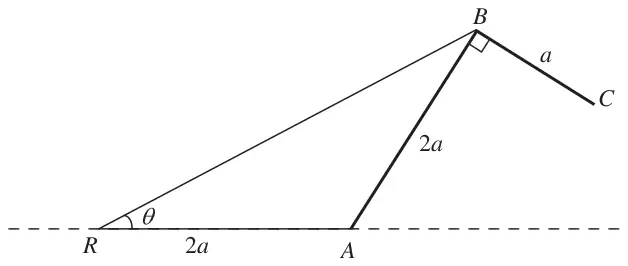
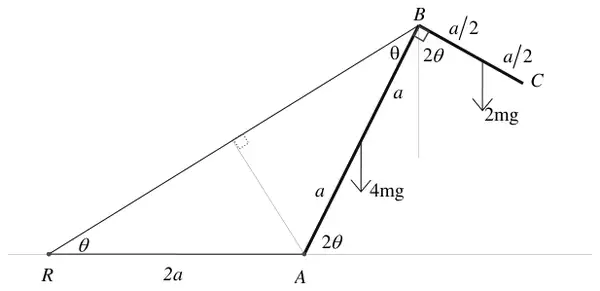
Figure 3 shows a framework \(ABC\), consisting of two uniform rods rigidly joined together at \(B\) so that \(\angle ABC = 90^\circ\). The rod \(AB\) has length \(2a\) and mass \(4m\), and the rod \(BC\) has length \(a\) and mass \(2m\). The framework is smoothly hinged at \(A\) to a fixed point, so that the framework can rotate in a fixed vertical plane. One end of a light elastic string, of natural length \(2a\) and modulus of elasticity \(3mg\), is attached to \(A\). The string passes through a small smooth ring \(R\) fixed at a distance \(2a\) from \(A\), on the same horizontal level as \(A\) and in the same vertical plane as the framework. The other end of the string is attached to \(B\).
The angle \(ARB\) is \(\theta\), where \(0 \lt \theta \lt \dfrac{\pi}{2}\).
(a) Show that the potential energy \(V\) of the system is given by\[V = 8amg\sin 2\theta + 5amg\cos 2\theta + \text{constant}\] (7)
(b) Find the value of \(\theta\) for which the system is in equilibrium. (4)
(c) Determine the stability of this position of equilibrium. (3)
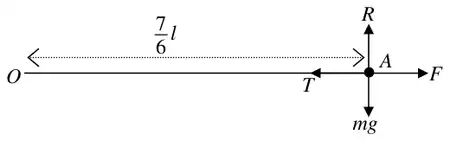
5. A particle \(P\) of mass \(m\) is attached to one end of a light elastic string of natural length \(l\) and modulus of elasticity \(3mg\). The other end of the string is attached to a fixed point \(O\) on a rough horizontal table. The particle lies at rest at the point \(A\) on the table, where \(OA = \dfrac{7}{6}l\). The coefficient of friction between \(P\) and the table is \(\mu\).
(a) Show that \(\mu \geqslant \dfrac{1}{2}\). (4)
The particle is now moved along the table to the point \(B\), where \(OB = \dfrac{3}{2}l\), and released from rest. Given that \(\mu = \dfrac{1}{2}\), find
(b) the speed of \(P\) at the instant when the string becomes slack, (5)
(c) the total distance moved by \(P\) before it comes to rest again. (3)
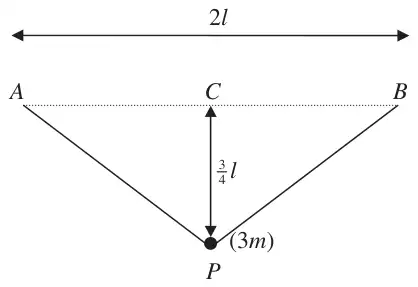
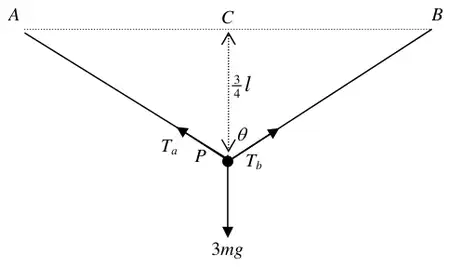
A small ball of mass \(3m\) is attached to the ends of two light elastic strings \(AP\) and \(BP\), each of natural length \(l\) and modulus of elasticity \(kmg\). The ends \(A\) and \(B\) of the strings are attached to fixed points on the same horizontal level, with \(AB = 2l\). The mid-point of \(AB\) is \(C\). The ball hangs in equilibrium at a distance \(\tfrac{3}{4}l\) vertically below \(C\) as shown in Figure 4.
(a) Show that \(k = 10\) (7)
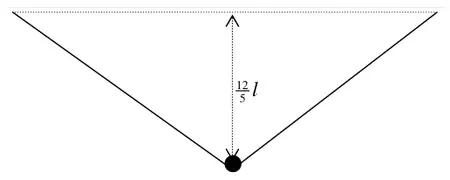
The ball is now pulled vertically downwards until it is at a distance \(\tfrac{12}{5}l\) below \(C\). The ball is released from rest.
(b) Find the speed of the ball as it reaches \(C\). (6)
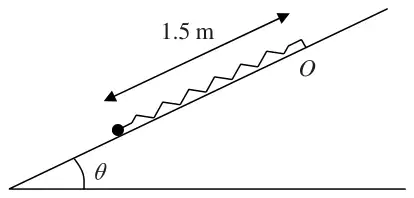
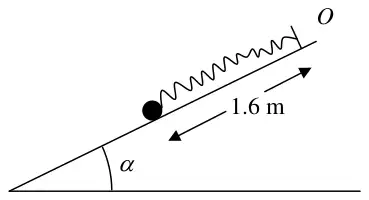
A particle of mass 0.5 kg is attached to one end of a light elastic spring of natural length 0.9 m and modulus of elasticity \(\lambda\) newtons. The other end of the spring is attached to a fixed point \(O\) on a rough plane which is inclined at an angle \(\theta\) to the horizontal, where \(\sin\theta = \dfrac{3}{5}\). The coefficient of friction between the particle and the plane is 0.15. The particle is held on the plane at a point which is 1.5 m down the line of greatest slope from \(O\), as shown in Figure 2. The particle is released from rest and first comes to rest again after moving 0.7 m up the plane.
7. A light elastic string has natural length \(a\) and modulus of elasticity \(\dfrac{3}{2}mg\). A particle \(P\) of mass \(m\) is attached to one end of the string. The other end of the string is attached to a fixed point \(A\). The particle is released from rest at \(A\) and falls vertically. When \(P\) has fallen a distance \(a + x\), where \(x > 0\), the speed of \(P\) is \(v\).
(a) Show that \(v^2 = 2g(a + x) - \dfrac{3gx^2}{2a}\). (4)
(b) Find the greatest speed attained by \(P\) as it falls. (4)
After release, \(P\) next comes to instantaneous rest at a point \(D\).
(c) Find the magnitude of the acceleration of \(P\) at \(D\). (6)
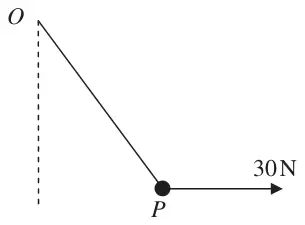
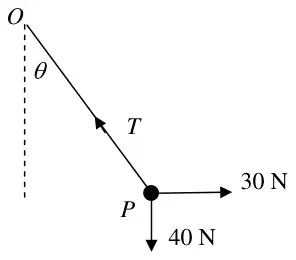
A particle \(P\) of weight 40 N is attached to one end of a light elastic string of natural length 0.5 m. The other end of the string is attached to a fixed point \(O\). A horizontal force of magnitude 30 N is applied to \(P\), as shown in Figure 3. The particle \(P\) is in equilibrium and the elastic energy stored in the string is 10 J.
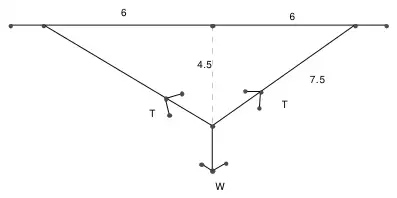
1. A light elastic string has natural length 8 m and modulus of elasticity 80 N. The ends of the string are attached to fixed points \(P\) and \(Q\) which are on the same horizontal level and 12 m apart. A particle is attached to the mid-point of the string and hangs in equilibrium at a point 4.5 m below \(PQ\).
(a) Calculate the weight of the particle. (6)
(b) Calculate the elastic energy in the string when the particle is in this position. (3)
One end \(A\) of a light elastic string, of natural length \(a\) and modulus of elasticity \(6mg\), is fixed at a point on a smooth plane inclined at 30\(^\circ\) to the horizontal. A small ball \(B\) of mass \(m\) is attached to the other end of the string. Initially \(B\) is held at rest with the string lying along a line of greatest slope of the plane, with \(B\) below \(A\) and \(AB = a\). The ball is released and comes to instantaneous rest at a point \(C\) on the plane, as shown in Figure 2.
Find
(a) the length \(AC\), (5)
(b) the greatest speed attained by \(B\) as it moves from its initial position to \(C\). (7)
Mark scheme (a)
Scheme
Marks
Let \(x\) be the distance from the initial position of \(B\) to \(C\) GPE lost = EPE gained
\(mgx\sin 30^\circ = \dfrac{6mgx^2}{2a}\)
M1 A1=A1
Leading to \(x = \dfrac{a}{6}\)
M1
\(AC = \dfrac{7a}{6}\)
A1
(5)
Mark scheme (b)
Scheme
Marks
The greatest speed is attained when the acceleration of \(B\) is zero, that is where the forces on \(B\) are equal.
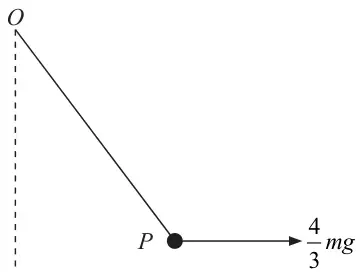
A particle \(P\) of mass \(m\) is attached to one end of a light elastic string, of natural length \(a\) and modulus of elasticity \(3mg\). The other end of the string is attached to a fixed point \(O\). The particle \(P\) is held in equilibrium by a horizontal force of magnitude \(\tfrac{4}{3}mg\) applied to \(P\). This force acts in the vertical plane containing the string, as shown in Figure 1. Find
(a) the tension in the string, (5)
(b) the elastic energy stored in the string. (4)
Mark scheme (a)
Scheme
Marks
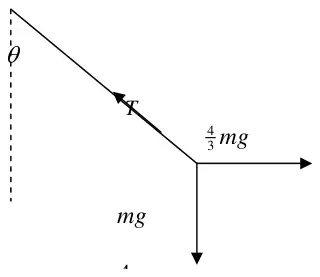
\((\leftarrow)\) \(T\sin\theta = \dfrac{4}{3}mg\)
M1 A1
\((\uparrow)\) \(T\cos\theta = mg\)
A1
\(T^2 = \left(\dfrac{4}{3}mg\right)^2 + (mg)^2\)
M1
Leading to \(T = \dfrac{5}{3}mg\)
A1
(5)
Mark scheme (b)
Scheme
Marks
HL \(T = \dfrac{\lambda x}{a} \Rightarrow \dfrac{5}{3}mg = \dfrac{3mge}{a}\) ft their \(T\)
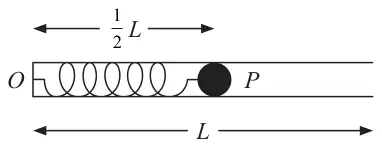
A light elastic spring, of natural length \(L\) and modulus of elasticity \(\lambda\), has a particle \(P\) of mass \(m\) attached to one end. The other end of the spring is fixed to a point \(O\) on the closed end of a fixed smooth hollow tube of length \(L\).
The tube is placed horizontally and \(P\) is held inside the tube with \(OP = \tfrac{1}{2}L\), as shown in Figure 1. The particle \(P\) is released and passes through the open end of the tube with speed \(\sqrt{(2gL)}\).
(a) Show that \(\lambda = 8mg\). (4)
The tube is now fixed vertically and \(P\) is held inside the tube with \(OP = \tfrac{1}{2}L\) and \(P\) above \(O\). The particle \(P\) is released and passes through the open top of the tube with speed \(u\).
4. A particle \(P\) of mass \(m\) lies on a smooth plane inclined at an angle 30\(^\circ\) to the horizontal. The particle is attached to one end of a light elastic string, of natural length \(a\) and modulus of elasticity \(2mg\). The other end of the string is attached to a fixed point \(O\) on the plane. The particle \(P\) is in equilibrium at the point \(A\) on the plane and the extension of the string is \(\tfrac{1}{4}a\). The particle \(P\) is now projected from \(A\) down a line of greatest slope of the plane with speed \(V\). It comes to instantaneous rest after moving a distance \(\tfrac{1}{2}a\).
By using the principle of conservation of energy,
(a) find \(V\) in terms of \(a\) and \(g\), (6)
(b) find, in terms of \(a\) and \(g\), the speed of \(P\) when the string first becomes slack. (4)
Mark scheme (a)
Scheme
Marks
Energy equation with at least three terms, including K.E term
In parts (a) and (b) A marks need to have the correct signs
In part (b) for M1 need one KE term in energy equation of at least 3 terms with distance \(\dfrac{3a}{4}\) to indicate first method, and two KE terms in energy equation of at least 4 terms with distance \(\dfrac{a}{4}\) to indicate second method.
Alternative (using point of projection and point where string becomes slack):
1. A light elastic string of natural length 0.4 m has one end \(A\) attached to a fixed point. The other end of the string is attached to a particle \(P\) of mass 2 kg. When \(P\) hangs in equilibrium vertically below \(A\), the length of the string is 0.56 m.
(a) Find the modulus of elasticity of the string. (3)
A horizontal force is applied to \(P\) so that it is held in equilibrium with the string making an angle \(\theta\) with the downward vertical. The length of the string is now 0.72 m.
(b) Find the angle \(\theta\). (3)
Mark scheme (a)
Scheme
Marks
\(T\) or \(\dfrac{\lambda \times e}{l} = mg\) (even \(T = m\) is M1, A0, A0 sp case)
M1
\(\dfrac{\lambda \times 0.16}{0.4} = 2g\)
A1
\(\Rightarrow \lambda = \underline{49\text{ N}}\) or 5g
A1
(3)
Mark scheme (b)
Scheme
Marks
R(\(\uparrow\)) \(T\cos\theta = mg\) or \(\cos\theta = \dfrac{mg}{T}\)
M1
\(49.\dfrac{0.32}{0.4}.\cos\theta = 19.6\) or \(4g.\cos\theta = 2g\) or \(2mg.\cos\theta = mg\) (ft on their \(\lambda\))
Special case \(T\sin\theta = mg\) giving \(\theta = 30\) is M1 A0 A0 unless there is evidence that they think \(\theta\) is with horizontal – then M1 A1 A0
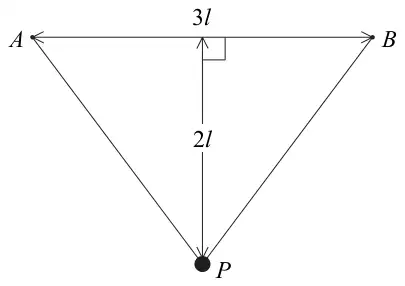
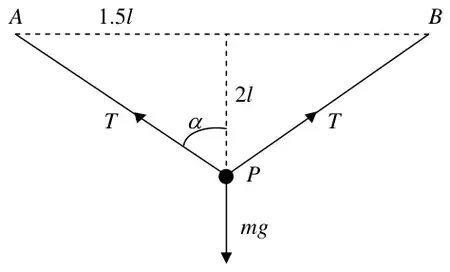
A light elastic string, of natural length \(3l\) and modulus of elasticity \(\lambda\), has its ends attached to two points \(A\) and \(B\), where \(AB = 3l\) and \(AB\) is horizontal. A particle \(P\) of mass \(m\) is attached to the mid-point of the string. Given that \(P\) rests in equilibrium at a distance \(2l\) below \(AB\), as shown in Figure 1,
(a) show that \(\lambda = \dfrac{15mg}{16}\). (9)
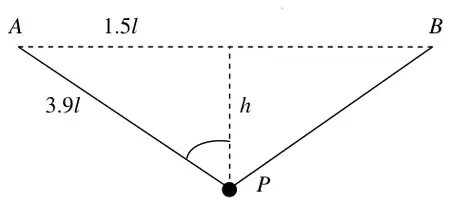
The particle is pulled vertically downwards from its equilibrium position until the total length of the elastic string is \(7.8l\). The particle is released from rest.
(b) Show that \(P\) comes to instantaneous rest on the line \(AB\). (6)
3. A particle \(P\) of mass \(m\) is attached to one end of a light elastic string, of natural length \(a\) and modulus of elasticity \(3.6mg\). The other end of the string is fixed at a point \(O\) on a rough horizontal table. The particle is projected along the surface of the table from \(O\) with speed \(\sqrt{(2ag)}\). At its furthest point from \(O\), the particle is at the point \(A\), where \(OA = \tfrac{4}{3}a\).
(a) Find, in terms of \(m\), \(g\) and \(a\), the elastic energy stored in the string when \(P\) is at \(A\). (3)
(b) Using the work-energy principle, or otherwise, find the coefficient of friction between \(P\) and the table. (6)
↓ marks a mark that depends on the M mark above it (an arrow in the scheme).
1st M1: allow for attempt to find work done by frictional force (i.e. not just finding friction). 2nd M1: “relevant” terms, i.e. energy or work terms! A1 f.t. on their work done by friction
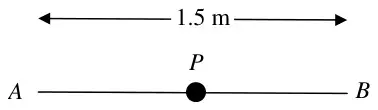
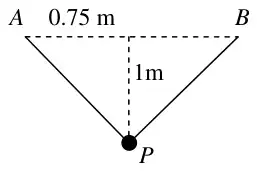
5. Two light elastic strings each have natural length 0.75 m and modulus of elasticity 49 N. A particle \(P\) of mass 2 kg is attached to one end of each string. The other ends of the strings are attached to fixed points \(A\) and \(B\), where \(AB\) is horizontal and \(AB = 1.5\) m.
Figure 2
The particle is held at the mid-point of \(AB\). The particle is released from rest, as shown in Figure 2.
(a) Find the speed of \(P\) when it has fallen a distance of 1 m. (6)
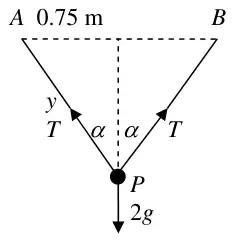
Given instead that \(P\) hangs in equilibrium vertically below the mid-point of \(AB\), with \(\angle APB = 2\alpha\),
(b) show that \(\tan\alpha + 5\sin\alpha = 5\). (6)
Mark scheme (a)
Scheme
Marks
\(AP = \sqrt{\left(0.75^2 + 1^2\right)} = 1.25\)
M1 A1
Conservation of energy
\(\dfrac{1}{2} \times 2 \times v^2 + 2 \times \dfrac{49 \times 0.5^2}{2 \times 0.75} = 2g \times 1\) −1 for each incorrect term
M1 A2 (1, 0)
Leading to \(v \approx 1.8\) (m s\(^{-1}\)) accept 1.81
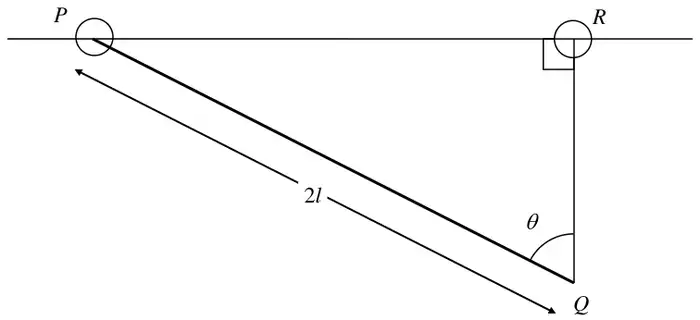
A uniform rod \(PQ\) has mass \(m\) and length \(2l\). A small smooth light ring is fixed to the end \(P\) of the rod. This ring is threaded on to a fixed horizontal smooth straight wire. A second small smooth light ring \(R\) is threaded on to the wire and is attached by a light elastic string, of natural length \(l\) and modulus of elasticity \(kmg\), to the end \(Q\) of the rod, where \(k\) is a constant.
(a) Show that, when the rod \(PQ\) makes an angle \(\theta\) with the vertical, where \(0 \lt \theta \leqslant \dfrac{\pi}{3}\), and \(Q\) is vertically below \(R\), as shown in Figure 1, the potential energy of the system is \[mgl\left[2k\cos^2\theta - (2k + 1)\cos\theta\right] + \text{constant}.\] (7)
Given that there is a position of equilibrium with \(\theta \gt 0\),
(b) show that \(k \gt \tfrac{1}{2}\). (5)
Mark scheme (a)
Scheme
Marks
PE of rod \(= -mgl\cos\theta\)
B1
EPE of string \(= \dfrac{kmg}{2l}(2l\cos\theta - l)^2\)
M1 A1
Total PE of system, \(\ V = -mgl\cos\theta + \dfrac{kmgl}{2}(2\cos\theta - 1)^2 + c\)
A particle \(P\) of mass 0.8 kg is attached to one end of a light inelastic string, of natural length 1.2 m and modulus of elasticity 24 N. The other end of the string is attached to a fixed point \(A\). A horizontal force of magnitude \(F\) newtons is applied to \(P\). The particle \(P\) in in equilibrium with the string making an angle 60\(^\circ\) with the downward vertical, as shown in Figure 1.
Calculate
(a) the value of \(F\), (3)
(b) the extension of the string, (3)
(c) the elasticity stored in the string. (2)
Mark scheme (a)
Scheme
Marks
\(\rightarrow\ \ F = T\sin 60^\circ \qquad \uparrow\ \ T\cos 60^\circ = 0.8g\) both
M1
[or (perpendicular to the string) \(\ F\cos 60^\circ = 0.8g\cos 30^\circ\) ]
5. A non-uniform rod \(BC\) has mass \(m\) and length \(3l\). The centre of mass of the rod is at distance \(l\) from \(B\). The rod can turn freely about a fixed smooth horizontal axis through \(B\). One end of a light elastic string, of natural length \(l\) and modulus of elasticity \(\dfrac{mg}{6}\), is attached to \(C\). The other end of the string is attached to a point \(P\) which is at a height \(3l\) vertically above \(B\).
(a) Show that, while the string is stretched, the potential energy of the system is \[mgl(\cos^2\theta - \cos\theta) + \text{constant},\] where \(\theta\) is the angle between the string and the downward vertical and \(-\dfrac{\pi}{2} \lt \theta \lt \dfrac{\pi}{2}\). (6)
(b) Find the values of \(\theta\) for which the system is in equilibrium with the string stretched. (6)
3. A light elastic string has natural length \(2l\) and modulus of elasticity \(4mg\). One end of the string is attached to a fixed point \(A\) and the other end to a fixed point \(B\), where \(A\) and \(B\) lie on a smooth horizontal table, with \(AB = 4l\). A particle \(P\) of mass \(m\) is attached to the mid-point of the string.
The particle is released from rest at the point of the line \(AB\) which is \(\dfrac{5l}{3}\) from \(B\). The speed of \(P\) at the mid-point of \(AB\) is \(V\).
(a) Find \(V\) in terms of \(g\) and \(L\). (7)
(b) Explain why \(V\) is the maximum speed of \(P\). (2)
Mark scheme (a)
Scheme
Marks
Elastic energy when \(P\) is at \(X\): \(E = \dfrac{4mg\left(\frac{2}{3}l\right)^2}{2l} + \dfrac{4mg\left(\frac{4}{3}l\right)^2}{2l}\ \ \left(= \dfrac{40mgl}{9}\right)\)
A particle of mass 0.8 kg is attached to one end of a light elastic spring, of natural length 2 m and modulus of elasticity 20 N. The other end of the spring is attached to a fixed point \(O\) on a smooth plane which is inclined at an angle \(\alpha\) to the horizontal, where \(\tan\alpha = \tfrac{3}{4}\). The particle is held on the plane at a point which is 1.6 m down a line of greatest slope of the plane from \(O\), as shown in Figure 1. The particle is then released from rest.
Find the initial acceleration of the particle. (6)
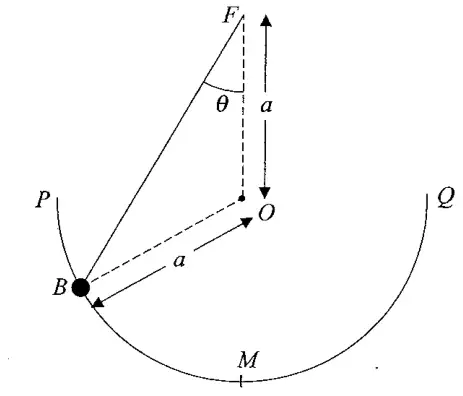
A smooth wire \(PMQ\) is in the shape of a semicircle with centre \(O\) and radius \(a\). The wire is fixed in a vertical plane with \(PQ\) horizontal and the mid-point \(M\) of the wire vertically below \(O\). A smooth bead \(B\) of mass \(m\) is threaded on the wire and is attached to one end of a light elastic string. The string has modulus of elasticity \(4mg\) and natural length \(\tfrac{5}{4}a\). The other end of the string is attached to a fixed point \(F\) which is a distance \(a\) vertically above \(O\), as shown in Fig. 1.
(a) Show that, when \(\angle BFO = \theta\), the potential energy of the system is \[\tfrac{1}{10}mga(8\cos\theta - 5)^2 - 2mga\cos^2\theta + \text{constant}.\] (6)
(b) Hence find the values of \(\theta\) for which the system is in equilibrium. (6)
(c) Determine the nature of the equilibrium at each of these positions. (5)
Mark scheme (a)
Scheme
Take \(O\) as zero p.e.
Mechanical potential energy \((mgh) = -mga\cos 2\theta\)
Total p.e. \(= -mga\left(2\cos^2\theta - 1\right) + \dfrac{8mg}{5a}\left(\dfrac{8a\cos\theta - 5a}{4}\right)^2\)
\(= -2mga\cos^2\theta + mga + \dfrac{mga}{10}(8\cos\theta - 5)^2\)
\(= \dfrac{mga}{10}(8\cos\theta - 5)^2 - 2mga\cos^2\theta + c \qquad\) (change of constant with referral of p.e. to any other zero position.)
Notes
The published mark scheme for this paper is a set of worked answers: no mark allocation is printed.
(Corrected from the printed mark scheme: the extension in the elastic potential energy is printed as \(2a\cos 2\theta - \tfrac{5}{4}a\); the string length is \(FB = 2a\cos\theta\), as used in the next line.)
Mark scheme (b)
Scheme
Equilibrium when p.e. is max/min so \(\dfrac{\mathrm{d}E}{\mathrm{d}\theta} = 0\)
When \(\theta = 0\), \(\ \dfrac{\mathrm{d}^2E}{\mathrm{d}\theta^2} = mga\left(8 - \tfrac{44}{5}\right) = -\tfrac{4}{5}mga\) which is \(\lt 0\) so max \(E\) so unstable.