
M4 June 2013 (R) Q6
6.
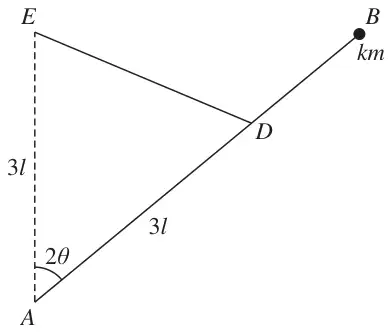
A uniform rod \(AB\) has mass \(4m\) and length \(4l\). The rod can turn freely in a vertical plane about a fixed smooth horizontal axis through \(A\). A particle of mass \(km\), where \(k < 7\), is attached to the rod at \(B\). One end of a light elastic string, of natural length \(l\) and modulus of elasticity \(4mg\), is attached to the point \(D\) of the rod, where \(AD = 3l\). The other end of the string is attached to a fixed point \(E\) which is vertically above \(A\), where \(AE = 3l\), as shown in Figure 2. The angle between the rod and the upward vertical is \(2\theta\), where \(\arcsin\left(\dfrac{1}{6}\right) < \theta \leqslant \dfrac{\pi}{2}\).
There is a position of equilibrium with \(\theta \leqslant \dfrac{\pi}{6}\).
Given that \(k = 4\),
| Scheme | Marks |
|---|---|
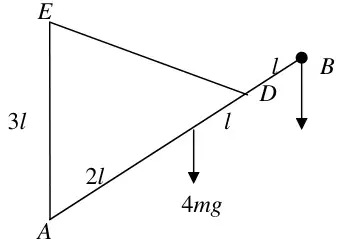
| Length of string \(= 2 \times 3l\sin\theta\) | B1 |
| Extension \(= 6l\sin\theta - l\) | |
| E.P.E. \(= \dfrac{4mg}{2l}(6l\sin\theta - l)^2\) | |
| G.P.E. of rod \(= 4mg \times 2l\cos 2\theta\) | |
| G.P.E. of mass at \(B\) \(= kmg \times 4l\cos 2\theta\) | |
| \(V = \dfrac{4mg}{2l}(6l\sin\theta - l)^2 + 8mgl\cos 2\theta + 4kmgl\cos 2\theta +\) const | M1 A2 |
| \(V = \dfrac{4mg}{2l}(6l\sin\theta - l)^2 + 8mgl\left(1 - 2\sin^2\theta\right) + 4kmgl\cos 2\theta +\) const | M1 |
| \(= 2mgl\left(36\sin^2\theta - 12\sin\theta - 8\sin^2\theta - 4k\sin^2\theta\right) +\) const | |
| \(= 8mgl\left((7 - k)\sin^2\theta - 3\sin\theta\right) +\) constant | A1 |
| (6) |
Notes
M1 EPE term needs to be dimensionally correct. Need all three terms.
A2 Correct unsimplified
M1 All in \(\sin\theta\)
A1 Given Answer
| Scheme | Marks |
|---|---|
| \(\dfrac{\mathrm{d}V}{\mathrm{d}\theta} = 8mgl\left(2(7 - k)\sin\theta\cos\theta - 3\cos\theta\right)\) | M1 |
| \(\dfrac{\mathrm{d}V}{\mathrm{d}\theta} = 0 \qquad \left(2(7 - k)\sin\theta - 3\right)\cos\theta = 0\) | M1 |
| \(\sin\theta = \dfrac{3}{2(7 - k)} \qquad (\text{or } \cos\theta = 0, \text{ need not be seen})\) | A1 |
| \(\theta \leqslant \frac{\pi}{6} \quad \Rightarrow \dfrac{3}{2(7 - k)} \leqslant \frac{1}{2}\) | M1 |
| \(3 \leqslant 7 - k \quad k \leqslant 4 \qquad *\) | A1 |
| (5) |
Notes
M1 Differentiate
M1 Set derivative = 0
M1 Use of \(\sin\theta \leqslant \dfrac{1}{2}\)
| Scheme | Marks |
|---|---|
| \(k = 4\ \Rightarrow \theta = \dfrac{\pi}{6}\) | B1 |
| \(\dfrac{\mathrm{d}^2V}{\mathrm{d}\theta^2} = 8mgl\left[6\cos^2\theta - (6\sin\theta - 3)\sin\theta\right]\) | M1 |
| \(= 8mgl\left[6 \times \left(\dfrac{\sqrt{3}}{2}\right)^2 - 6 \times \left(\dfrac{1}{2}\right)^2 + 3 \times \dfrac{1}{2}\right]\) | A1 |
| \(\dfrac{\mathrm{d}^2V}{\mathrm{d}\theta^2} > 0\) | M1 |
| \(V\) is min. \(\quad \therefore\) stable equilibrium | A1 |
| (5) | |
| (16 marks) |
Notes
M1 Second derivative (\(8mgl\) or \(24mgl\) not needed) [or differentiate \(8mgl(3\sin 2\theta - 3\cos\theta)\)]
A1 Numerical unsimplified
M1 by numerical evaluation or justification from trig terms \((36mgl)\)
A1 CSO