A2 June 2025 Q6
6.
| Player B | ||||
|---|---|---|---|---|
| Option P | Option Q | Option R | ||
| Player A | Option X | \(4\) | \(-2\) | \(-5\) |
| Option Y | \(-1\) | \(1\) | \(3\) | |
A two person zero-sum game is represented by the pay-off matrix for player A shown above.
Let player A play option X with probability \(p\)
A third option, Z, is added to player A’s options. Option Z has the pay-offs shown in the matrix below.
| Player B | ||||
|---|---|---|---|---|
| Option P | Option Q | Option R | ||
| Player A | Option X | \(4\) | \(-2\) | \(-5\) |
| Option Y | \(-1\) | \(1\) | \(3\) | |
| Option Z | \(4\) | \(-1\) | \(1\) | |
Player A now intends to make a random choice between options X, Y and Z, choosing option X with probability \(x\), option Y with probability \(y\) and option Z with probability \(z\)
Player A decides to use the Simplex algorithm to find the optimal values of \(x\), \(y\) and \(z\)
In the optimal Simplex tableau for this \(3 \times 3\) game, \(x = 0\) and \(y = \dfrac{5}{7}\)
You must make your reasoning clear. (3)
| Scheme | Marks | AO |
|---|---|---|
| Row minima: \(-5, -1\) max is \(-1\) Column maxima: 4, 1, 3 min is 1 | M1 | 1.1b |
| Row maximin \((-1) \neq\) Column minimax (1) so not stable | A1 | 2.4 |
| (2) |
Notes
M1: Attempt to calculate row minima and column maxima (all 5 values) – condone one error
A1: Correct reasoning that the game is not stable (accept \(-1 \neq 1\) + statement) – dependent on correct row maximin and column minimax which must be clearly identified either around the table or in their statement (must have all 5 max and min values correct)
| Scheme | Marks | AO |
|---|---|---|
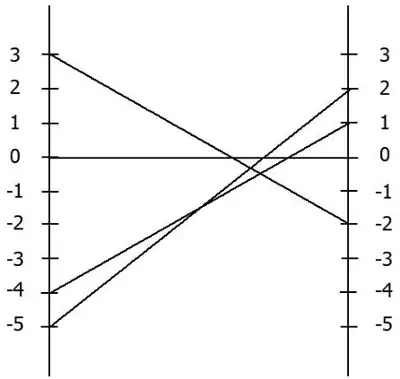
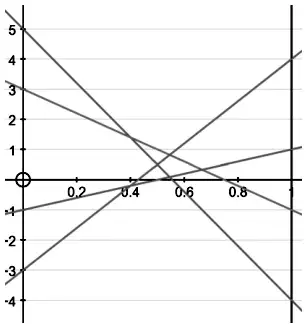
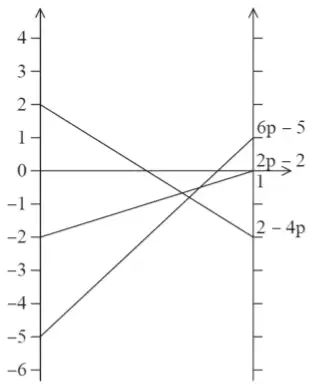
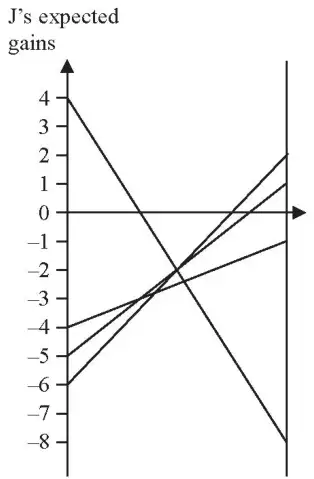
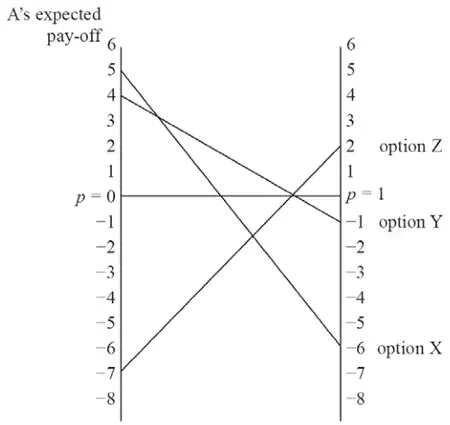
| If B plays option P, A’s gains are \(4p + (-1)(1-p) = -1 + 5p\) If B plays option Q, A’s gains are \(-2p + 1(1-p) = 1 - 3p\) If B plays option R, A’s gains are \(-5p + 3(1-p) = 3 - 8p\) | M1 A1 | 1.1b 1.1b |
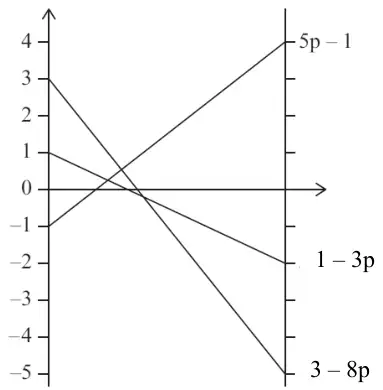 | M1 A1 | 1.1b 1.1b |
| \(1 - 3p = -1 + 5p \Rightarrow p = 1/4\) | A1 | 1.1b |
| A should play option X with probability 1/4 and option Y with probability 3/4 | A1ft | 3.2a |
| (6) |
Notes
M1: setting up three expressions in terms of \(p\)
A1: all three expressions correct
M1: axes correct, at least two lines correctly drawn for their expressions, horizontal scale from 0 to 1
A1: correct graph
A1: using the graph to obtain the correct probability expressions leading to the correct value of \(p\)
A1ft: interpret their value of \(p\) in the context of the question – must refer to play and name options
| Scheme | Marks | AO | ||||||||||||||||||||||||||||||||||||||||||||||||||||||||||||
|---|---|---|---|---|---|---|---|---|---|---|---|---|---|---|---|---|---|---|---|---|---|---|---|---|---|---|---|---|---|---|---|---|---|---|---|---|---|---|---|---|---|---|---|---|---|---|---|---|---|---|---|---|---|---|---|---|---|---|---|---|---|---|
| e.g. \(\begin{pmatrix} 4 & -2 & -5 \\ -1 & 1 & 3 \\ 4 & -1 & 1 \end{pmatrix} \rightarrow \begin{pmatrix} 9 & 3 & 0 \\ 4 & 6 & 8 \\ 9 & 4 & 6 \end{pmatrix}\) | B1 | 1.1b | ||||||||||||||||||||||||||||||||||||||||||||||||||||||||||||
| e.g. \(V - 9x - 4y - 9z + r = 0\) \(V - 3x - 6y - 4z + s = 0\) \(V - 8y - 6z + t = 0\) \(x + y + z + u = 1\) \(P - V = 0\) | ||||||||||||||||||||||||||||||||||||||||||||||||||||||||||||||
e.g.
| B1 B1 B1 | 3.3 1.1b 1.1b | ||||||||||||||||||||||||||||||||||||||||||||||||||||||||||||
| (4) |
Notes
(c) Condone use of \(p_1\ p_2\ p_3\) instead of \(x\ y\ z\)
B1: Correct augmentation (by at least 5) – possibly implied by later working in tableau
B1: Any one (numerical in nature) constraint row (\(r\), \(s\), \(t\) or \(u\)) correct (ignore labelling of b.v. column) or one correct constraint equation stated (so must be using columns)
B1: Any two (numerical in nature) constraint row (\(r\), \(s\), \(t\) or \(u\)) correct (ignore labelling of b.v. column) or two correct constraint equations stated
B1: CAO (including b.v. column)
| Scheme | Marks | AO |
|---|---|---|
| \(x = 0,\ y = \dfrac{5}{7} \Rightarrow z = \dfrac{2}{7}\) | B1 | 1.1b |
| e.g. \(V \leqslant \dfrac{38}{7}, \dfrac{38}{7}, \dfrac{52}{7} \Rightarrow V = \dfrac{38}{7}\) so the value of the \(3 \times 3\) game is \(\dfrac{3}{7}\) | M1 | 3.4 |
| The value of the \(3 \times 3\) game is \(\dfrac{3}{7}\) which is \(\dfrac{5}{28}\) better than the value of the \(2 \times 3\) game which was \(\dfrac{1}{4}\) | A1 | 2.4 |
| (3) | ||
| (15 marks) |
Notes
B1: correct value for \(z\) (may be implied by subsequent working)
M1: Attempts to calculate the value of the \(3 \times 3\) game – must substitute in to at least two of their equations which may either be augmented or unaugmented
(if using the original game then expect to see (if correct) \(V \leqslant \dfrac{3}{7}, \dfrac{3}{7}, \dfrac{17}{7} \Rightarrow V = \dfrac{3}{7}\) so the value of the \(3 \times 3\) game is \(\dfrac{3}{7}\))
A1: Correct values for both games seen together with some indication of how much better the new game is (could be given as a % increase, for example ‘71.4% better’, or equivalent or as a multiplier e.g, \(\dfrac{12}{7}\) or 1.714)