
A2 October 2021 Q7
7. Alexis and Becky are playing a zero-sum game.
Alexis has two options, Q and R. Becky has three options, X, Y and Z.
Alexis intends to make a random choice between options Q and R, choosing option Q with probability \(p_1\) and option R with probability \(p_2\)
Alexis wants to find the optimal values of \(p_1\) and \(p_2\) and formulates the following linear programme, writing the constraints as inequalities.
Maximise \(P = V\)
where \(V = 3 +\) the value of the game to Alexis
\[\begin{array}{ll} \text{subject to} & V \leqslant 6p_1 + p_2 \\ & V \leqslant 8p_2 \\ & V \leqslant 4p_1 + 2p_2 \\ & p_1 + p_2 \leqslant 1 \\ & p_1 \geqslant 0,\ p_2 \geqslant 0,\ V \geqslant 0 \end{array}\]| Option X | Option Y | Option Z | |
|---|---|---|---|
| Option Q | |||
| Option R |
Becky intends to make a random choice between options X, Y and Z, choosing option X with probability \(q_1\), option Y with probability \(q_2\) and option Z with probability \(q_3\)
| Scheme | Marks | AO | ||||||||||||
|---|---|---|---|---|---|---|---|---|---|---|---|---|---|---|
| M1 A1 | 3.1a 2.2a | ||||||||||||
| (2) |
Notes
M1: Either one correct row or column
A1: cao
SC M1 A0 for \(\begin{pmatrix} 6 & 0 & 4 \\ 1 & 8 & 2 \end{pmatrix}\)
| Scheme | Marks | AO |
|---|---|---|
| If \(B\) plays option X, \(A\)’s gains are \(6p_1 + p_2 = 6p_1 + (1 - p_1) = 5p_1 + 1\) If \(B\) plays option Y, \(A\)’s gains are \(8p_2 = 8(1 - p_1) = -8p_1 + 8\) If \(B\) plays option Z, \(A\)’s gains are \(4p_1 + 2p_2 = 4p_1 + 2(1 - p_1) = 2p_1 + 2\) | M1 A1 | 3.1a 1.1b |
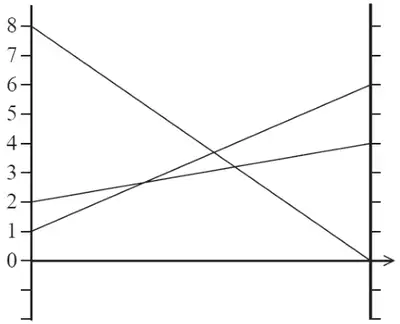 | M1 A1 | 1.1b 1.1b |
| \(2 + 2p_1 = 8 - 8p_1 \Rightarrow p_1 = 0.6\) | A1 | 1.1b |
| Alexis should play option Q with probability 0.6 and option R with probability 0.4 | A1ft | 3.2a |
| (6) |
Notes
M1: Setting up three expressions in terms of \(p_1\) (either in terms of the original or modified game) or \(p_2\)
A1: All three expressions correct – or equivalent e.g., \(5p_1 - 2, -8p_1 + 5, 2p_1 - 1\)
M1: Axes correct, at least one line correctly drawn for their expressions
A1: Correct graph
A1: Using a correct graph to obtain the correct probability expressions leading to the correct value of \(p_1\) or \(p_2\)
A1ft: Interpret their values in the context of the question – must refer to play and the associated probabilities
| Scheme | Marks | AO |
|---|---|---|
| Value of the game \(= 2 + 2\left(\dfrac{3}{5}\right) - 3 = \dfrac{1}{5}\) | B1 | 2.2a |
| (1) |
Notes
B1: cao
| Scheme | Marks | AO |
|---|---|---|
| \(4q_3 = \dfrac{16}{5},\ 8q_2 + 2q_3 = \dfrac{16}{5}\) or \(-3q_2 + q_3 = \dfrac{1}{5},\ 5q_2 - q_3 = \dfrac{1}{5}\) | M1 A1 | 3.1a 1.1b |
| \(q_2 = \dfrac{1}{5},\ q_3 = \dfrac{4}{5} \Rightarrow\) Becky should play option X never, option Y with probability 0.2 and option Z with probability 0.8 | A1 | 3.2a |
| (3) | ||
| (12 marks) |
Notes
M1: Setting up two equations in \(q_2\) and \(q_3\) with their value of either the original or modified game
A1: Correct two equations
A1: Interpret their values in the context of the question – must refer to play and the associated probabilities
For part (d) candidates might set up three equations in three unknowns e.g.,
\[\begin{aligned} 3q_1 - 3q_2 + q_3 &= \frac{1}{5} \\ -2q_1 + 5q_2 - q_3 &= \frac{1}{5} \\ q_1 + q_2 + q_3 &= 1 \end{aligned}\]