
MOG 2016 Q2
The diagram shows two circles \(C_1\) and \(C_2\) with diameters \(PA\) and \(AQ\). The circles meet at the points \(A\) and \(B\), and the line \(PA\) is a tangent to \(C_2\) at \(A\).
Prove that\[\frac{PB}{BQ} = \frac{\text{area}\,C_1}{\text{area}\,C_2}.\]
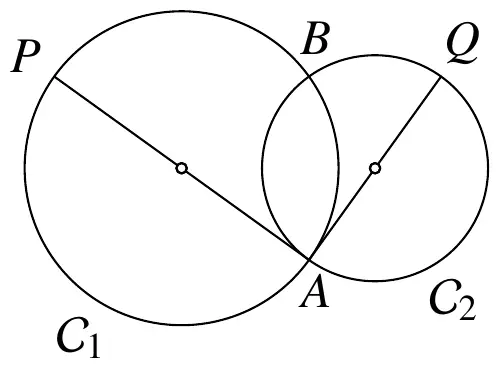
Mathematical Olympiad for Girls 2016, Question 2. © UK Mathematics Trust. Original paper on ukmt.org.uk
Commentary
In geometry questions, there are often lots of different extra lines we could draw, and different lengths and angles we could calculate, so it can be difficult to decide where to start. A useful strategy is to think about what we are trying to prove, and focus on lines, angles or triangles which we think might be useful. This is essentially “working backwards” from the answer; in writing up the solution, you need to be careful to start with the given facts and end with the required conclusion.
Results about ratios of lengths can often be proved using similar triangles. In this question we are also interested in the ratio of areas of the two circles. But the area of the circle is proportional to the square of its diameter, so the required result is equivalent to \(\dfrac{PB}{BQ} = \dfrac{AP^2}{AQ^2}\).
The four lengths from the above equation appear in triangles \(ABP\) and \(ABQ\). If you can show that those two triangles are similar, you may be able to use the ratios of their sides to get the required result.
To prove that two triangles are similar you need to find two pairs of equal angles. At the first glance it looks like there are no angles given in this question. However, diameters and tangents in circles create right angles, so this is a good place to start.
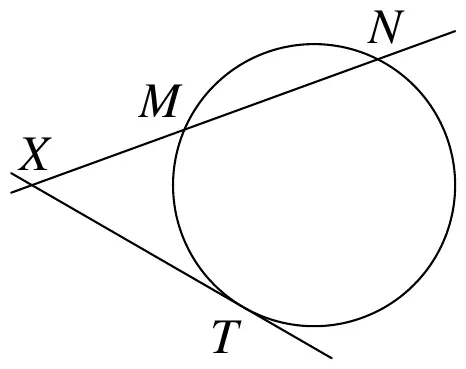
We present three possible solutions. The first two use similar triangles. The third uses the tangent-secant theorem, which says that in the diagram on the right, if \(XT\) is a tangent to the circle, then \(XM \times XN = XT^2\).
The third solution also uses the result that the angle between a diameter and the tangent at an endpoint of the diameter is a right angle. In fact it uses this result twice. First we use the fact that \(PA\) is tangent to \(C_2\) to conclude that \(PAQ\) is a right angle. Then we use the converse of the result: since \(PAQ\) is a right angle and \(AP\) is a diameter of \(C_1\), \(AQ\) is also a tangent to \(C_1\).
Method 1
The angle in a semicircle is a right angle. Since \(AP\) is a diameter of \(C_1\), \(\angle PBA = 90^\circ\), and since \(AQ\) is a diameter of \(C_2\), \(\angle ABQ = 90^\circ\).
Also, the angle between the tangent and the diameter of a circle at the point of contact is a right angle. Since \(PA\) is a tangent to \(C_2\), \(\angle PAQ = 90^\circ\). Hence \(\angle APB = 90^\circ - \angle PAB = \angle QAB\).
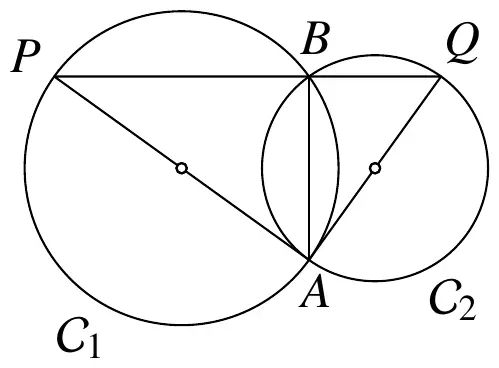
Each of triangles \(PBA\) and \(ABQ\) has a right angle at \(B\), and \(\angle APB = \angle QAB\). Hence they are similar (AA). Therefore, by considering the ratios of their sides, we obtain\[\frac{PB}{AB} = \frac{PA}{AQ}\]so that\[PB = \frac{PA \times AB}{AQ}, \qquad\qquad\qquad (1)\]and again from the similar triangles\[\frac{BA}{BQ} = \frac{PA}{AQ}\]so that\[BQ = \frac{BA \times AQ}{PA}. \qquad\qquad\qquad (2)\]Dividing equation (1) by equation (2), we get\[\frac{PB}{BQ} = \frac{PA^2}{AQ^2}.\]But \(\text{area}\,C_1 = \frac{1}{4}\pi AP^2\) and \(\text{area}\,C_2 = \frac{1}{4}\pi AQ^2\). Therefore \(\dfrac{PB}{BQ} = \dfrac{\text{area}\,C_1}{\text{area}\,C_2}\), as required.
Method 2
As in Method 1, \(\angle PBA = 90^\circ\) and \(\angle ABQ = 90^\circ\). Therefore\[\angle PBQ = \angle PBA + \angle ABQ = 180^\circ,\]and so \(PBQ\) is a straight line segment.
Triangles \(PAQ\) and \(PBA\) share an angle at \(P\) and have right angles at \(A\) and \(B\) respectively, so they are similar (AA).
Triangles \(PAQ\) and \(ABQ\) also share an angle, the one at \(Q\), and also have right angles at \(A\) and \(B\) respectively. Therefore they too are similar (AA).
From the similarity \(PBA \sim PAQ\) we have \(\dfrac{PB}{PA} = \dfrac{PA}{PQ}\), and from the similarity \(ABQ \sim PAQ\) we have \(\dfrac{BQ}{AQ} = \dfrac{AQ}{PQ}\). Therefore\[PB = \frac{PA^2}{PQ} \quad\text{and}\quad BQ = \frac{AQ^2}{PQ},\]so that\[\frac{PB}{BQ} = \frac{PA^2}{AQ^2},\]which is equivalent to the required result.
Method 3
First, prove that \(PBQ\) is a straight line segment as in the previous solution.
Since \(PA\) is tangent to the circle \(C_2\) at \(A\), \(\angle PAQ = 90^\circ\). But \(AP\) is the diameter of \(C_1\), so \(AQ\) is a tangent to \(C_1\) at \(A\).
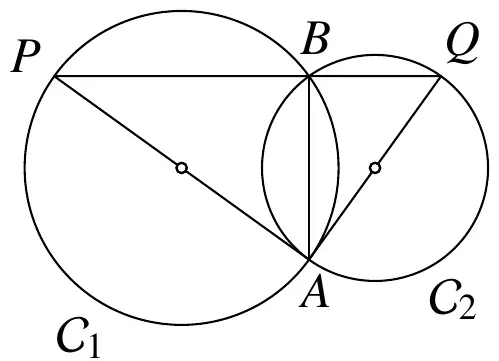
Using the tangent-secant theorem for circle \(C_2\) and point \(P\), we obtain\[PB \times PQ = PA^2.\]Using the same theorem for circle \(C_1\) and point \(Q\), we get\[QB \times QP = QA^2.\]Dividing the first equation by the second gives \(\dfrac{PB}{QB} = \dfrac{PA^2}{QA^2}\), and the required result follows.
Solution © UK Mathematics Trust, from the MOG 2016 solutions.