
Hamilton 2018 Q3
3. The diagram shows a regular dodecagon and a square, whose vertices are also vertices of the dodecagon.
What is the value of the ratio
area of the square : area of the dodecagon?
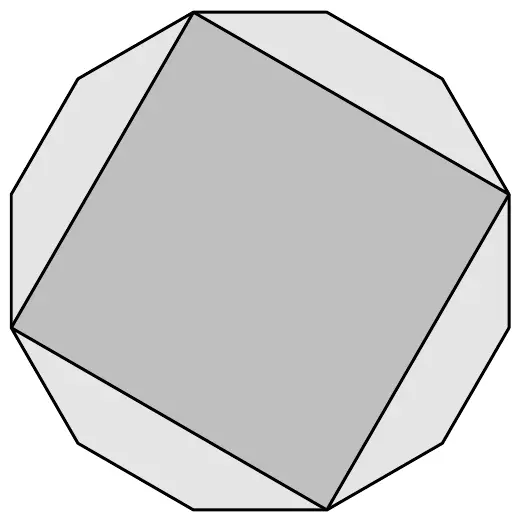
Hamilton Olympiad 2018, Question 3. © UK Mathematics Trust. Original paper on ukmt.org.uk
Answer: \(2 : 3\)
Comment
There are several ways to attempt this question. If you know the formula \(\tfrac{1}{2}ab\sin C\) for the area of a triangle, the result can be arrived at very quickly (see Solution 2). The majority of candidates offered a method similar to that described in Solution 1.
Solution 1
Let the side length of the dodecagon be \(x\). Consider one of the four trapezia created by the edge of the square and the edges of the dodecagon.
The interior angle of a dodecagon is 150°, which quickly leads to the fact that the angles at the base of the trapezium are both equal to 30°.
We can then split the trapezium up into a rectangle and two right-angled triangles:
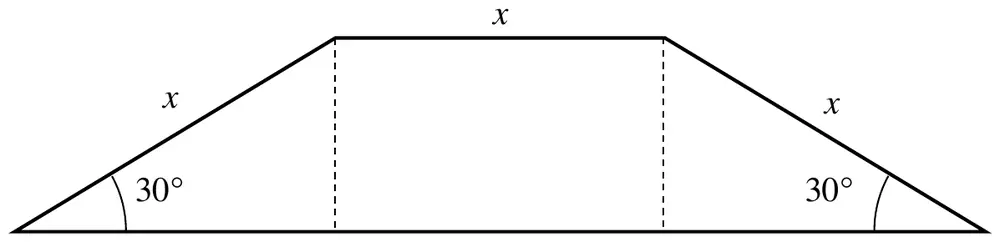
Then, by recognising that each of the triangles in the trapezium is half an equilateral triangle (or by using the well-known values of \(\sin 30^\circ\) and \(\cos 30^\circ\)), we can establish that the height of this trapezium is \(x / 2\) and the base is \(x + x\sqrt{3}\).
The area of the square is therefore \(\left(x + x\sqrt{3}\right)^2 = 2x^2\left(2 + \sqrt{3}\right)\) and the area of the dodecagon is equal to (the area of the square) + (4 × the area of the trapezium) which is
We can divide through by the common factor of \(x^2\left(2 + \sqrt{3}\right)\) to show that the required ratio is 2: 3.
Solution 2
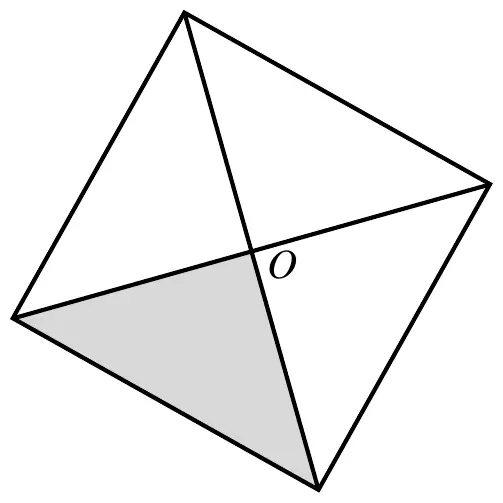
Since the dodecagon is regular, all its diagonals intersect at the same point (its centre). Call this point \(O\). Since the diagonals of the square are two of the diagonals of the dodecagon, they intersect at \(O\). Hence \(O\) is also the centre of the square.
Let each diagonal have length \(2r\).
Then the dodecagon comprises 12 congruent isosceles triangles radiating from \(O\), each with two sides equal to \(r\) and vertex angle 30°:
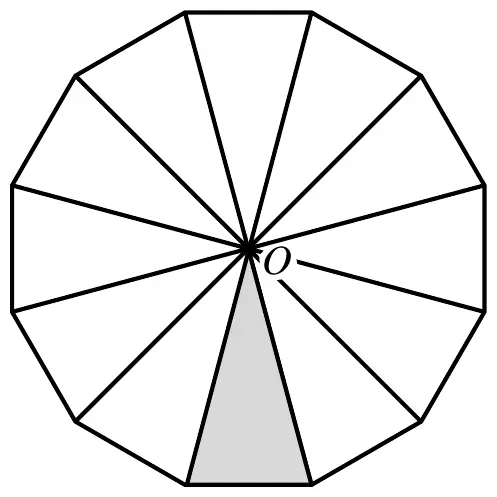
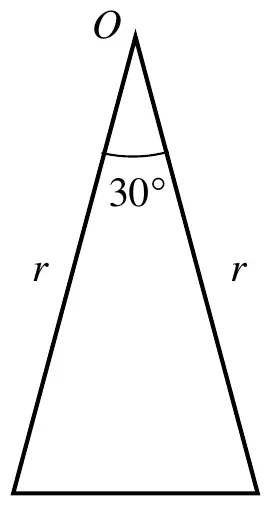
The area of the dodecagon is equal to 12 × the area of one of these triangles, which is equal to
Since \(\sin 30^\circ = \tfrac{1}{2}\), this simplifies to
The square can be split into four congruent isosceles right-angled triangles, with perpendicular sides of length \(r\).
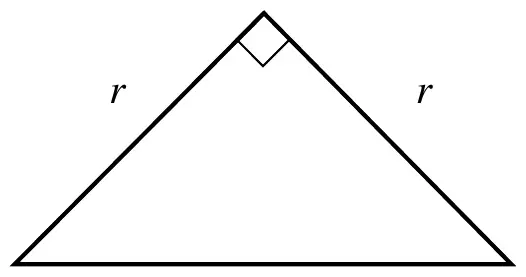
The area of the square is equal to 4 × the area of one of these triangles, which is equal to
which simplifies to
The required ratio is therefore \(2r^2 : 3r^2\) which is equal to \(2 : 3\).
Solution © UK Mathematics Trust, from the Hamilton Olympiad 2018 solutions.