
GK 2017 Q25
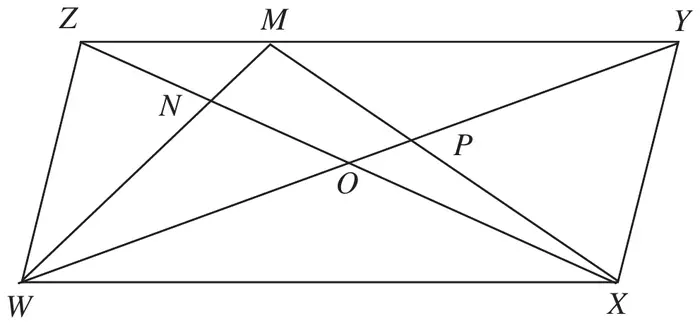
25. The diagram shows a parallelogram \(WXYZ\) with area \(S\). The diagonals of the parallelogram meet at the point \(O\). The point \(M\) is on the edge \(ZY\). The lines \(WM\) and \(ZX\) meet at \(N\). The lines \(MX\) and \(WY\) meet at \(P\). The sum of the areas of triangles \(WNZ\) and \(XYP\) is \(\tfrac{1}{3}S\). What is the area of quadrilateral \(MNOP\)?
- A \(\dfrac{1}{6}S\)
- B \(\dfrac{1}{8}S\)
- C \(\dfrac{1}{10}S\)
- D \(\dfrac{1}{12}S\)
- E \(\dfrac{1}{14}S\)
Grey Kangaroo 2017, Question 25. © UK Mathematics Trust. Original paper on ukmt.org.uk
Answer: D \(\dfrac{1}{12}S\)
The area of parallelogram \(WXYZ\) is \(S\). Therefore the area of triangle \(WXM\), which has the same base and height, is \(\tfrac{1}{2}S\). Hence the sum of the areas of triangle \(WMZ\) and triangle \(XYM\) is also \(\tfrac{1}{2}S\). The sum of the areas of triangle \(WNZ\) and triangle \(XYP\) is given as \(\tfrac{1}{3}S\) and therefore the sum of the areas of triangle \(ZNM\) and triangle \(MPY\) is \(\tfrac{1}{2}S - \tfrac{1}{3}S = \tfrac{1}{6}S\). The area of triangle \(ZOY\), which has the same base as the parallelogram but only half the height is \(\tfrac{1}{2} \times \tfrac{1}{2}S = \tfrac{1}{4}S\). Therefore the area of quadrilateral \(MNOP\) is \(\tfrac{1}{4}S - \tfrac{1}{6}S = \tfrac{1}{12}S\).
Solution © UK Mathematics Trust, from the GK 2017 solutions.