
PK 2018 Q4
4. The diagram shows three congruent regular hexagons. Some diagonals have been drawn, and some regions then shaded. The total shaded areas of the hexagons are \(X\), \(Y\), \(Z\) as shown.
Which of the following statements is true?
- A \(X\), \(Y\) and \(Z\) are all the same
- B \(Y\) and \(Z\) are equal, but \(X\) is different
- C \(X\) and \(Z\) are equal, but \(Y\) is different
- D \(X\) and \(Y\) are equal, but \(Z\) is different
- E \(X\), \(Y\), \(Z\) are all different
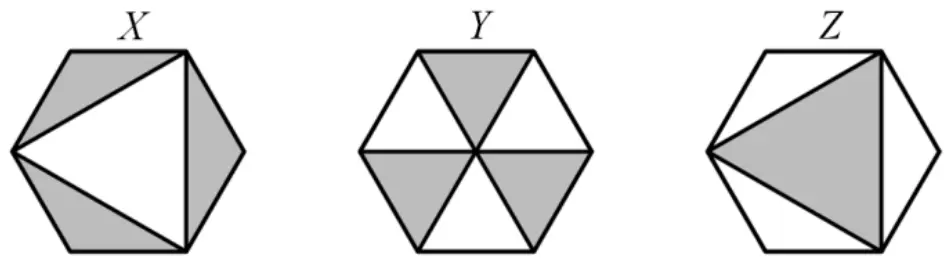
Pink Kangaroo 2018, Question 4. © UK Mathematics Trust. Original paper on ukmt.org.uk
Answer: A \(X\), \(Y\) and \(Z\) are all the same
By joining the vertices of the inner triangle to the centre of the hexagon in both the first and third diagrams, it can be seen that each hexagon has been dissected into six equal parts, three of which are shaded.
Therefore, \(X\), \(Y\) and \(Z\) are each half of the hexagon and hence they are all the same.
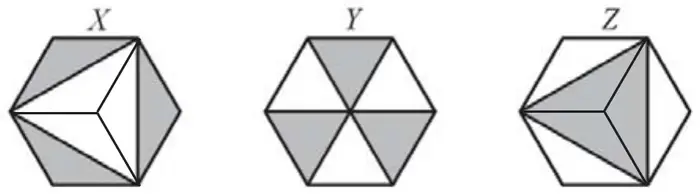
Solution © UK Mathematics Trust, from the PK 2018 solutions.