
Hamilton 2016 Q2
2. The diagram shows two arcs. Arc \(AB\) is one eighth of a circle with centre \(C\), and arc \(AC\) is one quarter of a circle with centre \(D\). The points \(A\) and \(B\) are joined by straight lines to \(C\), and \(A\) and \(C\) are joined by straight lines to \(D\).
Prove that the area of the shaded triangle \(T\) is equal to the area of the shaded region \(R\).
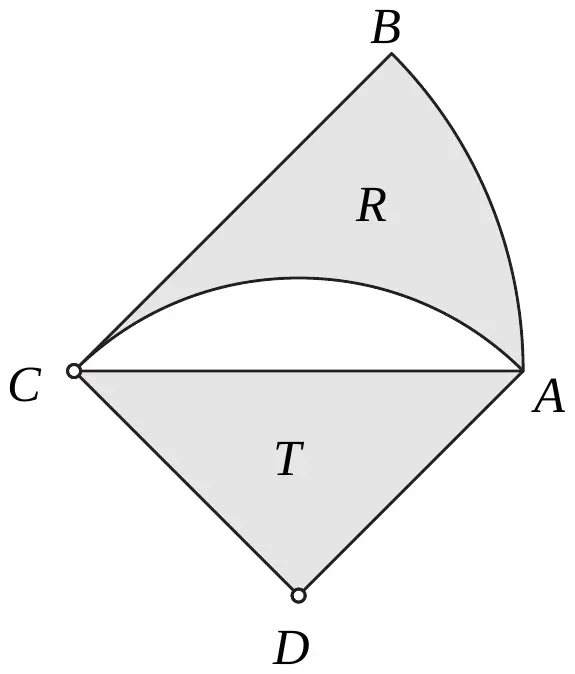
Hamilton Olympiad 2016, Question 2. © UK Mathematics Trust. Original paper on ukmt.org.uk
Let the radius \(DA\) be \(r\), so that \(DC\) also equals \(r\). Since arc \(AC\) is one quarter of a circle, angle \(\angle CDA\) is 90°. Hence, using Pythagoras' Theorem in the triangle \(ACD\), we obtain \(CA^2 = 2r^2\).
Now consider the segment \(S\) bounded by the arc \(AC\) and the chord \(AC\), shown shaded in the following diagram.
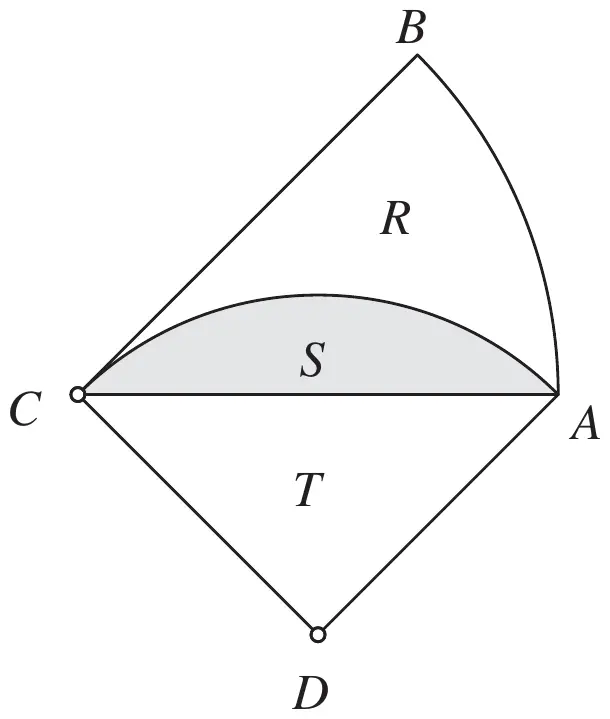
We shall combine this region with each of \(R\) and \(T\)—if the areas of the combined regions are equal, then the areas of \(R\) and \(T\) are equal.
The region obtained by combining \(R\) and \(S\) is one eighth of a circle with centre \(C\) and radius \(CA\). Thus its area is
The region obtained by combining \(S\)and \(T\)is one quarter of a circle with centre \(D\)and radius \(DA\). Thus its area is \(\tfrac{1}{4}\pi r^2\).
Hence the areas of the regions obtained by combining \(S\) with each of \(T\) and \(R\) are equal. Therefore the area of \(T\) is equal to the area of \(R\).
Solution © UK Mathematics Trust, from the Hamilton Olympiad 2016 solutions.