
Maclaurin 2016 Q2
2. A ‘stepped’ shape, such as the example shown, is made from \(1 \times 1\) squares in the following way.
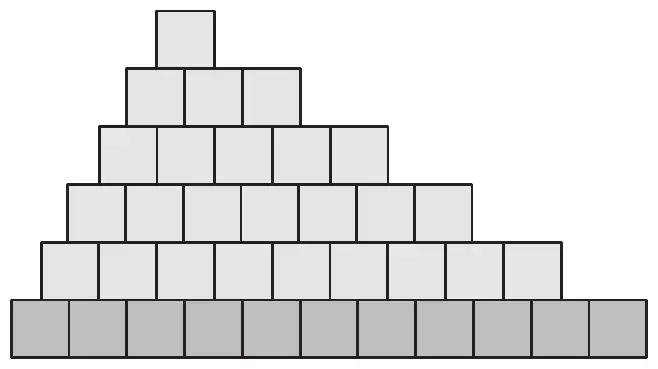
Prove that \(36A = (P + 2)^2\), where \(A\) is the area of the shape and \(P\) is the length of its perimeter.
Maclaurin Olympiad 2016, Question 2. © UK Mathematics Trust. Original paper on ukmt.org.uk
Let \(n\) be the number of steps in the shape.
Now the top row consists of one square, and each subsequent row has two more squares than the one before. Hence the number of squares in the bottom row is \(1 + 2\,(n - 1) = 2n - 1\).
The perimeter length \(P\) can be calculated by viewing the shape from four different directions and counting the number of horizontal or vertical segments. There are \(n\) vertical segments on each side (one for each row), making \(2n\) in all. There are \(2n - 1\) horizontal segments viewed from above, and the same number viewed from below, making \(4n - 2\) in all. Therefore \(P = 6n - 2\).
The area \(A\) is the total number of squares in the shape. But we may rearrange the shape into a square of side \(n\), by dividing it into two pieces, rotating one of them by half a turn, and then recombining the squares, as shown in the diagrams.
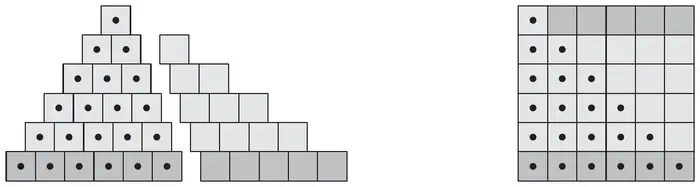
Thus \(A = n^2\) and hence
Solution © UK Mathematics Trust, from the Maclaurin Olympiad 2016 solutions.