
Hamilton 2016 Q4
4. The diagram shows a right-angled triangle \(ACD\) with a point \(B\) on the side \(AC\).
The sides of triangle \(ABD\) have lengths 3, 7 and 8, as shown.
What is the area of triangle \(BCD\)?
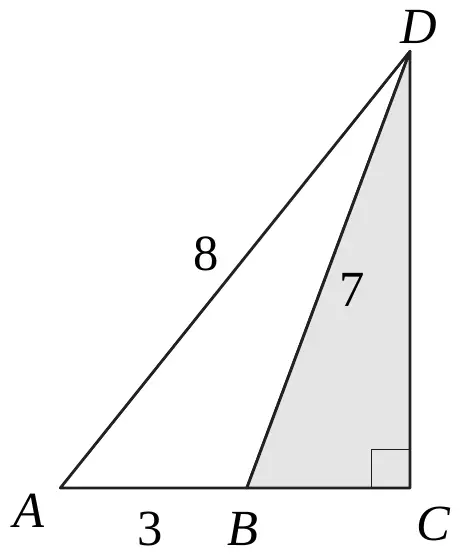
Hamilton Olympiad 2016, Question 4. © UK Mathematics Trust. Original paper on ukmt.org.uk
Answer: \(2\sqrt{3}\)
Let \(BC\) equal \(b\) and \(CD\) equal \(h\), as shown in the following diagram.
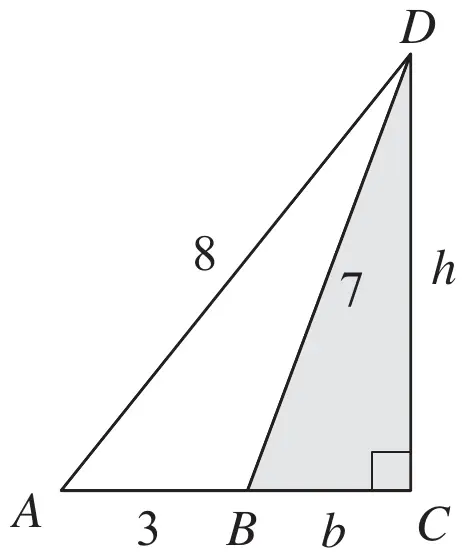
Using Pythagoras' Theorem in both the triangle \(BCD\) and the triangle \(ACD\), we get the two equations
Subtracting equation (1) from equation (2), we obtain
Factorising the difference of two squares, we get
so that
Therefore
Using equation (1), we now obtain \(1 + h^2 = 7^2\), and so \(h = \sqrt{48} = 4\sqrt{3}\).
Therefore the area of the triangle \(BCD\) is \(\tfrac{1}{2} \times 1 \times 4\sqrt{3}\), that is, \(2\sqrt{3}\).
Solution © UK Mathematics Trust, from the Hamilton Olympiad 2016 solutions.