
SMC 2012 Q8
8. The diagrams below show four types of tile, each of which is made up of one or more equilateral triangles. For how many of these types of tile can we place three identical copies of the tile together, without gaps or overlaps, to make an equilateral triangle?

- A 0
- B 1
- C 2
- D 3
- E 4
Senior Mathematical Challenge 2012, Question 8. © UK Mathematics Trust. Original paper on ukmt.org.uk
Answer: C 2
If an equilateral triangle is split into a number of smaller identical equilateral triangles then there must be one small triangle in the top row, three small triangles in the row below, five small triangles in the row below that and so on. So the total number of small triangles is 4 or 9 or 16 etc. These are all squares and it is left to the reader to prove that the sum of the first \(n\) odd numbers is \(n^2\). So, for three copies of a given tile to form an equilateral triangle, the number of triangles which comprise the tile must be one third of a square number.
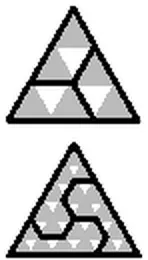
Only the tiles made up of three equilateral triangles and twelve equilateral triangles satisfy this condition. However, it is still necessary to show that three copies of these tiles can indeed make equilateral triangles. The diagrams above show how they can do this.
Solution © UK Mathematics Trust, from the SMC 2012 solutions. Longer versions with investigations: Solutions and investigations (PDF).