
Numeracy Higher June 2019 Unit 1 Q11
11.
He is designing a symmetrical pendant, as shown below.
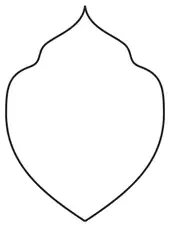
Diagram not drawn to scale
The pendant will be made from solid silver, with a uniform thickness of 3 mm.
In order to calculate the cost of making the pendant, Alun wants to calculate an estimate of the volume of the pendant.
He has accurately drawn one of the symmetrical halves of the shape on graph paper.
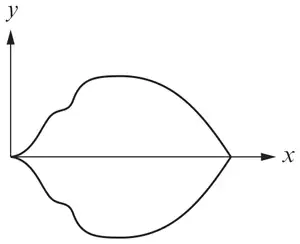
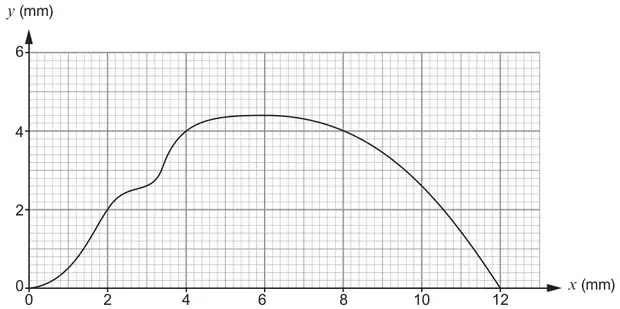
Calculate an estimate of the volume of the whole pendant.
Use the graph above, with 6 strips of equal width. [5]
The following table shows the pendants and the number of these pendants that Alun made last month.
| Pendant | Triangle | Circle | Rectangle | Trapezium |
|---|---|---|---|---|
| Number made last month | 52 | 96 | 30 | 62 |
At the end of last month, Alun took a stratified sample of 30 of these 240 pendants to check their quality.
Calculate how many pendants of each shape were in Alun’s sample.
You must show all your working. [4]
| Pendant | Triangle | Circle | Rectangle | Trapezium |
|---|---|---|---|---|
| Number in sample |
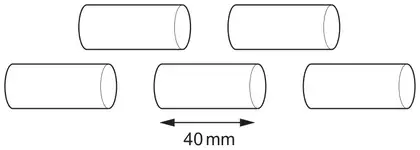
Diagram not drawn to scale
He has been asked to make a solid sphere of radius 30 mm.
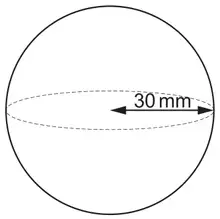
Diagram not drawn to scale
He melts the 5 cylinders and recasts all the metal to make the sphere.
Calculate the radius of each of the cylinders.
Give your answer in mm, in the form \(a\sqrt{b}\), where \(a\) and \(b\) are integers, and \(b\) is as small as possible. [6]
From the formula list: Volume of sphere \(= \dfrac{4}{3}\pi r^3\)
| Scheme | Marks | Comments |
|---|---|---|
| (Area =) \(\dfrac{1}{2}\) × 2 × (0 + 0 + 2(2 + 4 + 4.4 + 4 + 2.6)) OR \(\dfrac{1}{2}\) × 2 × (4 + 8 + 8.8 + 8 + 5.2) | M2 | Award M1 if only one reading incorrect |
| = 34 (mm2) | A1 | FT from M1 |
| (Volume =) 34 × 3 (× 2) | M1 | FT from M1 or M2 for a possible M1A1 If no marks previously awarded, FT ‘their 34’ provided an attempt made to use the trapezium rule for a possible M1 only |
| = 204 (mm3) | A1 |
Alternative method:
| Scheme | Marks | Comments |
|---|---|---|
| \(\dfrac{(0 + 2)}{2}\) × 2 + \(\dfrac{(2 + 4)}{2}\) × 2 + \(\dfrac{(4 + 4.4)}{2}\) × 2 + \(\dfrac{(4.4 + 4)}{2}\) × 2 + \(\dfrac{(4 + 2.6)}{2}\) × 2 + \(\dfrac{(2.6 + 0)}{2}\) × 2 [2 + 6 + 8.4 + 8.4 + 6.6 + 2.6] | M2 | Each area may be seen as the sum of the area of a rectangle and a triangle M1 for the sum of these 6 areas with one error (maybe repeated) in reading the scale OR with 1 incorrect term |
| = 34 (mm2) | A1 | FT from M1 or M2 |
| (Volume =) 34 × 3 (× 2) | M1 | FT from M1 or M2 for a possible M1A1 If no marks previously awarded, FT ‘their 34’ provided an attempt made to sum the 6 areas for a possible M1 only |
| = 204 (mm3) | A1 |
| Scheme | Marks | Comments |
|---|---|---|
| 30 × (number of pendants made) ÷ 240 or equivalent | M1 | e.g. (number of pendants made) ÷ 8 Sight of this calculation for any shaped pendant |
| (Number of circular pendants in sample =) 12 | A1 | |
| Sight of any 2 of 6.5, 3.7(5), 7.7(5) or equivalents | A1 | Accept mixed numbers |
| (Number in sample =) 6, 12, 4, 8 | B1 | Needs to be from correct working Can come from M1A1A0 An unsupported 6, 12, 4, 8 is awarded M1A1A0B1 An unsupported 7, 12, 4, 8 is awarded M1A1A0B0 |
| Scheme | Marks | Comments |
|---|---|---|
| (Volume of sphere =) \(\dfrac{4}{3}\) × π × 303 (= 36000π) | B1 | |
| π × radius2 × 40 (× 5) = \(\dfrac{4}{3}\) × π × 303 | M1 | FT 'their derived volume of sphere' |
| radius2 = \(\dfrac{4 \times \pi \times 30^3}{3 \times \pi \times 40(\times 5)}\) or equivalent | m1 | e.g. radius2 = \(\dfrac{36000\pi}{\pi \times 40(\times 5)}\) |
| radius2 = 180 or (radius =) √180 | A1 | CAO |
| = 6√5 (mm) | B2 | For B2, FT ‘their derived 180’ provided their 'b' is as small as possible and that ‘their derived 180’ can be simplified If ‘their derived 180’ is a square number, then B1 only can be awarded for the correct square root of ‘their 180’ For B1, FT 'their derived 180' B1 for writing 180 as a product of 2 or more factors where one of the factors OR the product of a pair of their factors is a square number e.g. 4 × 45, 3 × 3 × 20, OR B1 for writing √180 as a product of 2 or more factors where one of the factors OR the product of a pair of their factors is a whole number e.g. √5 × √12 × √3 |