
Numeracy Higher November 2023 Unit 2 Q8
8. Form-A-Part is a company that makes metal parts for use in engineering.
A metal part is made from a circular disc with a piece cut out.
The part has uniform thickness, a diameter of 60 mm, and centre O.
The diagram below shows the cross-section of the metal part.
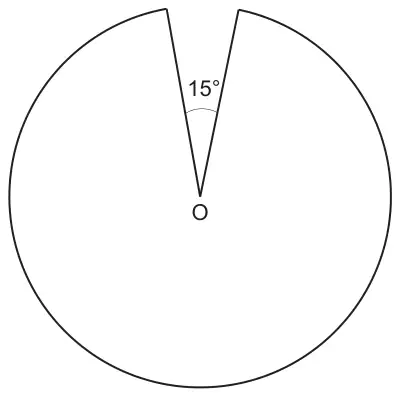
Diagram not drawn to scale
Calculate the perimeter of the cross-section of this metal part.
Give your answer correct to the nearest millimetre. [3]
Perimeter of the metal part is …………… mm, correct to the nearest millimetre.
The diagram below shows a metal part made by Form-A-Part.
Each part consists of a cone sitting on top of a hemisphere.
The diameter of the base of the cone and the diameter of the hemisphere are equal.
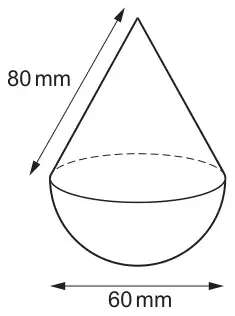
Diagram not drawn to scale
A customer has ordered 20 000 of these parts.
Form-A-Part has guaranteed that they will make all of the parts with the measurements shown in the diagram being correct to the nearest mm.
All 20 000 parts will be given a protective coating that comes in tins.
Each tin covers an area of 4 000 000 mm\(^2\), correct to the nearest 100 000 mm\(^2\).
Form-A-Part must guarantee that they have enough tins of protective coating to coat all 20 000 parts.
Calculate the minimum number of tins they will need.
You must show all your working. [6]
Minimum number of tins needed to guarantee having enough coating = ……………
Form-A-Part has decided to randomly sample these 20 000 metal parts to check their quality.
Use the following list of random numbers to select the first 5 parts for the sample.
You must start with the first number in the list.
Explain clearly how you are using the numbers to select the sample. [3]
| 66923 | 01325 | 58552 | 86923 |
| 48925 | 72712 | 58033 | 18266 |
| 95775 | 51056 | 01325 | 81036 |
| 05929 | 10429 | 26883 | 45630 |
| 88925 | 24800 | 02891 | 38441 |
The 5 parts selected will be
1st …………… 2nd …………… 3rd ……………
4th …………… 5th ……………
From the formula list: Surface area of sphere \(= 4\pi r^2\); Curved surface area of cone \(= \pi r l\)
| Scheme | Marks | Comments |
|---|---|---|
| \(\dfrac{360 - 15}{360}\) × π × 60 (+60) | M1 | |
| = 241 (mm) | A2 | A1 for any one of the following:
|
| Scheme | Marks | Comments |
|---|---|---|
| An answer of 68 tins does not imply full marks should be awarded, as it can be a result of inaccuracy in workings | ||
| (Greatest possible area of a part = ) \(\pi \times 80.5 \times 30.25 \;+\; \dfrac{4 \times \pi \times 30.25^2}{2}\) (7646.2 to 7651.2) (5746.59 to 5750.3) | M3 | M2 for
|
| = 13392.79 to 13401.5 or 4265.25π (mm\(^2\)) | A1 | CAO. May be implied by sight of 267 857 600 to 268 028 400 (total surface area of 20 000 parts) |
| (Minimum number of tins needed =) 20 000 × 13399.678.. ÷ 3 950 000 | M1 | FT ‘their 13399.678…’ provided it has come from the use of ‘their upper bounds’ of 80mm and 60mm if bounds used Allow M1 only for 20 000 × 13399.678.. ÷ ‘their 3 950 000’ where 3 900 000 ≤ ‘their 3 950 000’ < 4 000 000 |
| = 68 (tins) | A1 | A0 for 67.8…tins If no marks awarded, and from a misinterpretation of the question, SC3 for an answer of 65 tins from 20000×(π×79.5×29.75 + \(\dfrac{4 \times \pi \times 29.75^2}{2}\)) ÷ 4 050 000 OR SC2 for an answer of 64(.1...) tins from 20000×(π×79.5×29.75 + \(\dfrac{4 \times \pi \times 29.75^2}{2}\)) ÷ 4 050 000 OR SC1 for a correct evaluation (rounded, truncated or unrounded) of the calculation 20000×(π×79.5×29.75 + \(\dfrac{4 \times \pi \times 29.75^2}{2}\)) ÷ 4 050 000 where 79 ≤ ‘their 79.5’ < 80 and 29.5 ≤ ‘their 29.75’ < 30 and 4 000 000 < ‘their 4 050 000’ ≤ 4 100 000 OR If no marks awarded, SC1 for use of 80.5 and 30.25 |
Corrected by Westie's Workshop
- The board's mark scheme printed “π×79.5×.29.75”. Changed to “π×79.5×29.75” because the stray full stop before 29.75 is a misprint; the other two lines of the scheme show the same calculation as π×79.5×29.75.
Original: see the board's mark scheme PDF (link above).
| Scheme | Marks | Comments |
|---|---|---|
| Statements required: | E2 | All 4 needed for E2 E1 for any 2 or 3 correct statements |
| • Number the parts from (0000)1 to 20000 | Allow an equivalent numbering system e.g. (0000)0 to 19 999 Their numbering system can be implied by the range of numbers they state they will choose from | |
| • Consider successive 5-digit numbers | Allow the 2nd statement to be implied by their numbering of the parts (from 00001) AND their use of 5-digit numbers in their answer OR 5-digit numbers used in their answer and e.g. 01325 seen | |
| • Use numbers in the range e.g. Use numbers from (0000)1 to 20000 or Do not use 0000 or numbers > 20000 | Do not allow ‘Use numbers less than 20000’ if they have numbered the parts from 00001 to 20000 | |
| • Ignore repeats | ||
| (Working in rows would give parts) (0)1325, 18266, OR (Working in columns would give parts) (0)5929, (0)1325, 10429, | B1 | ISW. Part numbers can be given in any order |
Alternative
8(c) Alternative method:
| Scheme | Marks | Comments |
|---|---|---|
| Statements required: | E2 | All 4 needed for E2 E1 for any 2 or 3 correct statements |
| • Number the parts from (0000)1 to 20000 | Allow an equivalent numbering system e.g. (0000)0 to 19 999 Their numbering system can be implied by the range of numbers they state they will choose from | |
| • Consider successive 5-digit numbers | Allow the 2nd statement to be implied by their numbering of the parts (from 00001) AND their use of 5-digit numbers in their answer OR 5-digit numbers used in their answer and e.g. 06923 seen | |
| • Divide each number by 20000 and use the remainder to choose a part | ||
| • If the 5-digit number is 00000, then part 20000 is chosen, and ignore repeats. | If (0000)0 to 19 999 used, when the remainder is 0, part (0000)0 is selected | |
| (Working in rows would give parts) (0)6923, (0)1325, 18552, OR (Working in columns would give parts) (0)6923, (0)8925, 15775, (0)5929, | B1 | ISW |
Struck-through numbers are struck through in the original mark scheme (repeats).