(a) Malik has two orchards. He has apple trees and pear trees in his north orchard. He has pear trees and cherry trees in his west orchard.
In the north orchard,
Malik has a total of 35 trees
number of apple trees : number of pear trees = 4 : 3.
In the west orchard,
Malik has twice as many pear trees as he has pear trees in the north orchard
number of pear trees : number of cherry trees = 5 : 11.
How many cherry trees does Malik have? You must show all your working. [5]
(b) Malik’s crop of apples this year has a total mass of 5280 pounds. He makes apple juice from \(\frac{1}{6}\) of the mass of his apple crop. Malik makes 2 litres of apple juice from every 5 kg of apples.
Calculate the number of litres of apple juice Malik makes. [6]
(c) Malik makes cherry jam using some of the fruit from his trees.
(i) He makes and sells 200 jars of cherry jam.
It costs him £94 for all the ingredients to make the jam. Malik pays 23p for each jam jar he uses. He sells each jar of jam for £1.60.
Calculate the profit Malik makes from selling his 200 jars of jam. [5]
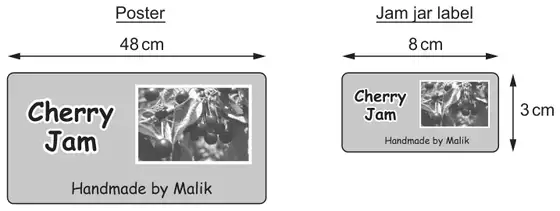
(ii) Malik makes a poster to advertise his jam. He also makes labels for the jars. The poster and the labels are mathematically similar.
Diagrams not drawn to scale
Calculate the height of the poster. [2]
Mark scheme (a)
Scheme
Marks
Comments
(North orchard, number of pear trees is) 3 × 35 ÷ (4 + 3) or 3 × 5 or equivalent
M1
15 (pear trees)
A1
(West orchard number of pear trees is 2 × 15) 30 (pear trees)
B1
FT ‘their derived 15’
(West orchard number of cherry trees is) 11 × 30 ÷ 5
M1
FT ‘their derived number of pear trees’ Allow M1 for a final answer of 88 (cherry trees from use of 40 apple trees as pear trees), but A0
66 (cherry trees)
A1
FT answer must be evaluated correctly and lead to a whole number
Mark scheme (b)
Scheme
Marks
Comments
(Mass of apples to make juice) 5280 ÷ 6 ÷ 2.2
M1 M1
Method may be seen in either order M0 for statement ‘1/6 of 5280’ without calculation
400 (kg)
A2
Ignore incorrect units given May be seen or implied in later working
A1 for any one of the following:
(5280 ÷ 2.2 =) 2400
(5280 ÷ 6 =) 880
a correct evaluation of ‘their 2400’ ÷ 6
a correct evaluation of ‘their 880’ ÷ 2.2
(Number of litres of juice produced) 400 × 2 ÷ 5 or 2 ÷ (5 ÷ 400) or 2 × \(\frac{400}{5}\)
M1
FT ‘their derived 400(kg)’ (not 5280) If ‘their derived 400’ is used as g (rather than kg) allow M1 for ‘their derived 400’ × 2 ÷ 5000 or 2 ÷ (5000 ÷ ‘their derived 400’), but A0
160 (litres)
A1
5(b) Alternative method
Scheme
Marks
Comments
(Mass of apples used to make juice) 5280 ÷ 6
M1
880 (lbs)
A1
(Mass of apples in 2 litres) 5 × 2.2
M1
11 (lbs)
A1
(Number of litres of juice produced) 2 × 880 ÷ 11
M1
FT ‘their derived 880’ and ‘their derived 11’
160 (litres)
A1
The alternative method is printed in italics in the original.
Mark scheme (c)
Scheme
Marks
Comments
(i) Method 1 for 200 jars (Cost of 200 jars) 200 × (0.)23 OR (Sales of 200 jars of jam) 200 × 1(.)60
M1
(Cost of 200 jars) 4600(p) or (£)46 (Sales of 200 jars of jam) 32000(p) or (£)320
A1 A1
(Cost 200 jars + jam) (£94 +£46=) (£)140 or 14000(p)
B1
FT £94 + ‘their derived £46’
(Profit £320 - £140 =) 18000(p) or (£)180
B1
If units are given they must be correct FT ‘their derived £320’ – ‘their derived £140’
(c)(i) Method 2 for 200 jars
Scheme
Marks
Comments
(Cost of jam for 200 jars) 200 × (1(.)60 – 0(.)23)
M2
M1 for 1(.)60 – 0(.)23 or (£)1.37 or 137(p)
(=) £) 274 or 27400(p)
A2
A1 for 200 × 1(.)37
(Profit £274 - £94 =)18000(p) or (£)180
B1
If units are given they must be correct FT ‘their derived £274’ – £94
(c)(i) Method for 1 jar
Scheme
Marks
Comments
(Cost of ingredients for 1 jar of jam) 94(00) ÷ 200
M1
47(p) or (£)0.47
A1
(Cost of jam and jar) (23p + 47p =) 70(p) or (£)0.7(0)
B1
FT ‘their derived 47p’ + 23p
(Profit for 1 jar of jam £1.60 – 70p =) 90(p) or(£)0.9(0)
B1
FT £1.60 - ‘their derived 70p’ May be seen or implied in later working
(Profit for 200 jars of jam) 18000(p) or (£)180
B1
If units are given they must be correct FT ‘their derived 90p’
Method 2 and the method for 1 jar are printed in italics in the original, except the comment “If units are given they must be correct”.
We'd like to use Google Analytics cookies to count visits and see which pages help most. They're optional, and the site works exactly the same either way. Privacy policy