(a) After owning the car for a year, Carwyn had the car valued. He calculated that the car had lost \(0{\cdot}13\dot{8}\) of its value at the start of the year.
Express \(0{\cdot}13\dot{8}\) as a fraction in its lowest terms. [3]
(b) Carwyn bought the motorcycle for £9600. At the end of each year of owning the motorcycle, Carwyn had the motorcycle valued. Each year the motorcycle lost \(\frac{1}{5}\) of its value at the start of the year.
(i) Carwyn used the method \(9600\times\frac{1}{5}\times\frac{1}{5}\) to calculate the value of the motorcycle after 2 years. Explain why Carwyn’s method is incorrect. [1]
(ii) Write down a formula for the value \(V\), in pounds, of Carwyn’s motorcycle after he has owned the motorcycle for \(t\) years. [3]
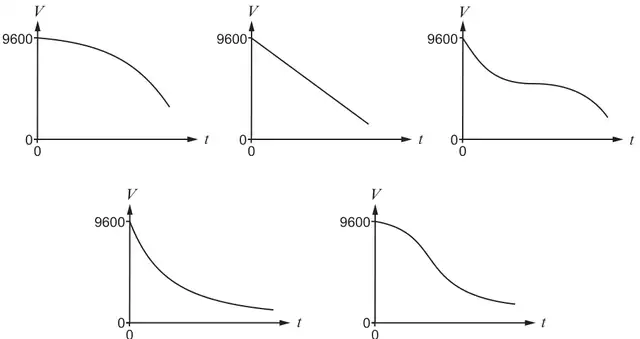
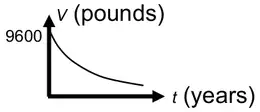
(iii) Which one of the following best represents the graph of \(V\) against \(t\)? Circle your answer. [1]
Mark scheme (a)
Scheme
Marks
Comments
e.g. 100x = 13.888… and 1000x = 138.888… or equivalent AND an attempt to subtract both sides
M1
(x =) \(\dfrac{125}{900}\) or \(\dfrac{1375}{9900}\) or \(\dfrac{13875}{99900}\) or equivalent
A1
Accept e.g. \(\dfrac{1.25}{9}\)
(x =) \(\dfrac{5}{36}\)
A1
FT ‘their 125/900’ provided of equivalent difficulty
Mark scheme (b)
(i)
Scheme
Marks
Comments
Appropriate explanation e.g. ‘It should be 4/5 × 4/5’, or ‘It should be × 0.82’, or ‘Each year it would be valued at 4/5 of the previous year’s value’, or ‘Each year he should be taking 1/5 off the value’
E1
Allow sight of correct calculation only Allow incorrect notation e.g. 9600 × \(\dfrac{4^{2}}{5}\) Do not accept e.g. ‘Because this calculates the amount lost’
(ii)
Scheme
Marks
Comments
\(V = 9600 \times 0{\cdot}8^{t}\) or \(V = 9600 \times (4/5)^{t}\) or equivalent
B3
Allow pound signs in their formula
B2 for \(9600 \times 0{\cdot}8^{t}\) or \(9600 \times (4/5)^{t}\) or \(V = 9600 \times \dfrac{4^{t}}{5}\) or \(V = \text{initial price} \times 0{\cdot}8^{t}\) or \(V = \text{initial price} \times (4/5)^{t}\)
B1 for sight of \(0{\cdot}8^{t}\) or \((4/5)^{t}\) or \(9600 \times \dfrac{4^{t}}{5}\) or \(V = (9600 \times 0{\cdot}8)^{t}\) or \(\text{initial price} \times 0{\cdot}8^{t}\) or \(\text{initial price} \times (4/5)^{t}\) or \(V = \text{initial price} \times \dfrac{4^{t}}{5}\)
If no marks awarded: SC1 for \(V = 9600\times 0{\cdot}2^{t}\) or \(V = 9600\times(1/5)^{t}\) or SC1 for \(V = 9600\times a^{t}\), where \(0{\cdot}5 \lt a \lt 1\)
We'd like to use Google Analytics cookies to count visits and see which pages help most. They're optional, and the site works exactly the same either way. Privacy policy