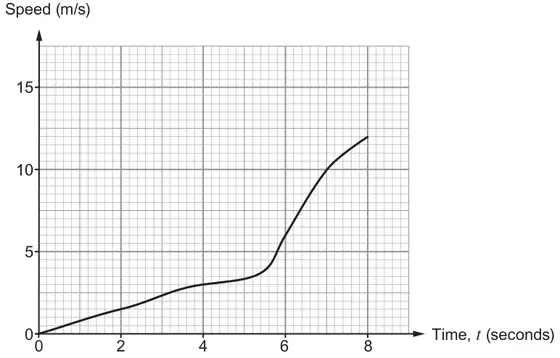
10. Eliska competed in an indoor cycle race. The speed-time graph below shows Eliska’s speed during the first 8 seconds of her race.
(a) Estimate the greatest acceleration that Eliska achieved during the first 8 seconds of her race. Give your answer in its simplest form. [4]
(b) Eliska’s initial acceleration was \(0{\cdot}\dot{7}\dot{2}\) m/s2. Write \(0{\cdot}\dot{7}\dot{2}\) as a fraction. [2]
(c) Use the trapezium rule with exactly 4 strips of equal width to estimate the distance Eliska travelled during the first 8 seconds of the race. [3]
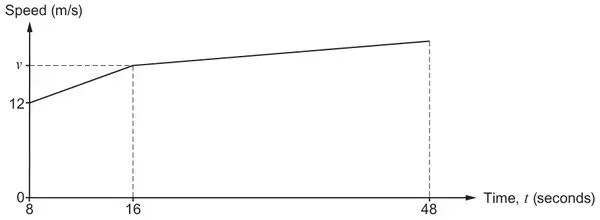
(d) The speed-time graph below shows Eliska’s speed from \(t\) = 8 seconds to \(t\) = 48 seconds. The graph shows that her speed increased at a constant rate from \(t\) = 8 to \(t\) = 16, and at a different constant rate from \(t\) = 16 to \(t\) = 48.
Diagram not drawn to scale
Eliska’s speed at \(t\) = 48 was 1 m/s faster than her speed at \(t\) = 16. From \(t\) = 8 to \(t\) = 48, Eliska travelled 550 m. Form and solve an equation to calculate Eliska’s speed at time \(t\) = 16 seconds. [4]
Eliska’s speed at time \(t\) = 16 seconds is …………………… m/s
From the formula list: Area of trapezium \(= \dfrac{1}{2}(a+b)h\)
Mark scheme (a)
Scheme
Marks
Comments
Appropriate tangent drawn at a time between t=5.7 and t=5.9 seconds
M2
Note: A tangent that follows the curve between t=6 and t=7 is not appropriate i.e. it should not pass through (7, 10) or below M1 for a tangent drawn at any other time
Difference in y ÷ difference in x
m1
FT from M1 previously awarded Award m1A0 if only 1 correct difference in the division
Correctly evaluated gradient from a tangent drawn at a time between t=5.7 and t=5.9 seconds, given in its simplest form
A1
FT for a tangent drawn at any time from t=5.6 onwards Mark final answer Accept a correct improper fraction (unless it gives a whole number), mixed number or decimal If a decimal answer is given, it needs to be correctly evaluated to at least 1 decimal place, rounded or truncated
If no marks awarded, SC1 for a final answer of 3/2 or \(1\frac{1}{2}\) or 1.5 from convincing work that they are calculating the average acceleration (12/8) over the 8 seconds
Mark scheme (b)
Scheme
Marks
Comments
e.g. x = 0.72727… and 100x = 72.72727… or equivalent AND an attempt to subtract
M1
(x =) \(\dfrac{72}{99}\) or \(\dfrac{7272}{9999}\) or \(\dfrac{8}{11}\) or equivalent
Allow use of 5.7 < speed < 6.3 for 6, leading to e.g. : use of 5.7 leads to 32.4 (m) use of 5.8 leads to 32.6 (m) use of 5.9 leads to 32.8 (m) use of 6.1 leads to 33.2 (m) use of 6.2 leads to 33.4 (m) use of 6.3 leads to 33.6 (m)
Allow use of 5.7 < speed < 6.3 for 6 leading to e.g.: use of 5.7 leads to (1.5 + 4.5 + 8.7 + 17.7 =) 32.4 (m) use of 5.8 leads to (1.5 + 4.5 + 8.8 + 17.8 =) 32.6 (m) use of 5.9 leads to (1.5 + 4.5 + 8.9 + 17.9 =) 32.8 (m) use of 6.1 leads to (1.5 + 4.5 + 9.1 + 18.1 =) 33.2 (m) use of 6.2 leads to (1.5 + 4.5 + 9.2 + 18.2 =) 33.4 (m) use of 6.3 leads to (1.5 + 4.5 + 9.3 + 18.3 =) 33.6 (m)
M1 for the sum of these 4 areas with one error (possibly repeated) in reading the scale OR M1 for 3 of the 4 areas (1.5, 4.5, 9, 18) shown in a sum where not all calculations shown
= 33 (m)
A1
FT from M1
Mark scheme (d)
Scheme
Marks
Comments
\(\dfrac{1}{2}\)×(12 + v)×(16−8) + \(\dfrac{1}{2}\)×(v + v + 1)×(48−16) = 550 or equivalent
M2
Accept any letter or symbol for v v is speed at t = 16 seconds M1 for
½×(12 + v)×8 (+ ….) = 550 OR
(…. +) ½×(v + v + 1)×32 = 550 OR
½×(12 + v)×8 + ½×(v + v + 1)×32
48 + 4v + 16v + 16v + 16 = 550 or equivalent
m1
e.g. 96 + 8v + 32v + 32v + 32 = 1100 FT from M1 For appropriately expanding the brackets, and dealing with the fractions
(Speed at t = 16 seconds is) 13.5 or 131/2 (m/s)
A1
CAO. An unsupported answer of 13.5 (m/s) is awarded M0m0A0
We'd like to use Google Analytics cookies to count visits and see which pages help most. They're optional, and the site works exactly the same either way. Privacy policy