
Higher June 2022 Unit 2 Q16
16. Shape A is a square and Shape B is a rectangle, as shown below.
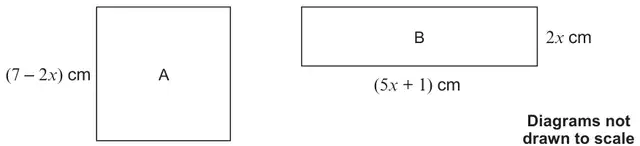
The area of square A is equal to the area of rectangle B.
Form an equation in \(x\) and hence calculate the value of \(x\).
Give your answer correct to 1 decimal place.
You must show all your working. [6]
\(x =\) ……………
From the formula list: The solutions of \(ax^2 + bx + c = 0\) where \(a \neq 0\) are given by \(x = \dfrac{-b \pm \sqrt{b^2 - 4ac}}{2a}\)
| Scheme | Marks | Comments |
|---|---|---|
| (Sight of \(2x(5x + 1)\) =) \(10x^2 + 2x\) OR (Sight of \((7 - 2x)^2\) =) \(49 - 14x - 14x + 4x^2\) OR \(2x(5x + 1) = (7 - 2x)^2\) | B1 | Or equivalent. Or equivalent. \(2x(5x + 1) = (7 - 2x)^2\) may be implied in later working. |
| \(10x^2 + 2x \;=\; 49 - 14x - 14x + 4x^2\) | B1 | |
| \(6x^2 + 30x - 49 = 0\) | B1 | F.T. expansions of equivalent level of difficulty provided B1 previously awarded. '= 0' required, but may be implied by an attempt to use the quadratic formula. |
| \(x = \dfrac{-30 \pm \sqrt{30^2 - 4 \times 6 \times -49}}{2 \times 6}\) or \(x = \dfrac{-30 + \sqrt{30^2 - 4 \times 6 \times -49}}{2 \times 6}\) | M1 | Substitution into the formula must be seen for M1. F.T. ‘their derived quadratic equation’ equated to zero of equivalent difficulty (\(a\), \(b\) and \(c\) must be non-zero). Allow one slip in substitution for M1 only, but must be correct formula. |
| \(x = \dfrac{-30 \pm \sqrt{2076}}{12}\) or \(x = \dfrac{-30 + \sqrt{2076}}{12}\) or \(x = \dfrac{-15 \pm \sqrt{519}}{6}\) or \(x = \dfrac{-15 + \sqrt{519}}{6}\) | A1 | Can be implied from at least one of their two values of \(x\) correctly evaluated (x=1·29… or x=−6·29…) |
| \(x = 1.3\) (answer to 1 d.p.) | A1 | FT for A1 for their quadratic equation provided:
Do not penalise if negative solution also shown (\(x = -6.3\) or \(-6.29(\ldots)\) ) Note: sight of a correct answer does not imply full marks without working. |
Using trial and improvement for the final 3 marks
| Scheme | Marks | Comments |
|---|---|---|
| Two correct evaluations 1.25 ≤ \(x\) ≤ 1.35, (one value < 0, one value > 0) | M2 | Two correct evaluations must be seen, otherwise M0. F.T. ‘their derived quadratic equation’ (=0 or =’their constant’) of equivalent difficulty (\(a\), \(b\) and \(c\) must be non-zero) and their x involves rounding to 1 d.p. |
| \(x = 1.3\) (answer to 1 d.p.) | A1 | FT for A1 for their quadratic equation. |