
Numeracy Higher June 2025 Unit 1 Q13
13. Pizza-Rea is a company that makes outdoor pizza ovens.
The front of the oven is symmetrical.
It has a rectangular hole, through which pizzas are placed in the oven.
Pizza-Rea wants to calculate an estimate of the area of the metal used for this front plate.
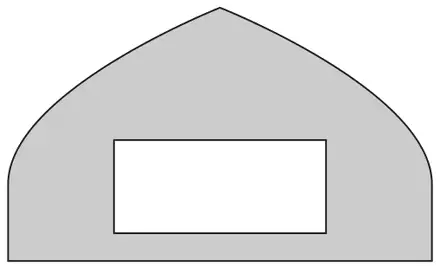
Diagram not drawn to scale
The diagram below is a sketch of the front plate of the pizza oven drawn on coordinate axes.
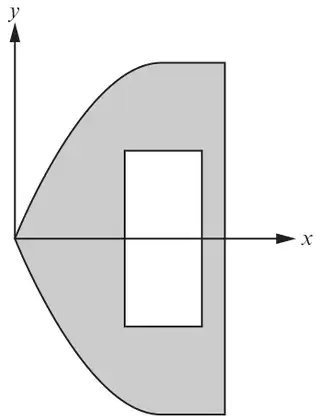
Diagram not drawn to scale
Pizza-Rea have accurately drawn one of the symmetrical halves of the front plate on graph paper.
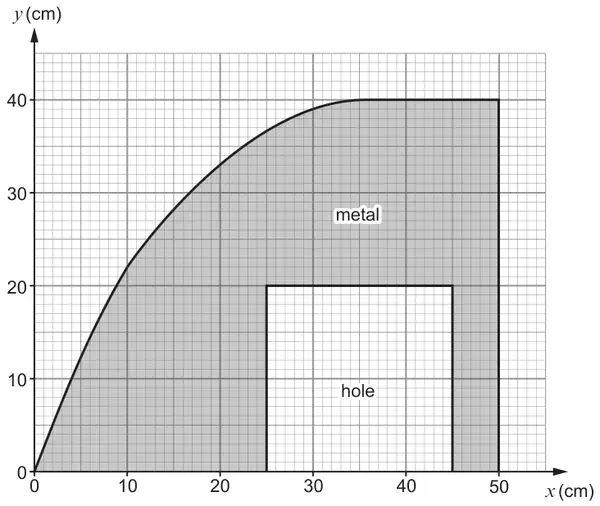
Using 5 strips of equal width, calculate an estimate of the area of metal shown in the graph.
Hence calculate the total area of metal in the complete front plate. [5]
The inner part is in the shape of a half-cylinder.
A hole is needed in the top of the oven to let hot air out.
The straight-line distance from the centre of this hole to either of the front bottom corners of the oven should be less than 50 cm.
The dotted line, \(AB\), in the diagram below represents one of these straight-line distances.
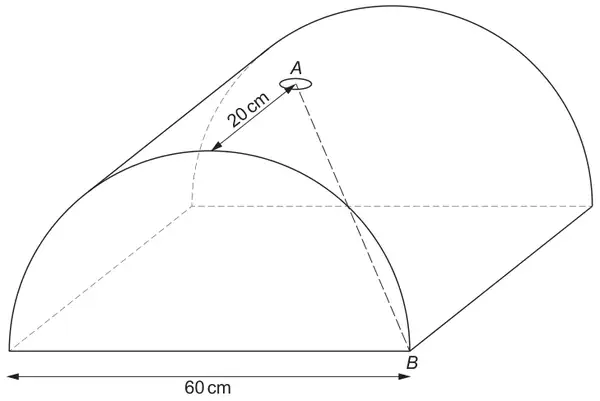
Diagram not drawn to scale
Show that the distance from \(A\) to \(B\) is less than 50 cm. [4]
Each leg is made by connecting a cuboid to a pyramid.
The perpendicular height of the pyramid is 42 cm.
The diagrams below show the design of the spiked legs.
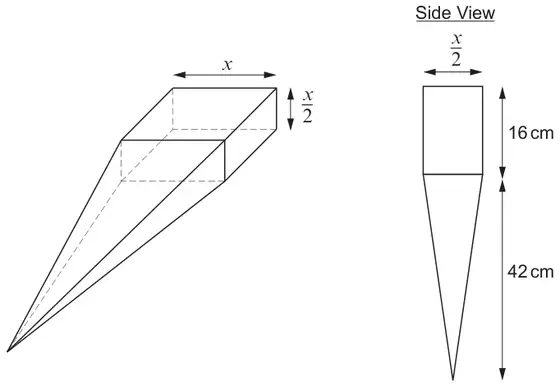
Diagrams not drawn to scale
The volume of each leg is 750 cm3.
Calculate the length \(x\).
Give your answer in the form \(a\sqrt{b}\), where \(a\) and \(b\) are integers and \(b\) is as small as possible. [6]
| Scheme | Marks | Comments |
|---|---|---|
| (Area =) \(\dfrac{1}{2}\)×10×(0+40 + 2(22+33+39+40)) OR \(\dfrac{1}{2}\) × 10 × (40+44+66+78+80) | M2 | If 5 strips of unequal width used, all marks available, but penalise -1 from accuracy marks gained M1 for at most 1 slip in substitution of values from the vertical axis OR M1 for 1 of the vertical readings omitted with all others correct |
| = 1540 (cm2) | A1 | FT from M1. May be implied in further working |
| (Area of the front plate = ) 1540 − 20×20 (×2) | m1 | FT ‘their 1540’ provided M1 or M2 previously awarded |
| = 2280 (cm2) | A1 | FT ‘their 1540’ If final m0A0 awarded, and again FT ‘their 1540’ award SC1 for any one of the following:
|
Alternative method 1
| Scheme | Marks | Comments |
|---|---|---|
| \(\dfrac{(0 + 22)}{2}\)×10 + \(\dfrac{(22 + 33)}{2}\)×10 + \(\dfrac{(33 + 39)}{2}\)×10 + \(\dfrac{(39 + 40)}{2}\)×10 + \(\dfrac{(40 + 40)}{2}\)×10 [110 + 275 + 360 + 395 + 400] | M2 | If 5 strips of unequal width used, all marks available, but penalise -1 from accuracy marks gained Each area may be seen as the sum of the area of a rectangle and triangle M1 for the sum of these 5 areas with at most one error (may be repeated) in the substitution of values from the vertical axis OR M1 for the sight of 5 correct areas with the intention to add them (possibly omitting one) |
| = 1540 (cm2) | A1 | FT from M1 |
| (Area of the front plate = ) 1540 − 20×20 (×2) | m1 | FT ‘their 1540’ provided M1 or M2 previously awarded |
| = 2280 (cm2) | A1 | FT ‘their 1540’ If final m0A0 awarded, and again FT ‘their 1540’ award SC1 for any one of the following:
|
Alternative method 2
| Scheme | Marks | Comments |
|---|---|---|
| \(\dfrac{(0 + 22)}{2}\)×10 + \(\dfrac{(22 + 33)}{2}\)×10 + (\(\dfrac{(33 + 39)}{2}\)×10 − 5×20 ) + (\(\dfrac{(39 + 40)}{2}\)×10 − 10×20 ) or + \(\dfrac{(19 + 20)}{2}\)×10 + (\(\dfrac{(40 + 40)}{2}\)×10 − 5×20 ) [110 + 275 + 260 + 195 + 300] | M3 | If 5 strips of unequal width used, all marks available, but penalise -1 from accuracy marks gained Each area may be seen as the sum of the area of a rectangle and triangle M2 for the sum of these 5 areas with 1 one error (possibly repeated) in the substitution of values from the vertical axis or 1 error in the values used for the rectangle being subtracted OR M2 for the sight of 5 correct areas with the intention to add them (possibly omitting one) M1 for the sum of these 5 areas with 1 one error (possibly repeated) in the substitution of values from the vertical axis and 1 error in the values used for the rectangle being subtracted |
| = 1140 (cm2) | A1 | FT from M2 |
| (Area of the front plate = ) 2280 (cm2) | A1 | FT provided M2 or M3 previously awarded FT 2 × ‘their 1140’ |
| Scheme | Marks | Comments |
|---|---|---|
| Correct use of Pythagoras in 1 of the planes 302 + 302 or \(\sqrt{30^2 + 30^2}\) OR 302 + 202 or \(\sqrt{30^2 + 20^2}\) | M1 | May be embedded in further working |
| (Distance2 =) 302 + 302 + 202 | M1 | May be seen as 2 applications of Pythagoras |
| Distance2 = 2200 or (Distance =) √2200 (= 46.9…) | A1 | CAO |
| Correct comparison statement e.g. ‘2200 is less than 2500’, or ‘2200 is less than 502’, or ‘√2200 is less than √2500’, or ‘√22 is less than 5’, or ‘√22 is less than √25’ | A1 | FT ‘their 2200’ provided > 900 and M1M1 previously awarded |
Alternative method 1
| Scheme | Marks | Comments |
|---|---|---|
| 502 − 302 or \(\sqrt{50^2 - 30^2}\) | M1 | |
| (Distance to hole2 =) 502 − 302 − 302 | M1 | May be seen as 2 applications of Pythagoras |
| Distance to hole2 = 700 or (Distance to hole =) √700 | A1 | CAO |
| Correct comparison statement e.g. ‘700 is greater than 400’, or ‘700 is greater than 202’, or ‘√700 is greater than √400’, or ‘√7 is greater than 2’, or ‘√7 is greater than √4’ | A1 | FT ‘their 700’ provided < 2500 and M1M1 previously awarded |
Alternative method 2
| Scheme | Marks | Comments |
|---|---|---|
| 502 − 202 or \(\sqrt{50^2 - 20^2}\) OR 502 − 302 or \(\sqrt{50^2 - 30^2}\) | M1 | May be embedded in further working |
| (Distance to hole2 =) 502 − 202 − 302 | M1 | May be seen as 2 applications of Pythagoras |
| Dist to hole2 = 1200 or (Distance to hole =) √1200 | A1 | CAO |
| Correct comparison statement e.g. ‘1200 is greater than 900’, or ‘1200 is greater than 302’, or ‘√1200 is greater than √900’, or ‘√12 is greater than 3’, or ‘√12 is greater than √9’ | A1 | FT ‘their 1200’ provided < 2500 and M1M1 previously awarded |
Alternative method 3
| Scheme | Marks | Comments |
|---|---|---|
| 502 − 302 or \(\sqrt{50^2 - 30^2}\) OR 202 + 302 or \(\sqrt{20^2 + 30^2}\) | M1 | |
| Comparison of 502 − 302 with 202 + 302 OR \(\sqrt{50^2 - 30^2}\) with \(\sqrt{20^2 + 30^2}\) | M1 | |
| = 1600 AND 1300 or √1600 AND √1300 AND a correct statement e.g. 1600 > 1300 | A2 | A1 for any one of the following:
|
Alternative method 4
| Scheme | Marks | Comments |
|---|---|---|
| 502 − 202 or \(\sqrt{50^2 - 20^2}\) OR 302 + 302 or \(\sqrt{30^2 + 30^2}\) | M1 | |
| Comparison of 502 − 202 with 302 + 302 OR \(\sqrt{50^2 - 20^2}\) with \(\sqrt{30^2 + 30^2}\) | M1 | |
| = 2100 AND 1800 or √2100 AND √1800 AND a correct statement e.g. 2100 > 1800 | A2 | A1 for any one of the following:
|
| Scheme | Marks | Comments |
|---|---|---|
| \(\dfrac{1}{3} \times x \times \dfrac{x}{2} \times 42 \;+\; x \times \dfrac{x}{2} \times 16 = 750\) or \(7x^2 + 8x^2 = 750\) or equivalent | M2 | M1 for any one of the following:
|
| \(15x^2 = 750\) | m1 | FT from M1 if possible Needs to be of the form \(ax^2 = 750\) |
| \(x^2 = 50\) or \(x = \sqrt{50}\) | A1 | CAO |
| \(x = 5\sqrt{2}\) (cm) | B2 | For B2 or B1, FT ‘their derived 50’ for equivalent level of difficulty provided it comes from \(ax^2 = 750\) B1 for writing 50 as a product of 2 or more factors where one of the factors OR the product of 2 of their factors is a square number e.g. 25 × 2, 5 × 5 × 2, OR B1 for writing \(\sqrt{50}\) as a product of 2 or more surds where one of the surds OR the product of 2 of their surds gives a whole number e.g. \(\sqrt{25} \times \sqrt{2}\), \(\sqrt{5} \times \sqrt{5} \times \sqrt{2}\) |