
Numeracy Foundation November 2024 Unit 1 Q1
1. Sharon has a new job in Margam Park.
On a Saturday afternoon, Sharon carried out a survey.
She asked visitors who were leaving Margam Park to choose their favourite activity.
Sharon shows the activities and some of her results in the tally chart below.
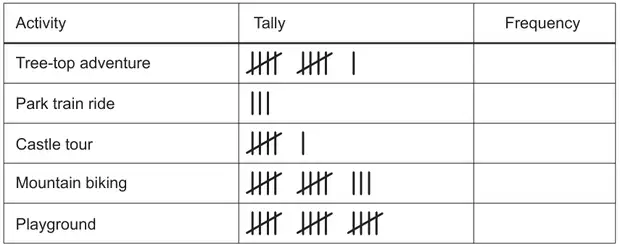
Sharon then realises she did not record the replies of the last 9 visitors. Of these:
- 3 visitors chose the tree-top adventure
- 3 visitors chose the castle tour
- 3 visitors chose mountain biking.
Sharon says:
“The modal favourite activity in the park is the Playground.”
Complete the tallies and frequencies in the tally chart above to decide if Sharon is correct.
Is Sharon correct?
Give a reason for your answer. [3]
Yes ☐ No ☐
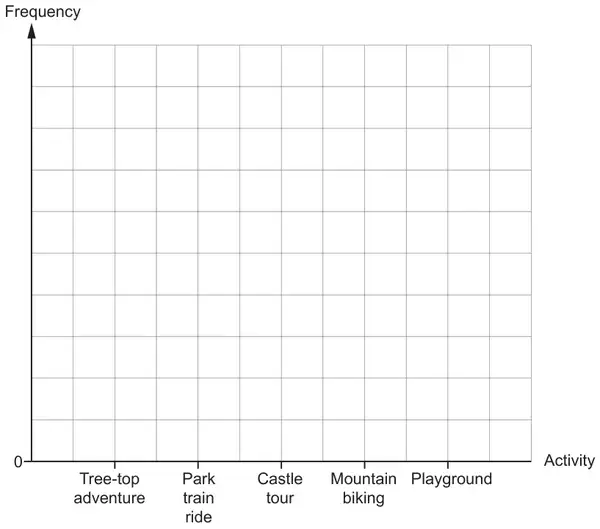
Sharon displays her findings in a vertical line diagram.
She shows this to other staff at a monthly meeting.
Draw Sharon’s vertical line diagram. [3]
Complete the statement below: [1]
‘The number of visitors who chose the Playground was …………… times the number who chose the Park train ride.’
At the monthly meeting, Sharon looks at the results from her Saturday afternoon survey and says:
“This month, the Park train ride is not doing very well when compared with the Playground.”
Give one reason why this may not be true. [1]
Sharon has checked the weather forecast for next week and it shows that it will rain on 5 out of the 7 days.
One day from next week is chosen at random.
Which of the following best describes the chance that it will rain on that day?
Circle your answer. [1]
impossible unlikely even chance likely certain
| Scheme | Marks | Comments |
|---|---|---|
(i)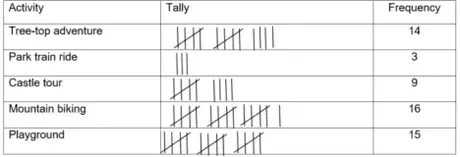 | B1 | For completing all the extra tallies correctly including correct tally notation (e.g. for mountain biking) (extra 3 for the castle tour, 3 for tree-top adventure and 3 for mountain biking) |
| B1 | For completing all the frequencies correctly. FT for ‘their tallies’ or FT if extra tallies are not added. (11, 3, 6, 13 and 15) Accept given frequencies and new frequencies written either in the table or beside the table or by the bullet points e.g. for mountain biking 13 and 16 seen | |
| Unambiguously indicates ‘No’ with a reason, e.g. ‘No, most people preferred mountain biking’ ‘No, mountain biking is’ ‘No, more people preferred mountain biking’ ‘No, 15 people chose playground, 16 chose mountain biking’ | E1 | FT ‘their frequencies’ if given, otherwise FT ‘their tallies’ including if extra tallies are not added. If 13 and 16 given for Mountain biking, then 16 must be used for their explanation. On FT, when using the given frequencies, allow ‘yes, as 15 people chose the playground’ Do not accept ‘No because it is not the modal activity’ |
| (ii) 57 | B1 | FT from ‘their table’ |
| (iii) A uniform scale used that would include all required frequencies | B1 | |
| Five vertical lines at correct heights. (intention of correct height e.g. line drawn for 9 but not quite at 9) | B2 | FT their scale if it includes all required frequencies If both the given frequency and new frequencies given, the new ones must be used. FT their frequencies throughout. Allow use of correct frequencies if not given in (a)(i). If frequencies not seen FT their tallies. Award B1 for any one of the following:
|
| (iv) 5 | B1 | FT from ‘their table’ or ‘their graph’ Answer space in front of the word ‘times’ takes precedence |
| (v) Valid reason given (linked to time, number of people surveyed, who was surveyed or the conditions) e.g. ‘Sharon only asked people in the afternoon’ ‘Sharon only used the afternoon data’ ‘It was only on Saturday’ ‘She only did the tally for one afternoon’ ‘Train may be more popular at other times’ ‘Maybe the people in the morning preferred the train ride and this wasn’t recorded’ ‘More children could have been in the morning’ ‘Sharon only asked 57 people’ ‘Not enough people asked’ ‘Could have asked only children’ ‘Maybe the children didn’t do the survey’ ‘Maybe only adults were asked’ ‘It was a sunny day’ | E1 | Accept ‘Just because it is not the favourite it could still be doing well (at other times)’ ‘lots of people may have gone on the train but it wasn’t their favourite’ Allow ‘Because it was only 1 day in the month’ ‘Ask more people’ ‘Train may have had more people overall' ‘Park train may not have been working’ Do not accept: ‘Playground is free and you have to pay for train’ ‘People just haven’t given the train a go’ ‘Because people went on it’ ‘Playground is more popular, and train is least’ ‘The playground may have had more or less people’ ‘Because the train was 3 and the playground was 15’ ‘She missed the results of 9 visitors’ |
| Scheme | Marks | Comments |
|---|---|---|
| likely | B1 |