(a) Tick (✓) the two correct statements about \(3xy(y + 2) \equiv 3xy^2 + 6xy\). [2]
It is an equation.
It is true for all values of \(x\) and \(y\).
It is an identity.
It is only true for certain values of \(x\) and \(y\).
It is an inequality.
It is true for only one value of \(x\) and one value of \(y\).
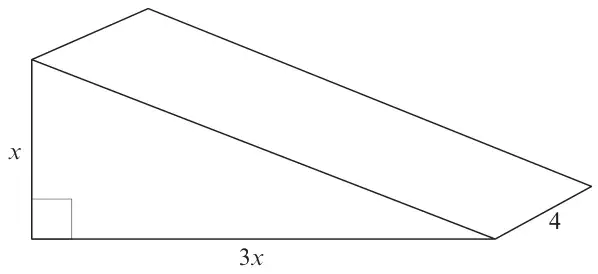
(b) In this part of the question all lengths are in centimetres.
Diagram not drawn to scale
The diagram shows a prism. The cross-section of the prism is a triangle with height \(x\) and base \(3x\). The volume of the prism is 216 cm3.
Use an algebraic method to find the height of the triangle. [5]
Mark scheme (a)
Scheme
Marks
Comments
Second and third statements indicated and no others
B2
Award B1 for one of the following:
One correct statement and up to one incorrect statement indicated
Two correct statements and exactly one incorrect statement indicated
Mark scheme (b)
Scheme
Marks
Comments
May be done in parts
(Area of cross-section =) \(\tfrac12 \times 3x \times x\)
M1
Accept ½ base x height oe
(Volume =) \(\tfrac12 \times 3x \times x \times 4\)
M1
FT ‘their \(\tfrac12 \times 3x \times x\)’ \(\times\, 4\), provided at least two terms in \(x\).
\(\tfrac12 \times 3x \times x \times 4 = 216\) oe
A1
CAO
\(x^2 = 216 \times 2 \div 4 \div 3\ (= 36)\)
M1
FT ‘their \(k\)’\(\times x^2 = 216\)
6 (cm)
A1
Mark final answer. FT Final 2 marks can be awarded if trials used on an equation of the form ‘their \(k\)’\(\times x^2 = 216\) to find a correct or correct FT answer. If \(x^2\) is a square number, \(x\) must be given as a whole number. Otherwise, it may be written as an unsimplified surd.
Alternative method
Scheme
Marks
Comments
(Area of cross-section =) \(216 \div 4\ (=54)\)
B1
(Area of cross-section =) \(\tfrac12 \times 3x \times x\)
M1
Accept ½ base x height oe
\(\tfrac12 \times 3x \times x = 54\) oe,
A1
CAO
\(x^2 = 54 \times 2 \div 3\ (= 36)\)
M1
FT ‘their \(k\)’\(\times x^2 =\) ‘their 54’
6 (cm)
A1
Mark final answer. FT Final 2 marks can be awarded if trials used on an equation of the form ‘their \(k\)’\(\times x^2 =\) ‘their 54’ to find a correct or correct FT answer If \(x^2\) is a square number, \(x\) must be given as a whole number. Otherwise, it may be written as an unsimplified surd.
Notes
If no marks award SC3 for a complete correct method using trials leading to an answer of 6 OR SC2 for a correct trial with height > 3, e.g. \(\tfrac12 \times 15 \times 5 \times 4\) (and comparison with 216) si OR a correct trial with height > 3. e.g. \(\tfrac12 \times 15 \times 5\) and comparison with 54 si
We'd like to use Google Analytics cookies to count visits and see which pages help most. They're optional, and the site works exactly the same either way. Privacy policy